

Facebook Video Ads vs Image Ads: CPM, CTR and Cost Compared
On Facebook and Instagram, video ads usually have a higher CPM than image ads, but they also get a higher click-through rate. In AdManage data from 162 Meta ad accounts in Q3 2026, the typical account paid 32% more per 1,000 impressions for video than for images, while video's link CTR was about 40% higher. Cost per click ended up roughly level.
So the cheaper format depends on what you measure. Image ads buy cheaper impressions. Video ads often buy cheaper attention. The only number that settles it for your account is cost per result, measured in a fair test.
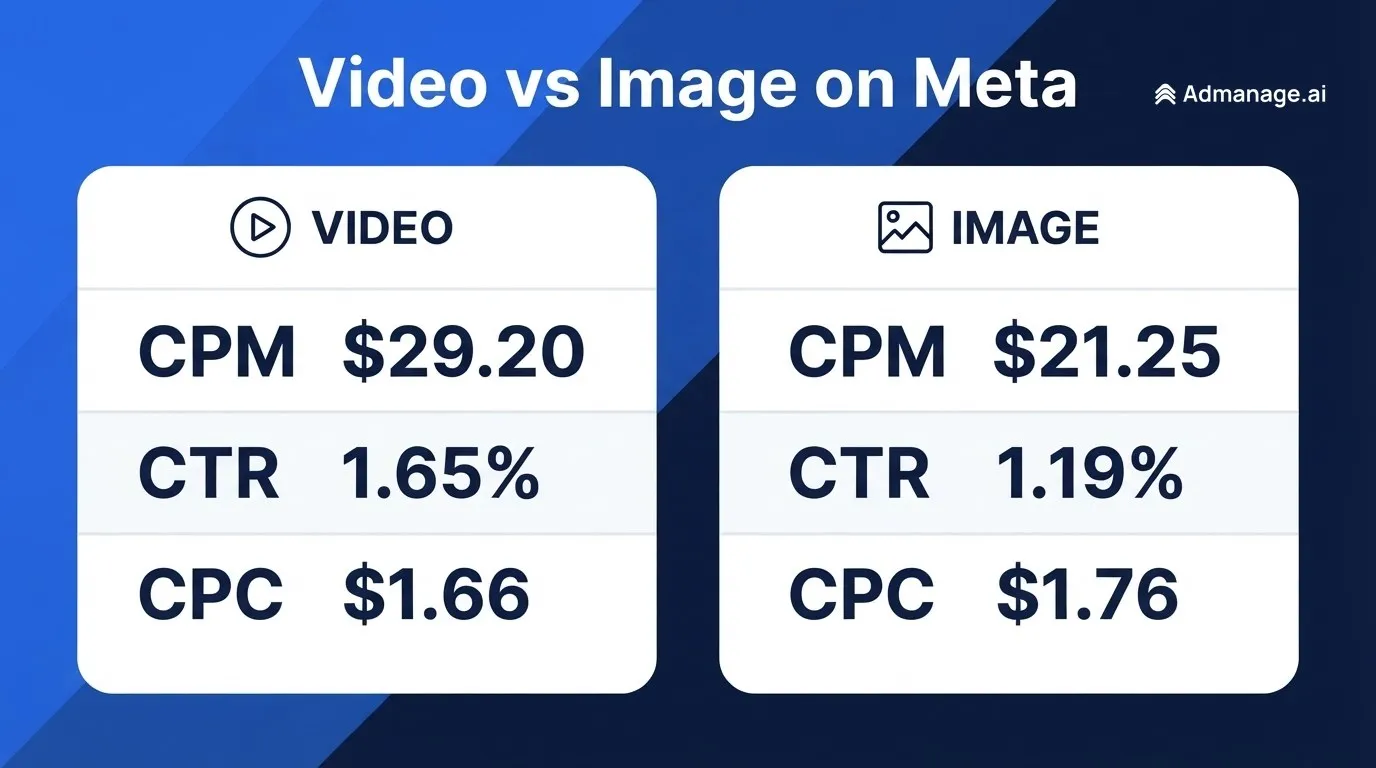
Facebook video vs image ads: CPM, CTR and CPC (2026 data)
We aggregated anonymized Meta ad performance from 162 ad accounts that bill in US dollars and launch ads with AdManage. The window is July 1 to September 30, 2026. Together these accounts served about 27 billion impressions on single-video and single-image ads. Carousels and mixed-media creatives are excluded.
The cleanest comparison is within the same account, because it holds the brand, offer and audience roughly constant. 144 accounts spent at least $500 and served at least 50,000 impressions on both formats:
| Median per account (144 accounts) | Video ads | Image ads |
|---|---|---|
| CPM | $29.20 | $21.25 |
| Link CTR | 1.65% | 1.19% |
| Cost per link click | $1.66 | $1.76 |
- Video CPM was higher in 127 of 144 accounts (88%). The median account paid 1.32x the image CPM for video. The middle half of accounts sat between 1.11x and 1.58x.
- Video link CTR was higher in 109 of 144 accounts (76%).
- Cost per click was close to a coin flip. Video had the lower CPC in 77 of 144 accounts (53%).
Pooling every impression gives the same direction. Across all 162 accounts, video ads averaged a $20.73 CPM, 1.34% link CTR and $1.55 CPC, against $15.72, 0.94% and $1.66 for image ads. Removing the three largest accounts barely moves it ($19.30 vs $15.40 CPM). Video also took 64% of the combined video and image spend.
The pooled CPMs are lower than the per-account medians because the biggest spenders tend to buy cheaper impressions. If you want a single benchmark for your own account, the per-account medians are the better guide. For industry-level CPMs, see our Facebook CPM benchmarks by industry.
Are Facebook video ads more expensive than image ads?
Per impression, usually yes. Per click, not really. Per sale, it depends on the account.
CPM is what you pay to be shown, not what you pay for an outcome. Meta's auction does not simply pick the highest bid. Meta says its system "looks at a number of factors equally to determine which ad is displayed", and that estimated action rates and ad quality "together measure ad relevance" (Meta: Facebook ad auctions explained). An ad that wins pricier impressions can still be the cheaper ad if it drives more of the action you optimize for.
Our data can't say why video CPMs run higher. Video and image ads in the same account often go to different placements, audiences and campaign types, and we did not control for those. Treat the gap as a pattern to plan around, not a fixed price list.
Video vs image ads by campaign objective
Most of the spend in this dataset came from sales campaigns, so that is the only objective with a large paired sample.
- Sales (139 paired accounts): median video CPM $30.69 vs $22.86 for images, a 1.31x ratio. Video CTR was 1.64% vs 1.20%. Cost per click was close: $1.73 vs $1.80.
- Leads (11 paired accounts): video CPM was higher again (1.54x median ratio) and video had the lower CPC in 7 of 11 accounts. The sample is small, so treat it as directional.
- Awareness and engagement: fewer than 10 accounts ran both formats with enough volume. We don't report a benchmark for them.
If you are budgeting by objective, our guide to how much it costs to advertise on Facebook covers CPC and CPL benchmarks for each.
When to use video ads vs image ads on Facebook
Use video when:
- The product needs a demo, a before-and-after or a person talking to camera.
- You're running in Reels and Stories, where full-screen vertical video is the native format. Our comparison of Facebook Reels ads vs Feed ads covers that placement choice.
- Your image ads get impressions but few clicks. Video's higher CTR often makes up for its higher CPM.
Use images when:
- The offer fits in one frame: a price, a discount, a product shot or a bold claim.
- You need to test many angles fast. Statics are quicker and cheaper to make, so you can test more hooks for the same production budget.
- You're running retargeting, where people already know the product and just need a reminder and a reason to click.
Most accounts in our data ran both. The useful question is not "video or image?" but "which format wins for this offer, in this placement, this month?"
Facebook video and image ad specs
Meta's Ads Guide lists the same recommended size for both formats in Facebook Feed:
| Spec | Image ads (Facebook Feed) | Video ads (Facebook Feed) |
|---|---|---|
| File type | JPG or PNG | MP4, MOV or GIF |
| Recommended ratio | 4:5 | 4:5 |
| Recommended resolution | 1440 x 1800 px | 1440 x 1800 px |
| Maximum file size | 30 MB | 4 GB |
| Length | n/a | 1 second to 241 minutes |
| Primary text / headline | 50–150 / 27 characters | 50–150 / 27 characters |
Sources: Meta Ads Guide for image ads and video ads in Facebook Feed. Meta lists captions and sound for video as "optional, but recommended".
How to test video vs image ads fairly
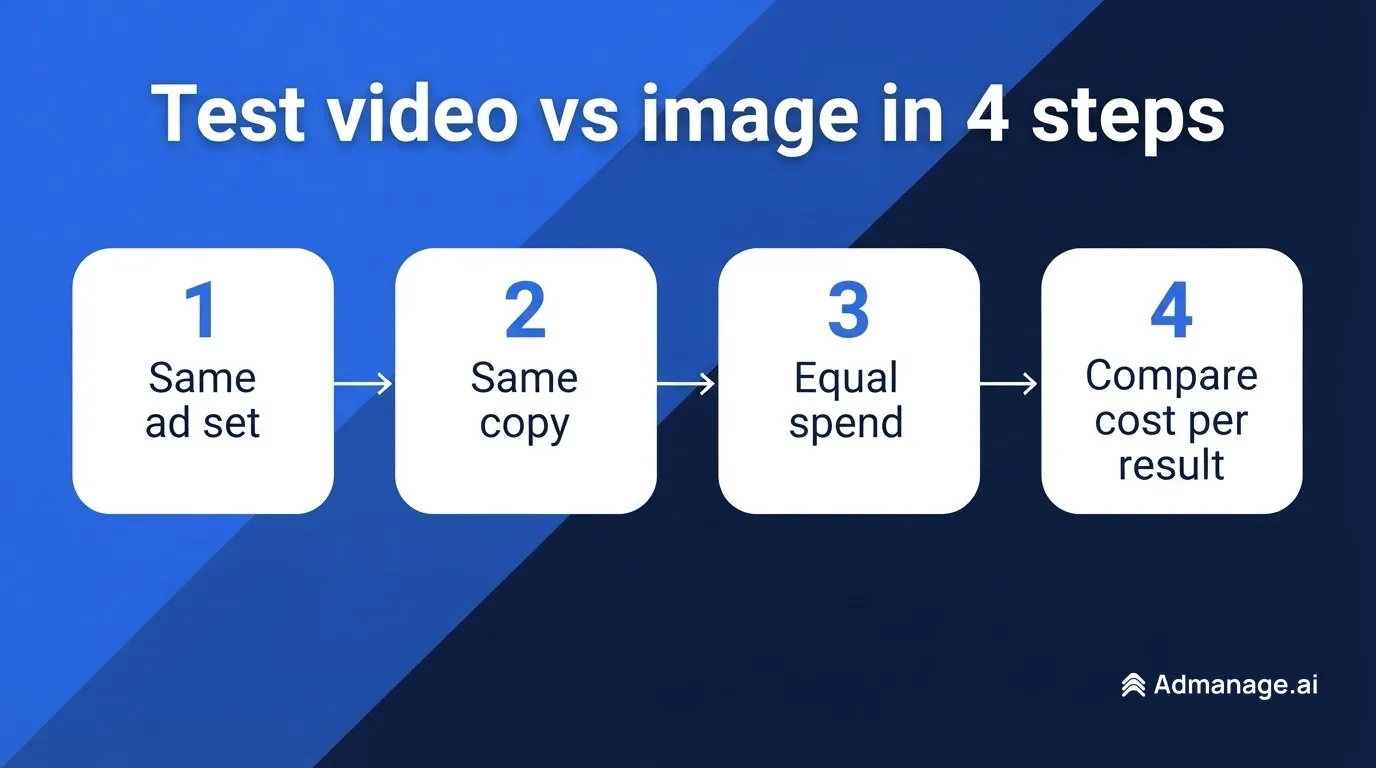
A CPM comparison pulled from two different campaigns tells you very little. Set up a test that only changes the format:
- Same ad set. Put the video and image versions in one ad set, with the same audience, placements and optimization event.
- Same message. Keep the hook, offer, primary text, headline and landing page identical. Only the asset changes.
- Equal spend. Check that both ads got a similar share of budget and reached a meaningful number of conversions before you judge. If delivery favours one ad early, give the other its own ad set with the same settings. A few hundred impressions will mislead you. Our creative testing framework explains how to size a test.
- Compare cost per result. Judge on cost per purchase or lead, then on CTR and conversion rate. CPM is context, not the verdict.
Run the test with several concepts, not just one. A single strong video against a weak image proves nothing about the format. Watch for creative fatigue too: the winner's costs will drift up as frequency rises.
Methodology
- Data: anonymized, aggregated Meta Ads insights from 162 AdManage customer ad accounts billing in USD, July 1–September 30, 2026. No account is identified. Accounts were drawn from the 400 most active AdManage launch accounts.
- Format: classified from each ad's creative. Ads with a video asset count as video, and ads with an image asset count as image. Carousels and creatives mixing images and videos are excluded.
- Metrics: CPM = spend ÷ impressions × 1,000. Link CTR = link clicks ÷ impressions. CPC = spend ÷ link clicks.
- Paired comparison: only accounts with at least $500 spend and 50,000 impressions on each format.
- Limits: this is observational data. We did not control for placement, audience or creative quality, and it covers one quarter.
Frequently asked questions
Is CPM higher for video ads or image ads on Facebook?
In our Q3 2026 data, video. The median account paid a $29.20 CPM for video ads vs $21.25 for image ads, and video CPM was higher in 88% of accounts that ran both.
Do video ads get a higher CTR than image ads?
Usually. The median link CTR was 1.65% for video vs 1.19% for images, and video had the higher CTR in 76% of accounts.
Which is cheaper per click, video or image ads?
Neither, reliably. Median cost per link click was $1.66 for video and $1.76 for images, and video had the lower CPC in just over half of accounts.
Should I run video or image ads on Facebook?
Run both and let results decide. Video tends to win where the product needs showing and in Reels and Stories. Images are faster to produce and work well for simple offers and retargeting.
What size should Facebook video and image ads be?
Meta's Ads Guide recommends 4:5 at 1440 x 1800 pixels for both video and image ads in Facebook Feed.
Launch video and image variations side by side
A fair video vs image test needs several concepts in both formats, with identical copy and settings. Building those pairs one at a time in Ads Manager is slow and easy to get wrong.
AdManage lets performance teams bulk-launch hundreds of Meta ads from a folder or spreadsheet, so video and static versions of each concept go live together with matching copy, naming conventions and UTMs. See how it works in our guide to Facebook ads bulk upload, or start a free trial.

About the author
Cedric Yarish
Co-founder of AdManage.ai