

How to Bulk Upload Facebook and Meta Ads
Facebook ads bulk upload, also called Meta ads bulk upload, means preparing many ads together: import the creative files, select destination ad sets, apply copy and URLs, review placements and submit the batch. Native tools and dedicated launchers handle different parts of that workflow.
Before you start, confirm that your ad account access, destination campaign and ad sets, creative formats, landing-page URLs and tracking parameters are ready. Keep the first batch paused when you need to review the output before delivery.
Use a consistent naming convention and match each creative to its intended copy, URL and placement. Batch workflows save repeated input, but errors in shared settings can affect many ads at once.
The steps below show the preparation and review process. Upload time, processing, platform review and delivery depend on file size, batch complexity and account conditions.
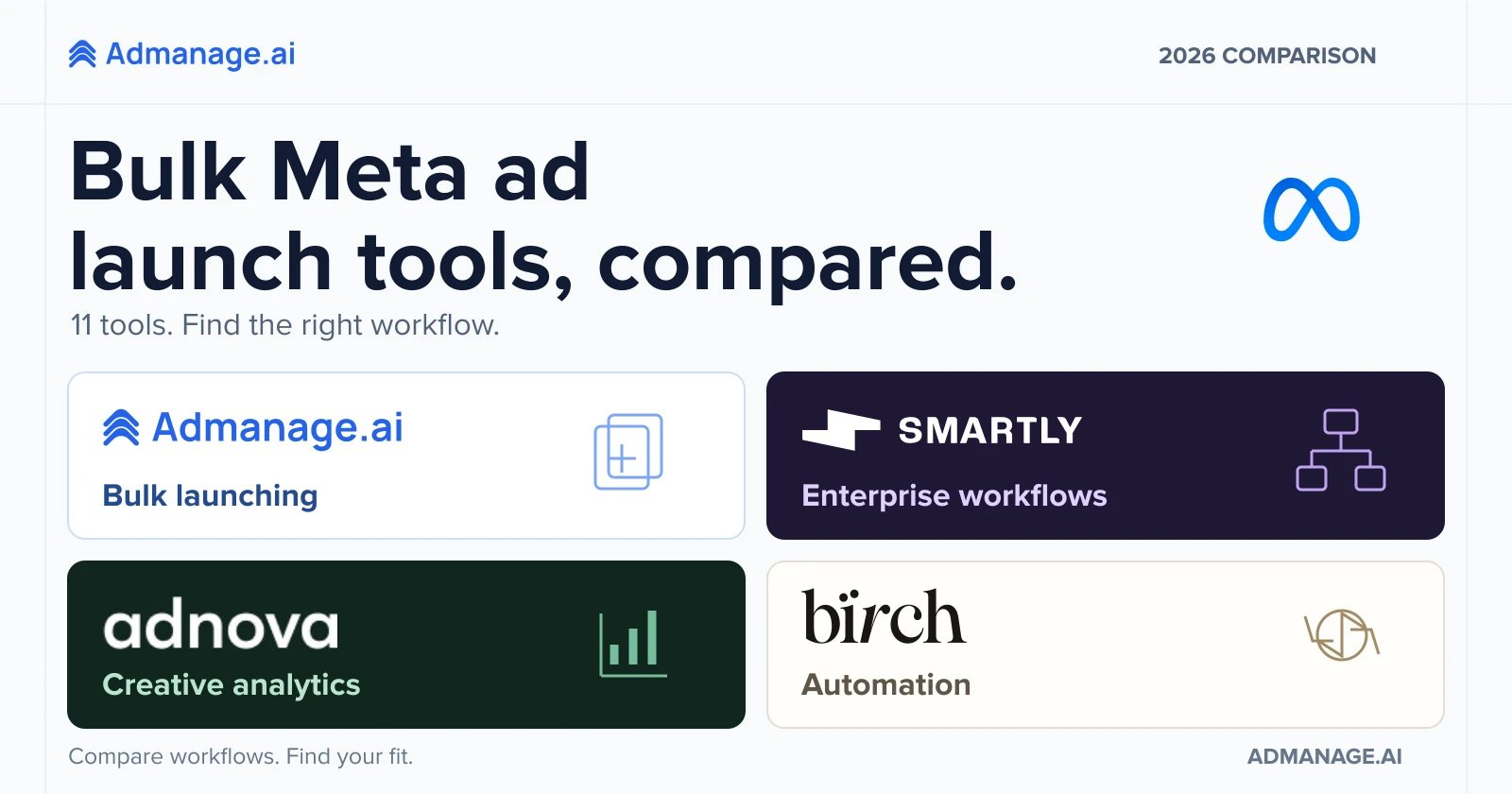
Follow the native and tool-assisted routes below. If you are choosing software first, see our bulk Meta ad upload and launch tools comparison.
What You'll Learn
• Prepare and review a batch without assuming a fixed launch time.
• Import creatives directly from Google Drive, Dropbox, Frame.io or Google Sheets
• Reuse existing Post IDs to maintain social proof
• Create carousel, multi-placement, and DLO ads in bulk
• Launch partnership ads at scale
• Choose honestly between native Meta bulk tools and a dedicated launcher
📑 Table of Contents
1. What is Facebook Ads Bulk Upload
1. Native vs Tool-Assisted Bulk Upload
1. Manual vs Bulk Upload Comparison
1. How to Bulk Upload Facebook Ads: Step-by-Step
1. Launching Multi-Placement Ads in Bulk
1. Launching Post ID Based Ads in Bulk
1. Launching Flexible Ads in Bulk
1. Launching Carousel Ads in Bulk
1. Launching Multi-Language DLO Ads in Bulk
1. Launching Partnership Ads in Bulk
1. Platforms to Bulk Upload From
1. Troubleshooting Common Issues
1. FAQs
What is Facebook Ads Bulk Upload
Bulk upload can combine object settings and media preparation, while publication submits the reviewed objects for approval. The exact workflow and supported features depend on the selected native or third-party tool.
Modern bulk upload handles complex ad formats too: carousel ads with 10 cards, multi-placement assets that auto-match to feeds and stories, Dynamic Language Optimization for multiple languages, and partnership ads using creator codes.
Bulk uploading vs bulk launching: what's the difference?
People search for both, and they're closely related. Bulk uploading is getting many creatives and their settings into Meta at once. Bulk launching is flipping that whole batch live in a single action. In practice, a good workflow does both in one pass: you load the batch, then launch it. The distinction only matters when a tool lets you stage ads as drafts first and launch later, which is handy when you want a teammate to review before anything spends money.
Two Ways to Bulk Upload Meta Ads: Native vs Tool-Assisted
You have two honest paths here, and each has a real place.
Meta’s native route is a desktop import of campaign, ad-set and ad information, with media import options. Use a current export or template and inspect the summary, warnings and errors. Some features are unsupported; it is not limited to copying a campaign one ad at a time.
A dedicated launcher can provide supported media preparation, templates and repeated launch workflows. Evaluate its output, review effort and current account/format coverage rather than assuming every advertiser needs one after a fixed weekly ad count.
Neither is universally right.
Use the native route when it meets the task and the review process. Consider a launcher when a measured recurring bottleneck remains. Neither a fixed five-ads threshold nor a promised coffee-break launch establishes the business case.
The native steps below are followed by the tool-assisted workflow. Keep preparation, submission, platform approval and delivery separate when measuring either route.
How to Import a Spreadsheet Batch in Meta Ads Manager
Meta’s current import instructions use Ads Manager on a computer. Under the Ads, Ad sets or Campaigns tabs, open More and choose Import ads in bulk. The workflow offers text paste or an Excel upload and media-import options. Availability can depend on the account.
Use the current template or export. The native overview lists an approximately 2 MB spreadsheet limit; that is separate from image/video specifications. Check unsupported features before preparing a complex batch.
After import, inspect the summary of accepted information, warnings and blocking errors. Use View errors in Excel for the identified blocking issues. Review the destination objects and intended statuses before publication; an imported file is not the same as approved, delivering ads.
Manual vs Bulk Upload Comparison
| Stage | Native Workflow | Tool-Assisted Workflow |
|---|---|---|
| Prepare | Current account template/export and mapped media | Supported asset inputs and reusable configuration |
| Validate | Inspect import summary and blocking errors | Inspect the tool’s validation and platform responses |
| Review | Check resulting objects and intended status | Check resulting objects and intended status |
| Measure |
This guide does not establish a universal 12–15% manual error rate or an under-one-percent automated rate. Count corrections and their causes for your own representative batch.
Measure preparation, review and exception handling as well as the initial upload. A shared configuration can replicate an error as easily as it can save repeated entry.
How to Bulk Upload Facebook Ads: Step-by-Step
Use the following sequence for the supported tool-assisted workflow. Active work, file transfer, processing and approval times vary with the batch and account.
Step 1: Upload All Creative Files
Open the supported launch page and upload the prepared assets. Check the current input limits and the media that actually processed rather than treating two hundred files as a universal batch allowance.
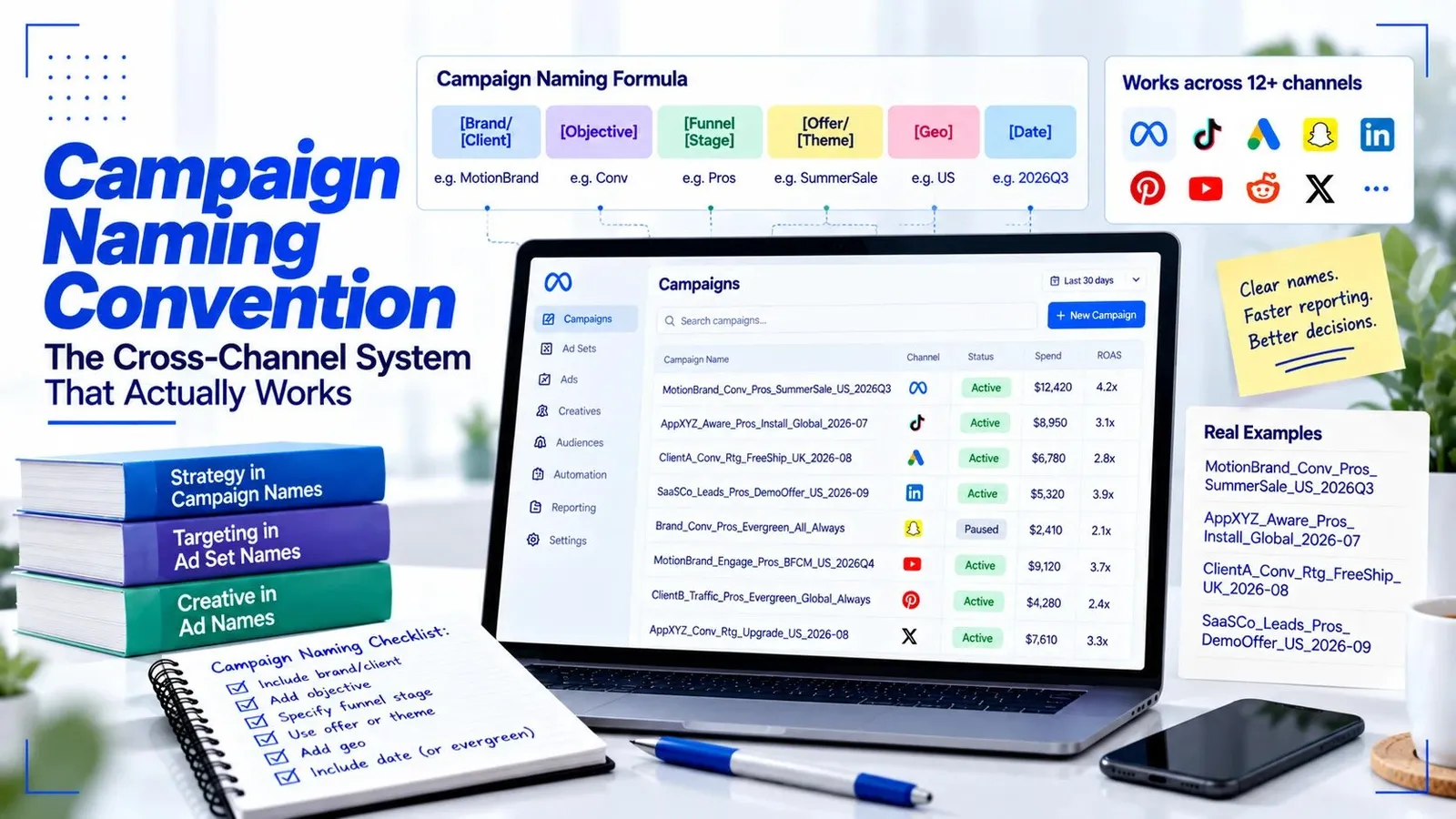
Pro tip: Name files correctly for auto-grouping: Product_A_4x5.jpg and Product_A_9x16.jpg automatically pair for multi-placement. If you don't have a system yet, our ad creative naming conventions guide gives you one.
Step 2: Pick Your Ad Sets
Use the dropdown to choose the ad sets you want to launch into. Running across several audiences? Select them all. AdManage will build unique ads for each one.
Step 3: Assign Creatives (optional)
Choose the supported format for each planned ad and inspect the resulting media mapping. Do not skip the review solely because a batch can be submitted without further edits.
Step 4: Fine-Tune Ad Setup
AdManage auto-fills copy and default settings for you. Want adjustments? Edit text or settings in bulk before launching.
Step 5: Go Live
Select Launch Ads after reviewing the batch. AdManage submits the configured ads to Meta and reports progress and any errors. Completion of a launch job does not guarantee immediate delivery: Meta's review, account permissions, processing and delivery eligibility still apply. See the bulk-creation guide for the workflow and the live platform statistics for current launch volume.
What to Do When Only Part of a Bulk Upload Works
| Outcome | Record | Next Step |
|---|---|---|
| Imported draft | Destination IDs and the intended configuration | Review before publishing |
| Published or submitted | Returned ad IDs and review/delivery status | Avoid recreating an already successful item |
| Blocking error | Affected row and exact validation message | Correct the identified issue |
| Uncertain result |
Keep a row-to-object ledger and compare planned versus actual counts. A missing confirmation is not proof that nothing was created. Avoid resubmitting a whole batch until the successful and uncertain items have been reconciled.
Setup Requirements
Before bulk uploading ads, you need a few things in place:
Meta Business Manager access. Admin or Advertiser role required. Check under Business Settings, then People, then your name.
An AdManage account. Sign up at admanage.ai and go through the step-by-step onboarding to connect your ad account.
Proper file naming (optional). Use AdManage's automated dynamic naming generator, or the format Campaign_Product_Version_Placement.ext. Example: BF2026_Shoes_A_4x5.jpg. A consistent Facebook ad naming convention keeps your reporting clean later.
Existing campaign structure. Before using bulk upload, your campaigns and ad sets should already exist in Meta. Bulk upload then either places new ads into those existing ad sets or creates duplicates of them to launch the ads. (If you also need to define campaigns and ad sets at scale, the Google Sheets workflow below can do that.)
Launching Multi-Placement (1x1/4x5 and 9x16) Ads in Bulk
Multi-placement ads deliver the right creative to each placement automatically. Feed gets 4:5, Stories get 9:16, Reels get 9:16 with safe zones.
Auto-Grouping Method
Name files with the same base and a placement suffix:
- Summer_Sale_4x5.jpg + Summer_Sale_9x16.jpg
- Product_1080x1080.jpg + Product_1080x1920.jpg
AdManage detects and groups these automatically.
Semi-Automated Grouping Method
① Load assets in all aspect ratios
② Click "Multi-Placement"
③ Select all aspect ratios of the asset
④ Click "Done"
Result: one ad that serves optimized creatives to each placement.

Launching Post ID Based Ads in Bulk
Reuse existing post IDs to maintain social proof. Keep the 10K likes and 500 comments the ad earned across all campaigns and ad sets. It's a completely free way to increase your ad's performance, and it's one of the smartest moves when you're scaling winners without losing social proof.
Steps to Use Existing Post IDs
1. Click "Load Media" → "Existing Ads" tab
1. Select your chosen ads
1. Toggle on "Use Post ID / Creative ID"
1. Select target ad sets
1. Launch
Your new ads point to the original posts, keeping all engagement.

Launching Flexible Ads in Bulk
Group multiple creative variations into one ad. Meta optimizes the strongest version to show.
Creating Flexible Ads
1. Load your chosen assets
1. Click "Flexible"
1. Select creatives to group
1. Click "Done"
1. Launch as single ad containing all variations
Meta automatically finds and serves the best performing variation.

Launching Carousel Ads in Bulk
Create multi-card carousels without configuring each card manually. If you need the exact card dimensions first, check the Meta carousel ad specs.
Carousel Creation Process
1. Load all carousel images/videos
1. Click "Carousel"
1. Arrange cards in order (or pre-name files: Product_01.jpg through Product_10.jpg)
1. Edit headlines, descriptions, and links (optional)
1. Click "Done"
1. Launch
One carousel ad with all cards created instantly.

Launching Multi-Language DLO Ads in Bulk
One ad, multiple languages. Meta automatically serves the right language to each user.
DLO Setup Process
Can't see Multi-Language Ads? Navigate to the 'Defaults' menu and toggle them on.
1. Toggle on Multi-Language ads
1. Select default language
1. Click 'Add Language' and select your additional languages
1. Input your translated copy and links or auto-translate the default copy in AdManage
1. Select the translated video for each language
1. Click launch
Meta delivers Spanish to Spanish speakers, French to French speakers, and so on.
Critical: Landing pages must match ad language or conversions tank.

Launching Partnership Ads in Bulk
Use influencer content at scale with partnership and whitelisted ads.
Partnership Ad Process
1. Toggle on "Partnership/Spark Ads" in AdManage
1. Select your partnership identities (accounts)
1. Choose which partnership accounts will be displayed with the ad
1. Click "Launch Ads"
Launch 50 creator posts in 2 minutes instead of entering codes manually for hours.
Select from your existing partnerships and send partnership requests through the Meta partnership ads hub.

Platforms to Bulk Upload From
Short answer to a common question: yes, media buyers can import creative assets straight from Google Drive (and Dropbox, Frame.io, or Google Sheets) into Meta ad campaigns, no manual downloading in between. Here's how each source works.
Google Drive Integration
Setup: Integrations → Google Drive → Connect
Usage: Load Media → Google Drive → Select files → Launch
No downloading required. Direct from Drive to ads.
Direct URL Links
Transform any file link for bulk upload:
- Google Drive: https://drive.google.com/uc?export=download&id=FILEID
- Dropbox: Change ?dl=0 to ?dl=1
- Any CDN with direct file URLs
Paste URLs in media fields. AdManage fetches during launch.
Dropbox Files
1. Get Dropbox share link
1. Change URL from ?dl=0 to ?dl=1
1. Use modified link as creative source
Frame.io Videos
1. Connect Frame.io in Integrations (Adobe account required)
1. Load Media → Frame.io
1. Select videos from projects
1. Launch directly
From final edit to live ad in 60 seconds. We break the full flow down in the Frame.io to Ads Manager guide.
Google Sheets Add-on
If you'd rather work from a spreadsheet, there's a bulk upload template built for exactly that:
1. Install from Google Workspace Marketplace
1. Extensions → AdManage → Launch Sidebar
1. Load template
1. Fill data: campaigns, ad sets, ads, creative URLs, copy
1. Click "Upload to AdManage"
1. Review and launch in web app
Launch 500+ ads from spreadsheets. Processes in 50-ad batches. For the end-to-end version, see how to automate Google Sheets to Facebook ads and our deeper walkthrough on going from Sheets to Meta Ads Manager.
Troubleshooting Common Issues
Launch Button Greyed Out
- Check ad set is selected
- Verify Primary Text isn't empty
- Confirm you're in correct ad account
- Refresh if session timed out
Multi-Placement Not Grouping
- Files need same base name: Creative_4x5.jpg and Creative_9x16.jpg
- Use manual grouping if names don't match pattern
Carousel Order Wrong
- Add numbers to filenames: Card_01.jpg, Card_02.jpg (use leading zeros)
- Or manually reorder in carousel builder
DLO Not Working
- Check audience targeting includes all language regions
- Verify language codes match Meta's standards
- Test with VPN to confirm languages display
Partnership Ads Failing
- Codes expire after 30 days
- Creator must grant advertiser access first
- Check code format (alphanumeric, no spaces)
Frame.io Connection Issues
- Use Adobe-linked account, not Google login
- Verify project permissions in Frame.io
Naming Convention Issues
- Use underscores, not spaces (spaces cause API failures)
- Keep under 100 characters
- No special characters except underscore
Need to Change Ads After Launch
Bulk-uploaded ads appear immediately in Meta Ads Manager, so you can bulk edit Facebook ads there like any other ad. For structural changes across many ads at once, it's usually faster to relaunch a corrected batch than to hand-edit each one.
FAQs
Q: How do I bulk upload Facebook ads?
A: Load all your creatives at once, pick the ad sets to launch into, assign any special formats, then hit launch. With AdManage that's five steps and about a minute of active work. Meta's native route is duplicating an existing ad and editing the copies.
Q: What's the difference between bulk uploading and bulk launching ads?
A: Bulk uploading is getting many ads and their settings into Meta together. Bulk launching is turning that batch live in one action. Most workflows do both in a single pass.
Q: Is there a tool to bulk upload Facebook ads?
A: Yes. Meta Ads Manager has native duplicate and spreadsheet import options, and dedicated launchers like AdManage handle the creative-heavy work (grouping, carousels, post IDs). Compare options in our bulk Meta ad launch tools roundup.
Q: Is there a Meta ads bulk upload template?
A: Yes. The AdManage Google Sheets add-on loads a template where you fill in campaigns, ad sets, ads, creative URLs, and copy, then upload the whole sheet at once.
Q: Can I bulk create Facebook campaigns and ad sets?
A: Bulk upload places ads into existing ad sets. To define campaigns and ad sets at scale, use the Google Sheets workflow, which can create that structure alongside the ads.
Q: Can I bulk edit Facebook ads after uploading?
A: Yes. Uploaded ads show up in Meta Ads Manager right away, so you can edit them there individually or in Meta's bulk edit view.
Q: How many ads can I upload at once?
A: Up to 200 in one batch. Google Sheets processes in 50-ad increments.
Q: Do I need to create campaigns first?
A: For the standard flow, yes. Bulk upload launches ads into existing campaigns and ad sets.
Q: How do I bulk upload Instagram-only ads?
A: Set Instagram placements in ad set settings, then bulk upload normally.
Q: Can I schedule ads?
A: Set scheduling at the ad set level. Bulk uploaded ads follow those schedules. More on timing in our guide to scheduling Meta ads.
Q: What file formats work?
A: JPG, PNG for images. MP4, MOV for videos. Same as Meta requirements.
Q: How do I handle different aspect ratios?
A: Use multi-placement ads with proper naming: _4x5, _9x16 suffixes.
Q: Can I duplicate winning ads to multiple countries?
A: Select Post IDs, then select ad sets across country campaigns. One launch, multiple markets.
Q: What if Meta's API goes down?
A: AdManage queues uploads and retries automatically.
Q: How much time will this save?
A: Manual runs 3-5 minutes per ad. Bulk runs 5 minutes for 100 ads. That's 4-8 hours back every week.

🎯 Start Bulk Uploading Now
Every minute spent manually uploading is a minute your competitor spends scaling winners.
The fastest-growing brands test 10X more because they eliminated the upload bottleneck. While competitors click "Create Ad" 100 times, they're already analyzing results from their second round of tests. That's the whole idea behind Facebook ads automation.
Set up AdManage. Upload your first batch. Launch 20 ads in the time it usually takes to create one.
Ready to launch more ads in 5 minutes than you currently launch in a week?
Curious how it handles your specific setup? Take a look at what AdManage does for Meta or check pricing.
📚 Resources
AdManage Documentation
AdManage Blog
- How to Create Multiple Ads on Facebook

About the author