
Google AI Mode ads raise a practical question for media buyers: if the search experience changes, how do you tell whether the traffic you buy is still profitable?
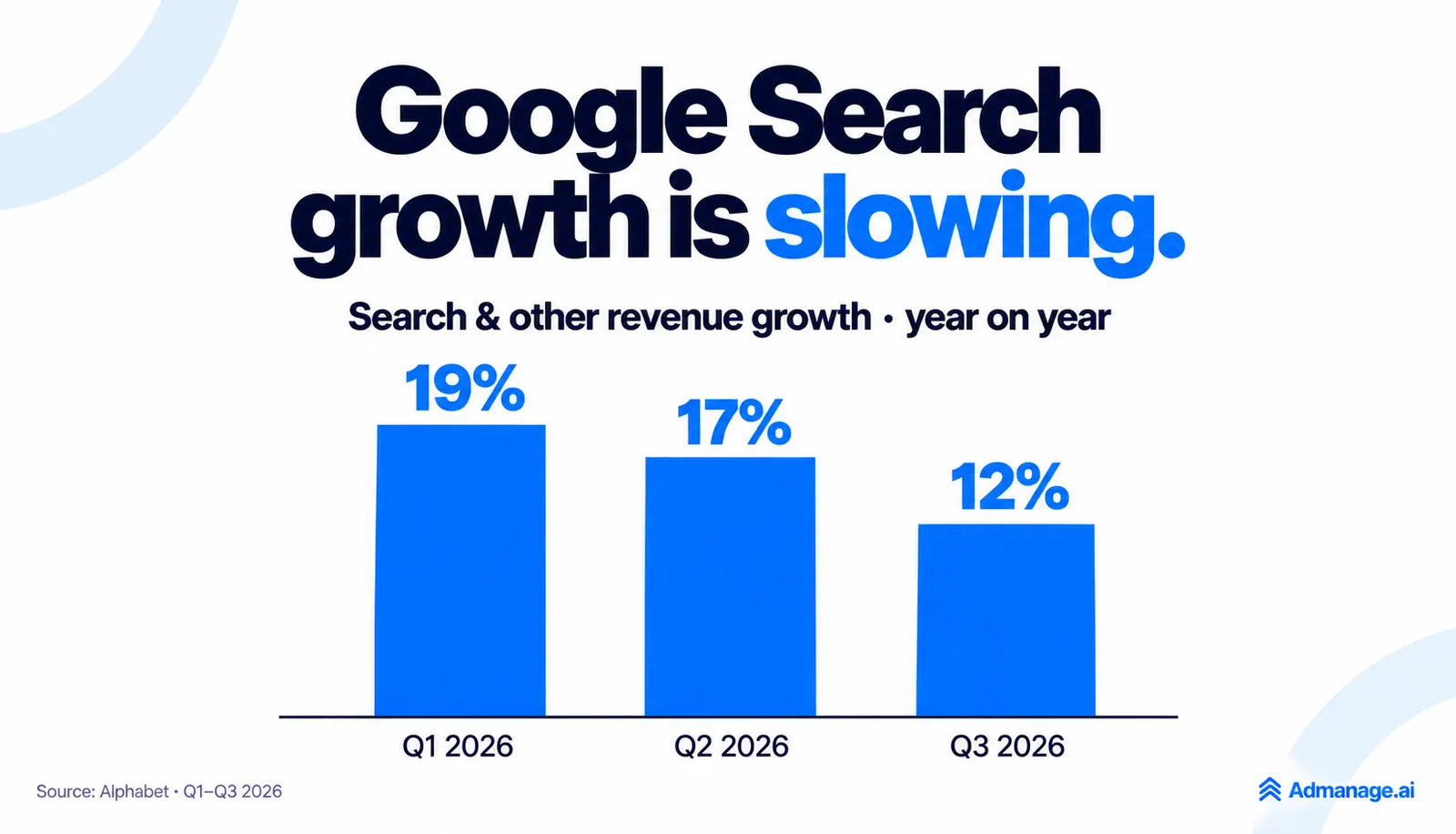
The latest earnings make that question timely. Google Search & other revenue growth slowed from 19% to 17% to 12% across the first three quarters of 2026. Meanwhile, Google is expanding advertising inside conversational search.
For a PPC team, the useful response is to examine intent, measurement and customer quality. This guide explains what the numbers establish, what the UK rollout means, and how to design a sensible campaign test.
What the Google Search growth figures actually show
These are year-on-year revenue growth rates for Google's Search & other reporting category. Each quarter is compared with the equivalent quarter a year earlier.
| Quarter | Search & other revenue growth, year on year |
|---|---|
| Q1 2026 | 19% |
| Q2 2026 | 17% |
| Q3 2026 | 12% |
Sources: Alphabet's official Q1 CEO remarks, Q2 CEO remarks and Q3 earnings release.
Search revenue is still growing. Its growth rate has slowed. The move from 19% to 12% is a seven percentage point reduction in the growth rate, not a 7% fall in revenue.
The Q3 release also says the year-on-year Search query growth rate was the highest in five years. Revenue growth and query growth measure different things. Neither gives an advertiser's cost per acquisition or return on ad spend.
Our interpretation: this is a reason to pay closer attention to the economics of changing search behaviour. It cannot diagnose what happened to your own campaigns, and the chart alone cannot establish how much of the slowdown AI caused.
What changes with Google AI Mode ads?
Google's current campaign guidance says eligible Search, Shopping and Performance Max campaigns can participate in AI Overviews and AI Mode without a separate campaign or budget. Their results are included in aggregate in existing campaign and search terms reports.
Exact and phrase match can serve against directly commercial queries. Broad match, AI Max, Shopping and Performance Max can also match contextually using the query and AI response. You cannot target only these AI experiences or opt out of them separately from Search.
That creates a measurement problem worth discussing with clients: a change in overall performance does not, by itself, identify the contribution of a particular search experience.
Keep a record of what changed, when it changed, and which business outcome followed. Avoid presenting an ordinary before-and-after comparison as an isolated measurement of AI Mode performance.
Why longer questions matter to advertisers
Google reports that AI Mode queries are, on average, three times longer than traditional searches, based on its May 2026 US research. This is a query-length comparison, not a claim that conversion rates or purchase intent are three times higher. Google's AI Mode research.
Consider these illustrative searches:
- “Running shoes.”
- “Which running shoes suit wet winter training if I need a wide fit and want to spend under £120?”
The second question includes conditions a buyer would otherwise have to communicate through filters, extra searches or a conversation with a retailer.
For a running brand, those conditions suggest a useful landing page review. Can shoppers quickly establish fit, suitability, price and availability? Does the ad promise match the actual range?
A generic bestsellers page may make the visitor repeat work they have already done. A relevant selection with clear product evidence could make the next decision easier. That is a testable landing page hypothesis, not a measured result from Google's study.
Are AI Mode ads available in the UK?
As of 29 October 2026, Google has announced a planned UK expansion during Q4 2026. Its 28 October announcement describes expansion into ten additional countries and names the UK, Brazil and Mexico as further planned markets. It also announces multiturn ads in the US. Google's rollout announcement.
A planned rollout is not confirmation that every UK advertiser can serve these placements today. Recheck availability when planning a test, especially if a client operates in multiple countries.
For a UK agency with US clients, this means separating preparation from observation. You can improve measurement and landing pages now. You should only describe a market-specific placement as available when current documentation or delivery evidence supports it.
It is also worth keeping UK and US performance reviews separate. Different prices, offers, delivery promises and customer mixes can change conversion economics even when the campaign structure looks similar.
The risk for lead generation: a cheaper lead can become a more expensive customer
The following is a hypothetical worked example, not AdManage customer data or a measured comparison of AI Mode with standard Search.
Suppose two acquisition approaches each spend £3,000. The second produces more form submissions, but a smaller share qualify and close.
| Metric | Approach A | Approach B |
|---|---|---|
| Ad spend | £3,000 | £3,000 |
| Form submissions | 100 | 150 |
| Cost per submission | £30 | £20 |
| Qualified leads | 40 | 30 |
| Cost per qualified lead | £75 | £100 |
| Customers won | 10 | 6 |
| Ad spend per customer won | £300 | £500 |
Approach B reduces cost per submission by a third. It also increases ad spend per customer won by two thirds.
If your report stops at form submissions, you may recommend increasing the budget for the weaker acquisition approach.
The important question is what caused the gap. Were enquiries outside your service area? Did prospects lack the required budget? Did the sales team respond more slowly? Were the two groups given enough time to close?
Do that diagnosis before blaming targeting or a new search format. A sales process failure can look like a media buying failure when the report ends at the wrong stage.
Give bidding and reporting an outcome that matters
For a lead generation business, agree on a concrete qualification definition with sales. “Qualified” might mean the prospect meets your location, budget and service requirements and has requested a relevant next step.
Then measure submissions, qualified leads and customers separately. Google recommends qualified-lead or converted-lead goals when setting up enhanced conversions for leads. Its offline conversion guidance explains how to bring downstream outcomes back into Google Ads.
Before changing a bidding goal, check that the selected event arrives consistently, is deduplicated and occurs often enough to support the decision. Longer sales cycles also require patience: last week's leads should not be judged against a fully matured cohort from last month.
For a deeper look at the workflow between enquiry and revenue, see our guide to Google Ads lead forms and qualified pipeline.
The ecommerce risk: the same ROAS can hide very different profit
Here is a second hypothetical example. Both campaigns spend £2,000 and generate £8,000 in attributed revenue, giving each a reported revenue ROAS of 4×.
The products sold have different margins.
| Metric | Product mix A | Product mix B |
|---|---|---|
| Ad spend | £2,000 | £2,000 |
| Attributed revenue | £8,000 | £8,000 |
| Reported revenue ROAS | 4× | 4× |
| Gross margin assumption | 60% | 35% |
| Gross profit before advertising | £4,800 | £2,800 |
| Gross profit less ad spend | £2,800 | £800 |
The final row is a simplified contribution measure before fulfilment, returns and other costs. It is not net profit.
The lesson for a retailer is straightforward: if the mix of products being sold changes, a stable ROAS can conceal a meaningful change in commercial value.
Review the products purchased, their margins, returns and customer mix alongside campaign totals. A campaign finding new customers with repeat-purchase potential can deserve a different decision from one mostly collecting existing demand.
Use your order system's customer history to validate the new-versus-existing split. Google also offers customer acquisition reporting for advertisers using the relevant acquisition goal and purchase conversions; its new customer tracking guidance explains the setup and scope.
The longer-term value of a new customer still needs evidence. An assumed lifetime value is a forecast, not cash already earned.
What should change in your ads and landing pages?
A conversational question can reveal constraints that a short keyword leaves unstated. Use those constraints to form better creative and landing page tests.
For a furniture retailer, a visitor may care about a sofa fitting through a narrow doorway. Put dimensions and delivery access information where the buyer can find them.
For a B2B software company, a prospect may be comparing integration requirements and implementation time. Give them a clear explanation of supported workflows and the evidence behind any time-saving claim.
For a local service business, a prospect may need a particular location, appointment window or qualification. Make those limits explicit before asking for contact details.
The useful exercise is to collect recurring buying questions and connect each one to:
- The promise your ad makes.
- The evidence the landing page supplies.
- The action you want the visitor to take.
- The outcome you will use to evaluate the test.
These are suggested tests. They do not require assuming that every longer query has stronger intent or that every visitor has used AI Mode.
How to test without losing track of what caused the result
Pick a commercial question before choosing a feature.
For example: “Can broader matching generate additional qualified enquiries within our acceptable cost per customer?” That gives the test a business purpose and a clear way to fail.
Google's AI Max experiments let eligible advertisers compare control and treatment traffic within a campaign. Where appropriate, use the experiment framework rather than turning on several settings across the whole programme at once.
An AI Max experiment tests the selected campaign features. It does not isolate AI Mode placements.
Write down the following before launch:
- Primary outcome: qualified-lead cost, customer acquisition cost or contribution after advertising.
- Budget limit: the amount the business can afford to spend answering the question.
- Commercial guardrails: location, brand scope, irrelevant enquiries and acceptable customer quality.
- Evaluation period: enough time for conversions and downstream outcomes to mature.
- Decision rule: what evidence would justify applying, extending or rejecting the change.
Hold unrelated changes steady where practical. If you simultaneously change your offer, landing page, conversion goal and targeting, interpretation becomes harder.
Review brand and nonbrand demand separately where your reporting supports it. This is a useful commercial distinction, but it is not a substitute for identifying AI placements.
If the result is inconclusive, say so. A fixed calendar deadline does not guarantee enough evidence to make a reliable decision.
Our Google Ads management guide covers the broader process of diagnosing changes before scaling spend.
A practical 30-day preparation plan
Use the first month to improve readiness and start a controlled test. The test itself may need longer, particularly for businesses with slow sales cycles.
| Period | Work to complete | Useful output |
|---|---|---|
| Week 1 | Check conversion definitions, CRM or order reconciliation, and outcome delays | A baseline you can explain |
| Week 2 | Review recurring buying questions, offers and landing page gaps | One prioritised test hypothesis |
| Week 3 | Confirm current market availability and launch a suitable bounded experiment | A recorded change with a budget limit |
| Week 4 | Review delivery, data quality and early outcomes; allow immature conversions more time | A next decision supported by evidence |
For an agency, a useful client update is specific: “We are testing whether this campaign change produces additional qualified demand at an acceptable acquisition cost. Here is the budget, the measurement window and the condition for expanding it.”
That is more actionable than forecasting an account's performance from Alphabet's earnings.
Where the organic click research fits
Pew Research Center's March 2025 US browsing study found traditional result clicks on 8% of Google visits with an AI summary, compared with 15% without one. This was an observational comparison of different searches. It was not an experiment on paid ad CTR, and it does not establish a current 2026 decline of the same size. Pew's study and methodology.
For a team responsible for both SEO and PPC, the useful next step is to compare organic visibility, paid outcomes and total business results. Keep those measures distinct so a drop in one channel's clicks does not automatically become a claim about the whole acquisition programme.
Questions PPC teams are asking
Can you run ads in AI Mode?
Yes, in supported markets through eligible existing campaign types. Check current availability before planning delivery. The campaign and rollout sections above explain the scope.
Can advertisers turn off AI Mode ads separately?
Google currently provides no separate Search opt-out for these experiences. See the campaign guidance linked above for the available controls.
Should we move budget away from Google because Search growth slowed?
The earnings figures do not establish your marginal acquisition cost. Make that decision using mature customer outcomes, the profit from additional spend and evidence from alternative uses of the budget.
Should we turn on every AI feature immediately?
Start with a specific hypothesis, reliable measurement and a spending limit. Expand when the evidence supports it.
Before your next Google Ads budget increase, choose one campaign and reconcile its reported conversions with qualified leads, customers or contribution after advertising. That is the most useful place to start.
For a practical comparison, see our ChatGPT advertising examples, costs and Ads Manager setup guide, including a Canva placement and a worked customer-acquisition model.
Research checked on 29 October 2026. Public platform facts are linked above. Worked examples are illustrative; no private ad account counts, account identifiers or customer-level results are disclosed.