
Google Display Network CPM Benchmarks (2025): What Display Ads Cost
The most recent published benchmark we could verify puts the average Google Display Network CPM at about $2.54 per 1,000 impressions. That figure comes from Pixis's 2025 Google Ads benchmark report, which analysed $996 million of Google Ads spend across 100 consumer brands from January 2024 to February 2025. That is a few dollars per thousand impressions.
Treat that number as a rough starting point, not a target. It comes from one vendor's customer base, and Pixis itself notes some self-selection bias. Your own display CPM depends on your audience, your placements, your bid strategy and whether you pay for all impressions or only viewable ones. This guide covers the published numbers, what is known for education advertisers, how Google charges for display impressions and how to work out your own benchmark.
What is the average Google Display Network CPM in 2025?
Public display CPM benchmarks are scarce, and the ones that exist rarely say where their data comes from. The figure we could check against a stated dataset:
- Pixis (2025): Display CPMs averaged $2.54. Dataset: $996M in Google Ads spend across 100 consumer brands running Search, Display, Shopping, Performance Max and Video, January 2024 to February 2025. Pixis does not split the display CPM by industry.
Several other blogs quote display CPMs of roughly $2 to $3, but we could not trace those figures to a stated dataset, so we have left them out.
Two cautions when you compare any benchmark to your account:
- "Google Ads CPM" is not "Display CPM". Many reports give one CPM for all of Google Ads. Search and display impressions are priced in different auctions, so a blended number can look very different from a display-only number.
- Average vs median. A few very expensive campaigns pull an average up. If a report does not say which it uses, compare it loosely.
For the full picture of Google Ads costs (CPC, CPL and budgets by campaign type), see our guide to how much it costs to advertise on Google.
Google Display Network CPM benchmark for education
We could not find a published, sourced Google Display Network CPM for the education industry. No report with a stated dataset that we could open gives one. If you see a precise "education display CPM" quoted online, check where it comes from before you plan a budget around it.
What we did find is a display CTR benchmark for education. Focus Digital's 2025 display CTR study (US display campaigns, median CTR, February to December 2025) reports:
| Industry | Median display CTR |
|---|---|
| Real Estate | 1.08% |
| Travel & Hospitality | 0.52% |
| Entertainment | 0.47% |
| All industries | 0.46% |
| E-Commerce & Retail | 0.43% |
| Education & eLearning | 0.38% |
| Technology & SaaS | 0.34% |
| Healthcare | 0.31% |
| Finance & Insurance | 0.26% |
| B2B Services | 0.22% |
So education display ads get clicked slightly less often than the average display ad. That matters more than CPM for most schools, colleges and course providers, because they pay for enrolments and leads, not impressions. A cheap CPM with a low CTR can still mean an expensive click.
For education advertisers, the practical benchmark is your own: run display for two to four weeks, then compare your CPM, CTR and cost per lead with your Search and social campaigns. Our guide to what a good CTR is shows how to judge CTR across channels.
How Google charges for display ads: CPC, CPM and vCPM
Your display CPM depends partly on how you bid. Google Display campaigns can be optimised for clicks, conversions or impressions.
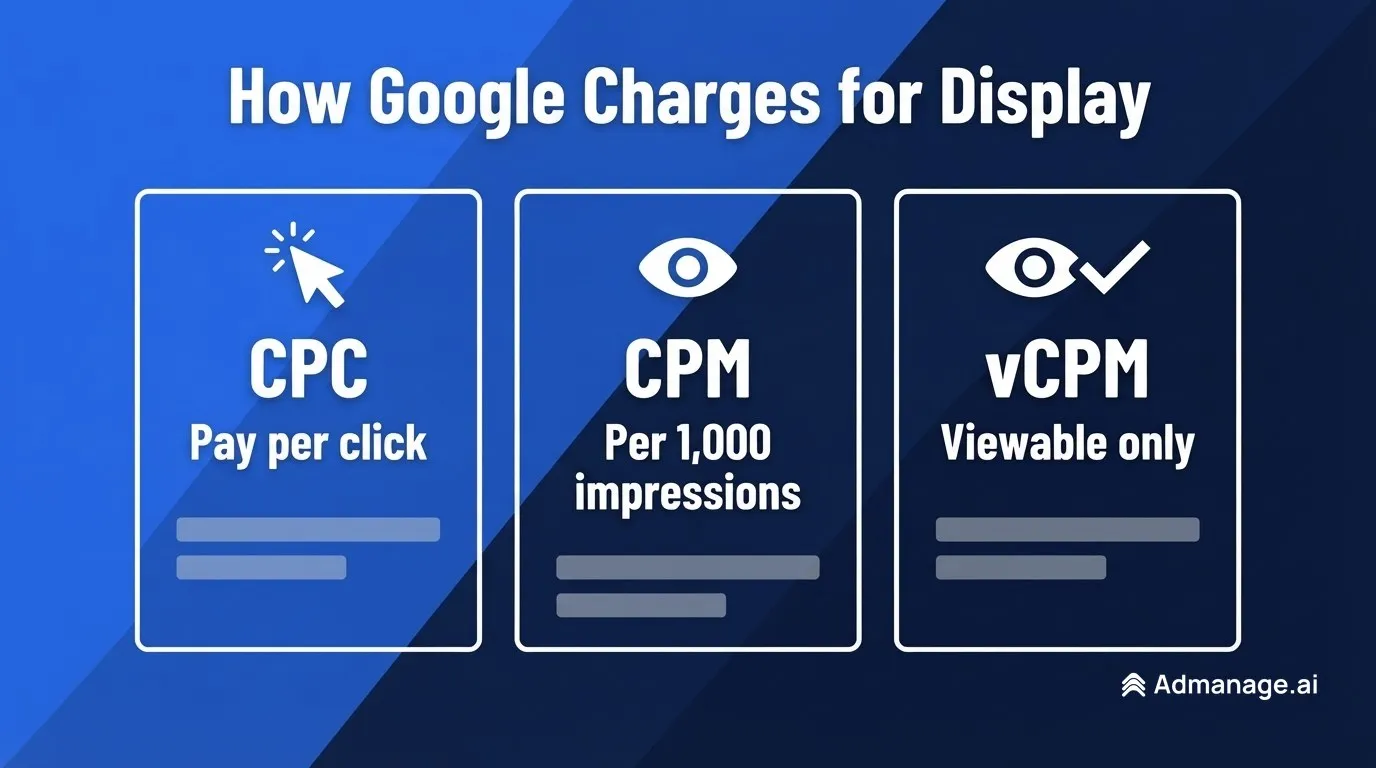
- Clicks or conversions (CPC, Maximize clicks, Maximize conversions): you pay per click, and CPM is just a result you calculate afterwards. Google's help page on bidding on impressions says these strategies may suit you better when your main goal is sales or website visits.
- Viewable CPM (vCPM): you bid a maximum price for 1,000 viewable impressions. Google says you "don't pay for any impressions that were not viewable", and that vCPM bidding is not available for Search Network campaigns.
Google defines a viewable display impression as one where at least 50% of the ad is on screen for one second or longer (two seconds for video), measured by Active View (Google Ads Help: viewable CPM).
This is why vCPM and regular CPM are not directly comparable. A viewable impression is a stricter unit than a served impression, so a vCPM will usually be higher than the CPM you would calculate across all impressions. Google also notes that vCPM bids may win different impressions at different prices than old max CPM bids, so you may need to adjust your bid to keep the same spend.
Why display CPMs differ from Search and social CPMs
A display impression is a banner or responsive ad shown on a website, app or Google property next to content someone came to see. It is not a response to a search, so it is priced differently from a search ad, and published display benchmarks like the $2.54 figure above are low compared with most CPM benchmarks for other channels.
Lower CPM does not mean cheaper results. Compare channels on cost per result:
- Search reaches people who are actively looking for something, so judge it on cost per lead or sale.
- Meta has its own auction and benchmarks. See our Facebook CPM benchmarks by industry for current numbers.
- Display is often used for remarketing and awareness. Judge it on view-through and assisted conversions as well as last-click results.
How to find your own Google Display CPM
Your account data beats any published benchmark. To get a clean display CPM:
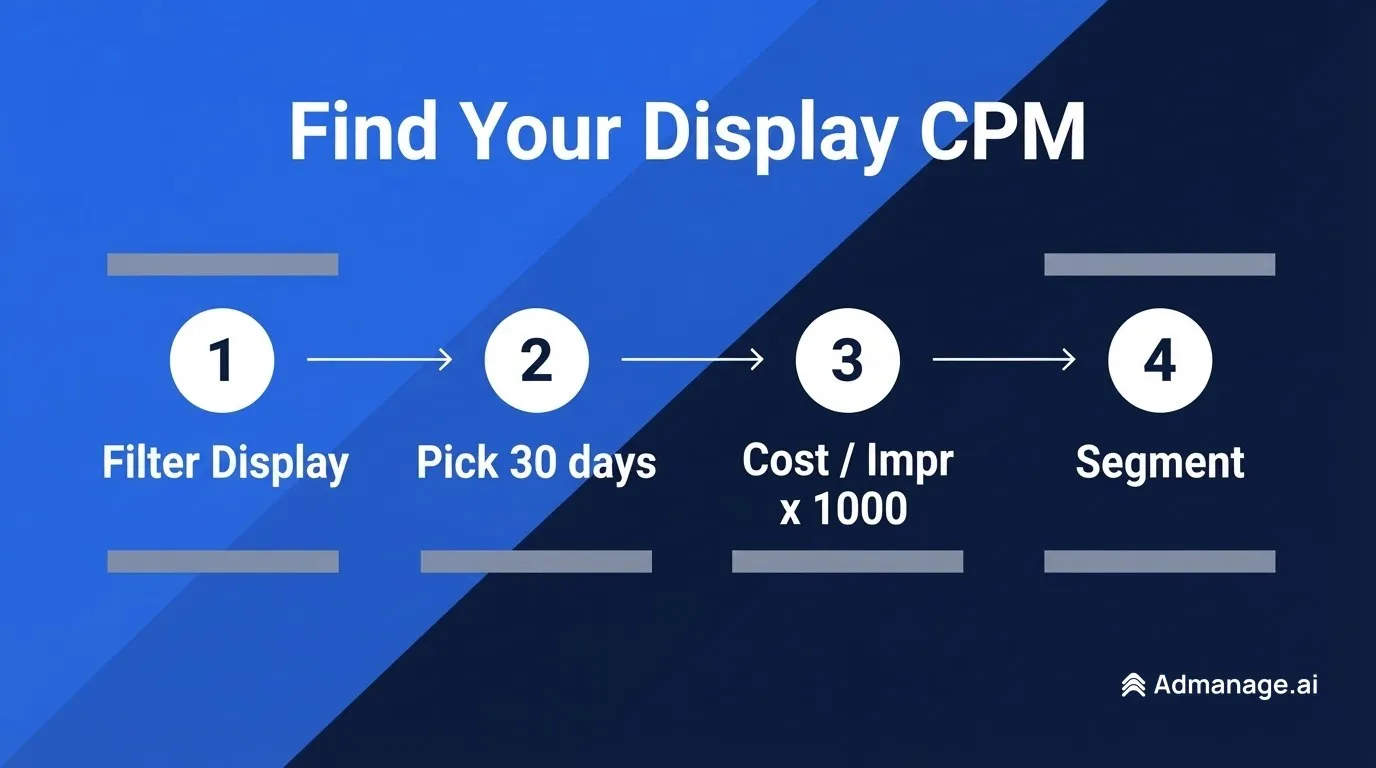
- Filter to Display campaigns only. Exclude Search, Shopping, Video and Performance Max, which report blended costs.
- Pick a long enough window. Use at least 30 days, and avoid comparing a November CPM with a January one: seasonal demand, especially in Q4, can push prices up.
- Calculate CPM from cost and impressions: CPM = cost ÷ impressions × 1,000. If you bid on vCPM, use viewable impressions instead.
- Segment before you compare. Split by remarketing vs prospecting, placement, device and country. Small remarketing audiences and broad prospecting audiences can have very different CPMs.
If you manage several accounts, pull this into one report rather than checking each account by hand. You can also see who you compete with in each auction with Google Ads Auction Insights.
From display CPM to CPC: what a display click costs
CPM and CPC are linked by CTR:
CPC = CPM ÷ (CTR × 1,000)
As an illustration only, combining two different datasets: a $2.54 CPM (Pixis) with the 0.46% all-industry display CTR (Focus Digital) gives a CPC of about $0.55. With the 0.38% education CTR it rises to about $0.67. Your real CPC comes from your own CPM and CTR, so use the formula, not these example numbers.
The same maths explains why a better creative lowers your effective click cost: raise CTR from 0.38% to 0.5% at the same CPM and every click costs about a quarter less.
Frequently asked questions
What is a good CPM for Google Display ads?
There is no official benchmark from Google. The most recent sourced figure we found is a $2.54 average display CPM from Pixis (100 consumer brands, January 2024 to February 2025). A good CPM is one that delivers your cost per lead or cost per sale target, not the lowest number.
What is the average Google Display Network CPM for education?
We could not find a sourced, published GDN CPM for the education industry. What is published is display CTR: Focus Digital reports a 0.38% median display CTR for Education & eLearning in 2025, against a 0.46% average.
Is vCPM the same as CPM?
No. CPM counts every served impression. Viewable CPM (vCPM) counts only impressions where at least 50% of the ad was on screen for at least one second, and with vCPM bidding you are not charged for impressions that were not viewable.
What is the average Google Display Network CPC?
It depends on your CPM and CTR: CPC = CPM ÷ (CTR × 1,000). Using the published averages above as an illustration, a display click works out at roughly $0.55 to $0.67, but your own account numbers are the only reliable figure.
Why are Google Display CPMs lower than other benchmarks?
Display ads are shown next to content rather than in response to a search, and they are bought in a different auction. Whatever the CPM, judge display on cost per result rather than CPM alone.
How can I lower my Google Display CPM?
Test broader audiences and placements, refresh creatives regularly, and compare CPM and conversions by placement so you can exclude expensive placements that do not convert.
Launch and test Google display creative faster
Display results depend on testing many sizes, messages and audiences. Building every variation by hand in Google Ads is slow.
AdManage lets performance teams bulk-launch ads on Google Ads, Meta, TikTok and more from one place, with naming conventions and UTMs handled for you. See how Google Ads bulk upload works in AdManage, or start a free trial.