
Meta Andromeda: How Meta's Ad Retrieval Engine Works and What Media Buyers Should Change
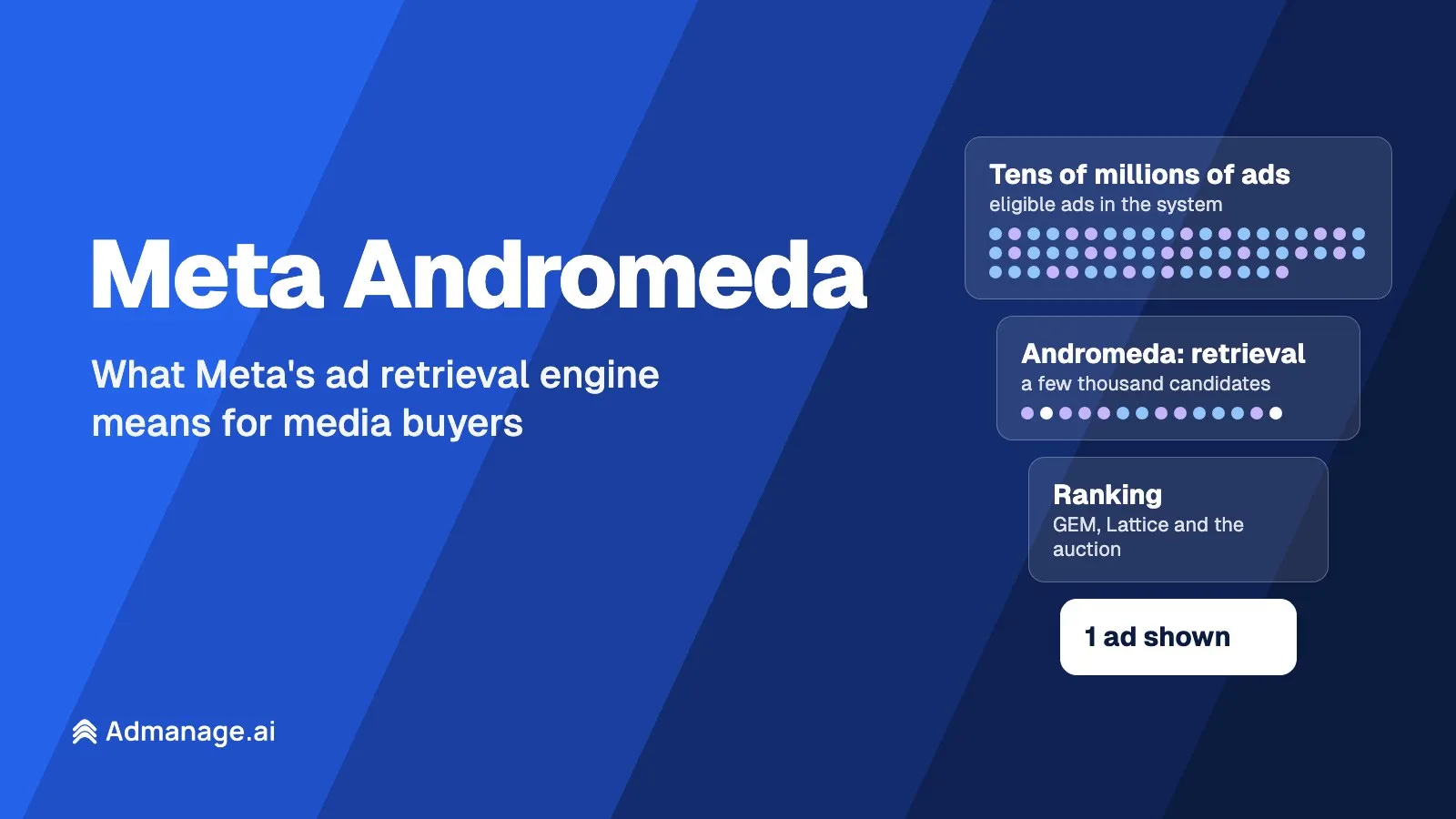
Meta Andromeda is the machine learning system that decides which ads are even considered for a person. Every time someone opens Facebook or Instagram, Andromeda narrows tens of millions of eligible ads down to a few thousand candidates. Only those candidates go on to Meta's ranking models and the auction. Meta announced it in December 2024, and it now runs across Facebook and Instagram.
For media buyers, the practical consequence is simple to state: your creative now does much of the work your targeting used to do. Andromeda reads what an ad is and matches it to people. Ads that look alike tend to reach the same people, so an account with ten distinct concepts has far more ways to find buyers than an account with ten versions of one concept.
We also looked at our own data: about 300 Meta ad accounts tracked from 2024 to 2026. The same advertisers now run nearly three times as many live ads, and their winning ads lose return on ad spend almost twice as fast in their first month. The charts are below.
This guide covers how retrieval and ranking work now, why creative diversity matters more than audience settings, the debate over how many ads to put in an ad set, why ads fatigue faster, and what to change in account structure and testing cadence. The last section covers the part most guides skip: what happens to your team when "launch more distinct ads every week" becomes the job.
What is Meta Andromeda?
Andromeda is Meta's ads retrieval engine: the first stage of its ad recommendation system. In Meta's words, retrieval selects "from tens of millions of ad candidates into a few thousand relevant ad candidates" (Engineering at Meta). Larger ranking models then score those candidates to pick the ad that is shown.
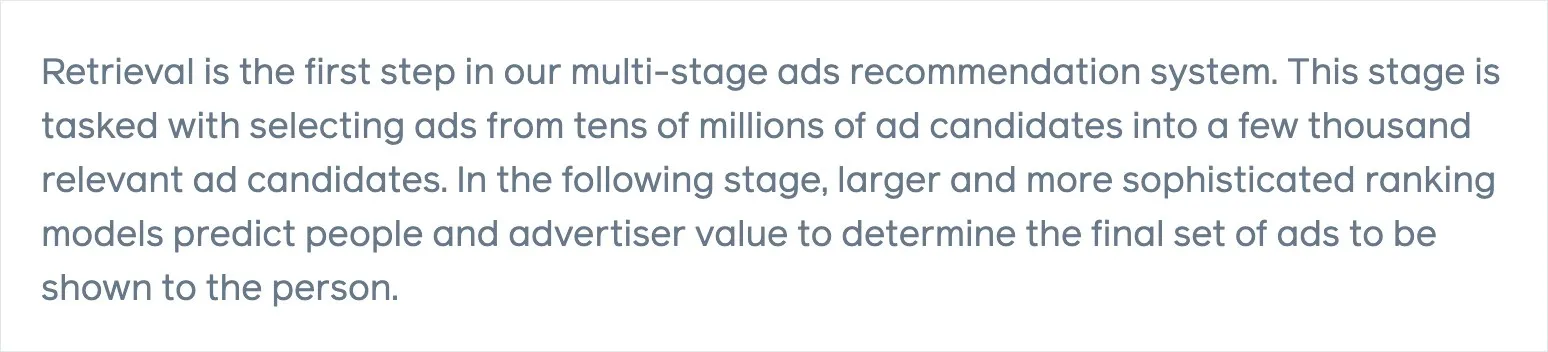
Source: Meta Andromeda: Supercharging Advantage+ automation with the next-gen personalized ads retrieval engine, Engineering at Meta, 2 December 2024.
Three facts from Meta's own sources set the scale:
- It is a big jump in model size. Meta says the new architecture allowed "a meaningful increase of model capacity (10,000x)" for retrieval, and expects another 1,000x as hardware improves.
- It runs on new hardware. Andromeda was built for NVIDIA's Grace Hopper Superchip and Meta's own MTIA chips, which is what makes a much larger model affordable at retrieval speed.
- It was built for more creative. Meta designed it to handle the growth in ad volume that Advantage+ and generative AI tools create. The post notes that more than a million advertisers made over 15 million ads with Meta's generative AI tools in a single month.
When did the Meta Andromeda update happen?
There was no single switch-over date. On its Q2 2025 earnings call, Meta said it "began introducing" the Andromeda architecture in the second half of 2024. It expanded coverage to Facebook Reels in Q2 2025 and has kept upgrading it since. On the Q3 2026 call (21 October 2026), CFO Susan Li said Andromeda improvements "increased conversions by 1.4% on Facebook" that quarter.
Practitioner datasets place the broad rollout through 2025. Confect's study of 3,014 ecommerce advertisers, for example, tracks enrolment rising through the year to full deployment around October 2025 (Confect). That is a vendor's reading of its own customer base, so treat the dates as approximate.
How retrieval and ranking work after Andromeda
It helps to think of Meta's delivery as a funnel with three gates.
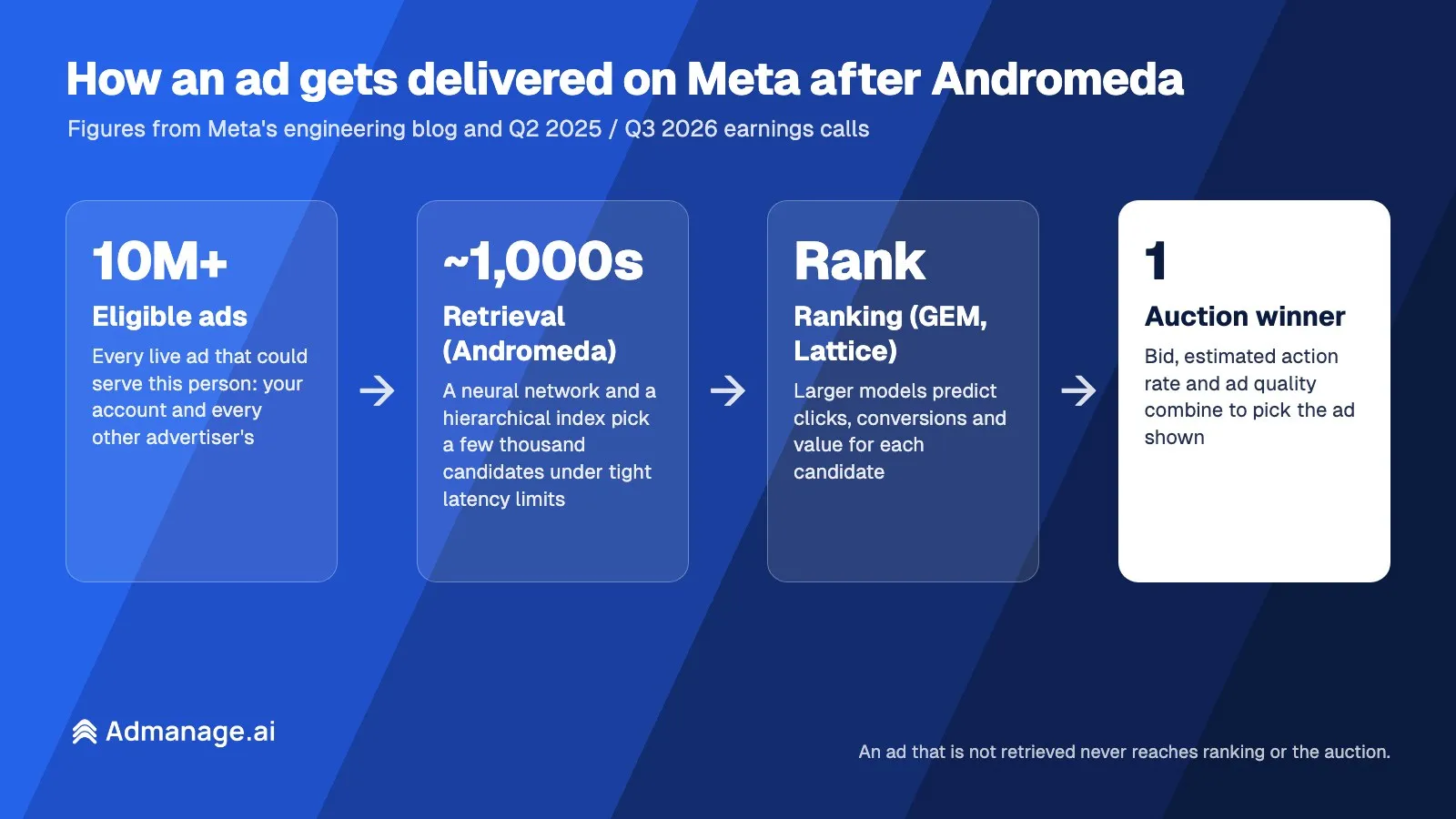
- Eligibility. Your ad set's settings (location, age, placements, budget, schedule, exclusions) decide which requests your ads can compete for at all. With broad targeting and Advantage+ audience, that pool is very large.
- Retrieval (Andromeda). For each request, a neural network scores the eligible ads against the person and keeps a few thousand. This is the gate that changed most.
- Ranking and auction. Larger models estimate how likely the person is to click, convert or deliver value. Meta's auction then combines your bid, the estimated action rate and ad quality to choose the winner.
The key point for buyers: an ad that is not retrieved never gets ranked. Bids and budgets only come into play for ads that clear retrieval.
How Andromeda organizes ads
The most important detail in Meta's post, for anyone planning creative, is the hierarchical index. Andromeda groups ads into layers of clusters and only explores the branches most relevant to the person, instead of scoring every ad one by one. The index is trained together with the retrieval model, so ads end up grouped by how the model sees them.
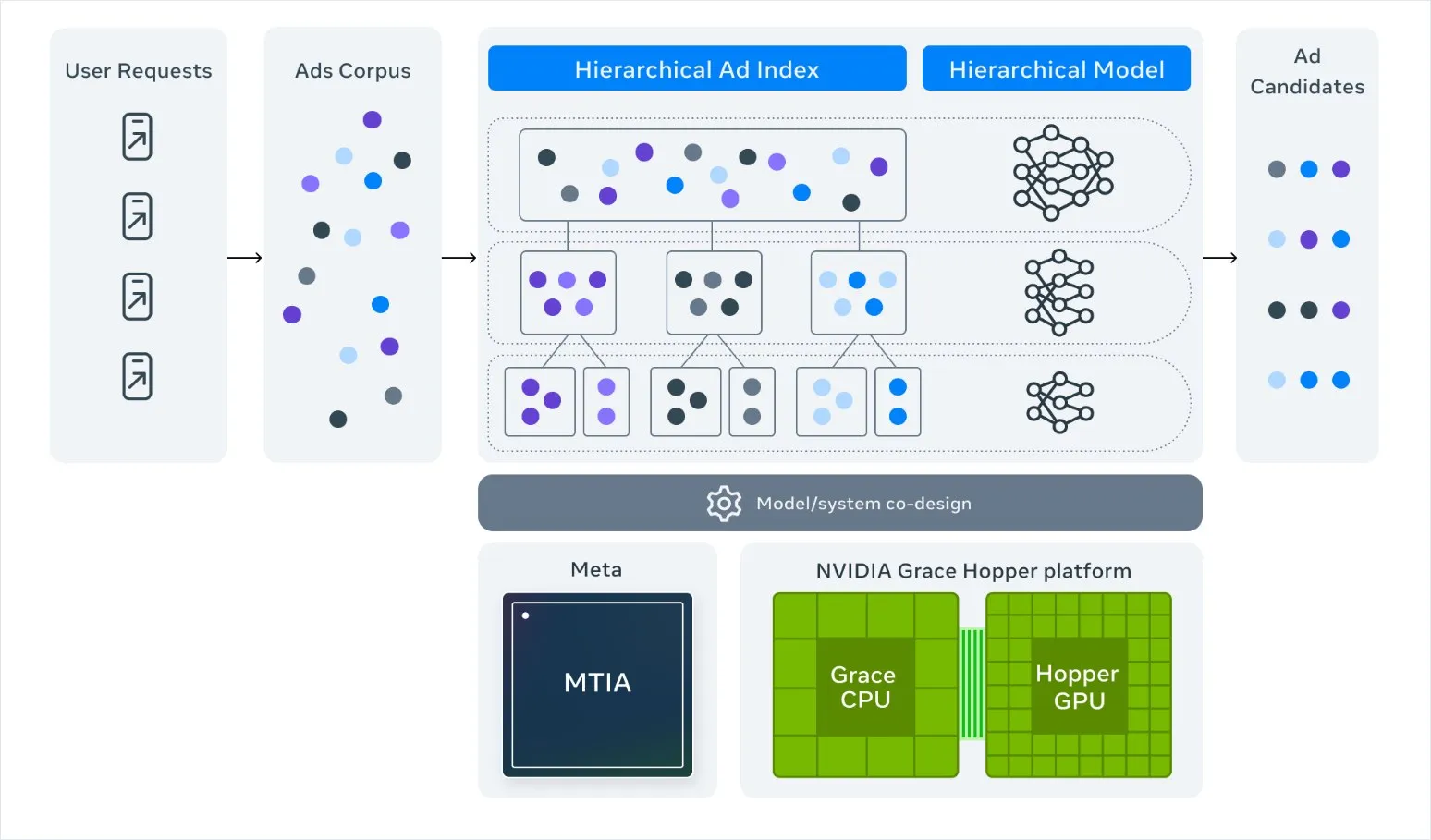
Diagram: Meta's personalized ads retrieval paradigm, from Engineering at Meta. Ads in the corpus are organized into nested clusters; the model walks down only the relevant branches.
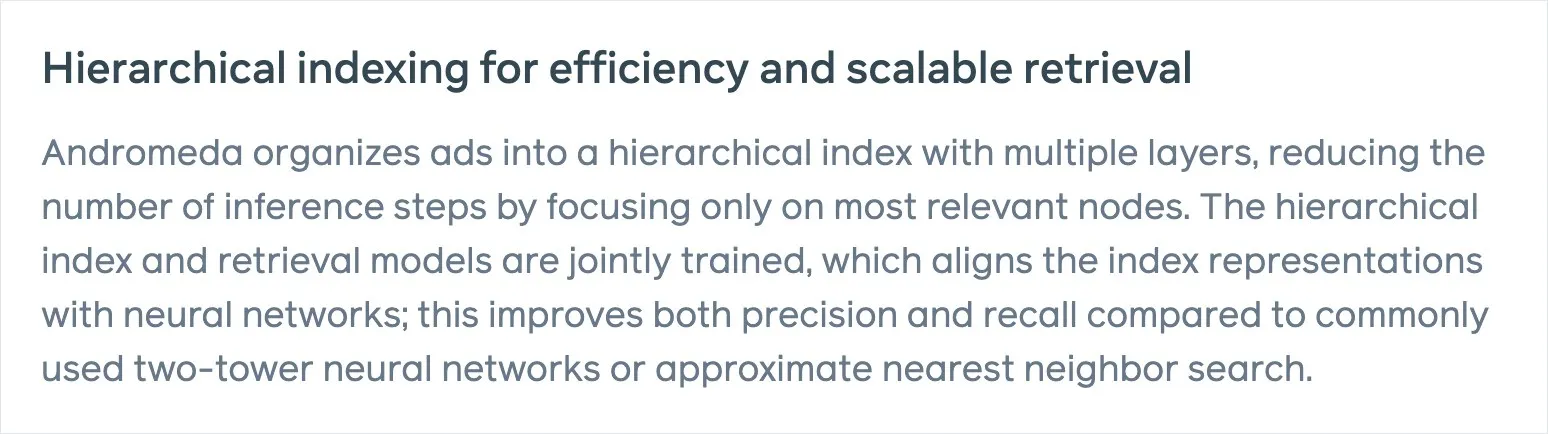
Source: Engineering at Meta, section "Hierarchical indexing for efficiency and scalable retrieval".
Meta does not publish how the clusters are formed. Third-party guides talk about a "creative similarity score" or "entity ID", but we could not find either in Meta's own documentation. What we can say from the design is narrower and still useful: ads the model sees as similar sit close together in the index and tend to be retrieved for the same kinds of people. Ten near-identical ads compete for one pocket of demand. Ten distinct ads can be retrieved for ten different pockets.
Meta's newer recommendation work points the same way. Its October 2026 GenRecs post describes encoding each ad with a multimodal model into short sequences of tokens, where similar items share tokens. That is how a new ad can borrow signal from earlier, similar ones.
What Meta says Andromeda improved
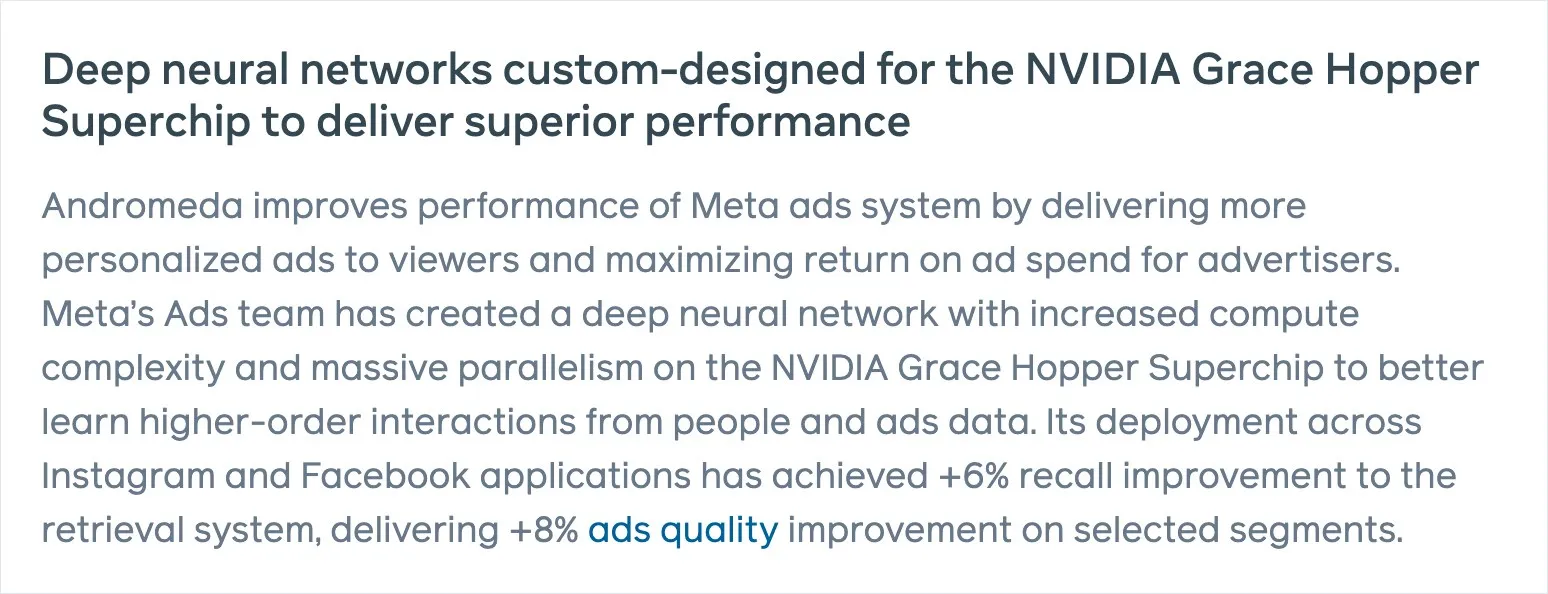
Source: Engineering at Meta, December 2024.
| Claim | Figure | Source |
|---|---|---|
| Retrieval recall | +6% | Engineering at Meta, Dec 2024 |
| Ads quality, selected segments | +8% | Engineering at Meta, Dec 2024; repeated by Meta for Business, Apr 2025 |
| Feature extraction latency and throughput | over 100x | Engineering at Meta, Dec 2024 |
| Conversions on Facebook from Andromeda upgrades | +1.4% | Q3 2026 earnings call |
| Conversions from generative retrieval on Facebook Feed | nearly +2% in targeted segments | Q3 2026 earnings call |
These are Meta's own measurements, reported at Meta's chosen segments and time frames. They tell you the direction of the system, not what will happen in your account.
Where GEM and Lattice fit
Andromeda is retrieval. Two other names come up in the same conversations, and both are ranking:
- GEM (Generative Ads Recommendation Model) is Meta's large foundation model for ranking. Meta says it passes what it learns to the smaller ranking models that serve ads. In its October 2026 post, Meta reports an 18.9% conversion improvement and a 12% CTR improvement across surfaces and objectives.
- Lattice is an architecture that replaced many small, single-objective ranking models with larger shared ones. Meta credited recent Lattice deployments with "a nearly 4% increase in ad conversions across Facebook Feed and Reels" on its Q2 2025 call.
The short version: Andromeda decides which ads get a chance. GEM and Lattice decide which of those wins. Better ranking cannot rescue an ad that retrieval never selects.
Why creative diversity now matters more than audience targeting
Before Andromeda, retrieval used "isolated model stages and numerous rule-based heuristics," in Meta's description. Buyers compensated with structure: interest stacks, lookalikes, many ad sets, each one telling the system who to look for.
A retrieval model with far more capacity, matching ads to people directly, makes much of that steering redundant. The signal it uses most is the ad itself: the visual, the format, the hook, the person on screen, the words, the offer and the landing page. Meta says it plainly in its April 2025 guidance: build ads with "different themes, messages, and visuals" so the system can match them to different people, rather than relying mainly on narrow targeting.
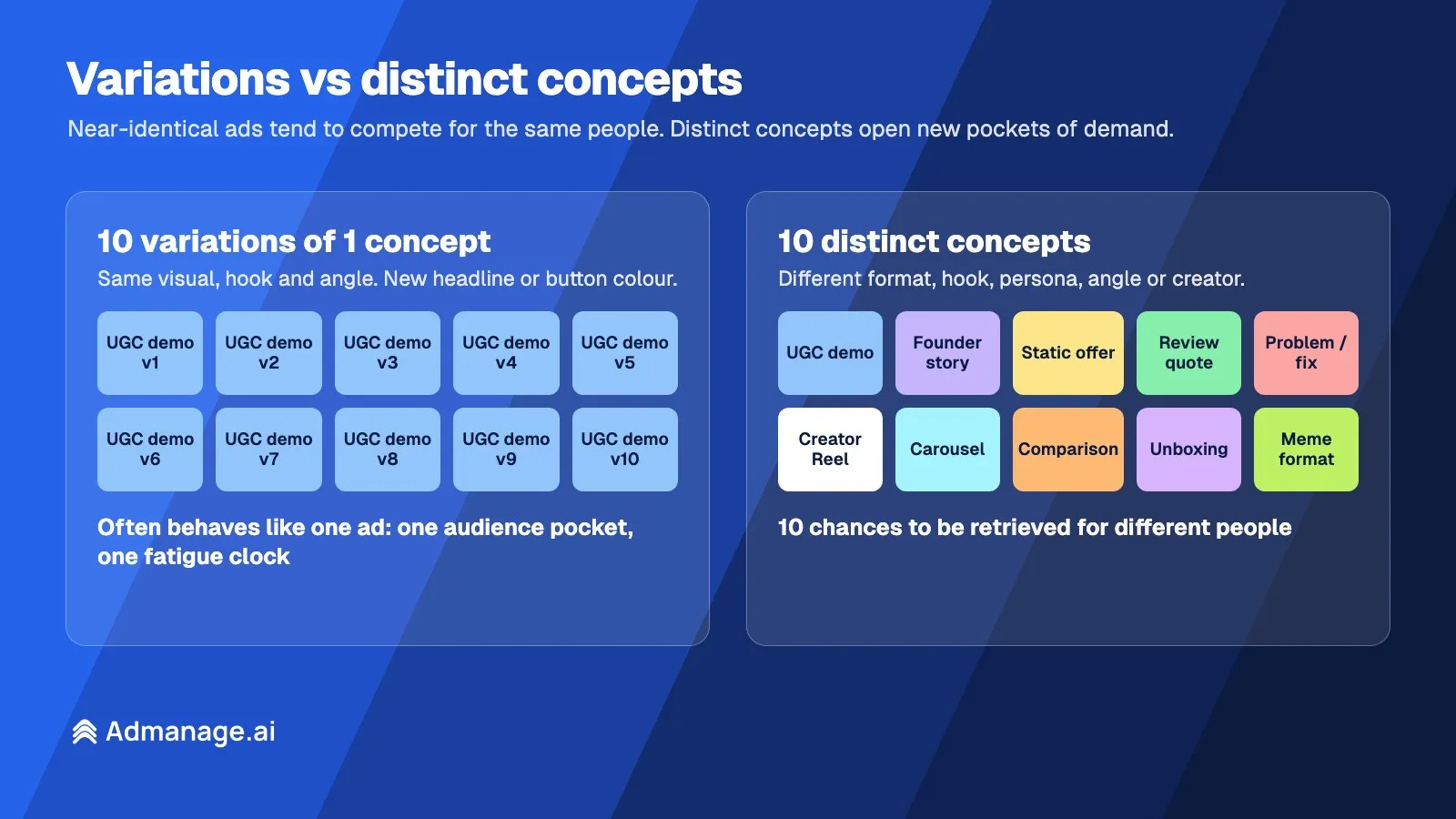
What counts as "different"
Small edits rarely change who an ad reaches. A new headline on the same video, a different button colour, or a 15-second cut of the same 30-second ad will usually be read as the same thing. Practitioners who test this report that the visual and format carry the most weight, and that the first seconds of a video matter more than copy changes (Alex Neiman, Jon Loomer). These are field observations, not Meta documentation.
A workable definition of a distinct concept is an ad that changes at least one of these:
| Lever | Example change |
|---|---|
| Format | Static → UGC video → carousel → creator Reel |
| Persona | Busy parent → gym regular → gift buyer |
| Angle or motivation | Save money → save time → status → fix a specific problem |
| Hook (first 3 seconds) | Problem shot → result shot → bold claim → question |
| Messenger | Founder → customer → creator → no person, product only |
| Offer or proof | Discount → bundle → review count → guarantee |
Copy, headline and CTA variations still have value. They are just second-order. Use them inside a concept, or let text variations handle them, instead of counting them as new tests.
What this means for targeting
Broad targeting is now the default starting point for most prospecting, because it gives retrieval the largest pool to match your creative against. You still need constraints that reflect the business: locations you ship to, age floors, existing-customer exclusions where they matter, and placements your assets are built for. What changes is the job of targeting. It sets the boundaries; the creative mix decides who inside those boundaries sees you.
For a structured look at the trade-off in Advantage+ campaigns, see our guides to Advantage+ shopping campaigns and Advantage+ vs manual creative.
How many ads per ad set after Andromeda?
This is the most argued-about question in Meta advertising right now, and the honest answer is that both camps are partly right.
The "many ads" camp points out that retrieval needs options. Meta's own creative diversification guidance (November 2024) recommends keeping at least 20 diversified ads in Advantage+ shopping campaigns and launching new ads weekly. Confect, which studied 3,014 ecommerce advertisers through 2025, found the top third by ROAS ran about 395 live ads at a time, against about 296 for the bottom third (Confect). Confect also cites an agency test where one ad set with 25 creatives beat five smaller ad sets.
The "fewer ads" camp points out that spend concentrates. Meta's own ad-volume guidance has long recommended six or fewer creatives per ad set outside Advantage+ shopping campaigns (PPC Land). In a large creative dataset reported by Motion and analysed by Alex Neiman, roughly 5% of ads become clear winners and around half get little or no spend. Put 30 ads in a small ad set and most of them never get enough delivery to tell you anything.
Two caveats on the vendor data. The Confect groups are defined by ROAS, so some of the gap is selection, not cause; bigger, better-run brands tend to run more ads anyway. And the Motion figures come via a secondary write-up. Treat both as directional.
The two views reconcile once you separate concepts from ads and tie both to budget:
- Count distinct concepts, not ads. Ten variations of one idea are closer to one entry in retrieval than to ten.
- Let budget cap your ad sets. Meta's long-standing guidance is that an ad set needs around 50 optimisation events a week to exit the learning phase. In its October 2026 peak-season guidance, as reported by PPC Land, Meta says ad sets under that threshold ran about 28% more expensive per purchase, and gives a ceiling: weekly budget ÷ (cost per result × 50). A $20,000 weekly budget at a $40 CPA supports about 10 ad sets.
- Let spend per concept cap your ads. Decide how much spend you need to judge a concept (for many accounts, 1–2x target CPA). Weekly ad set spend divided by that number is roughly how many new concepts that ad set can evaluate in a week. Below that, extra ads are not tests, they are spectators. This is our heuristic, not a Meta rule.
- Mind Page ad limits. Meta has capped how many ads a Page can run at once by spend tier, from 250 ads for Pages under $100,000 a month to 20,000 for the largest (PPC Land). Some accounts reported the cap lifting in September 2026, but Meta has not announced a change (PPC Land). Either way, switch off ads that no longer earn delivery so new concepts have room.
Our own data supports the "concepts, not count" view: across about 300 accounts, the number of ads in an ad set had almost no relationship with that ad set's ROAS compared with its account (see the table in the data section below).
In practice that lands most accounts on fewer ad sets, each holding a deeper and more varied pool of concepts, refreshed on a schedule. A $3,000-a-day account and a $300,000-a-day account will land in very different places on the same logic. For the maths behind test budgets, see how many ad creatives to test and our creative testing budget guide.
Why creatives fatigue faster now
Two forces make ads wear out faster than they used to.
- Better matching burns through the best audience quicker. If retrieval finds the people most likely to respond to a concept faster, it also reaches the edge of that group faster. Frequency within the pocket rises, and results fade.
- Similar ads share a fatigue clock. If your new ad looks like the old one, it is likely to be retrieved for the same people who have already seen the old one. It is not really fresh.
Our data shows the change directly. Among winning ads launched in the first half of 2026, median ROAS four weeks after launch was 71% of their first two weeks, against 84% for winners launched in the first half of 2024 (see the fatigue chart in the data section below). Other estimates vary. Confect reports effective creative lifespan falling from 6–8 weeks to 2–4 weeks, but does not show the source of that figure. In Neiman's data from six DTC brands, winners from concept-first testing lasted 34 days on average against 19 days for winners found by volume-first variation. The direction is consistent across sources: refresh cycles are shorter, and refreshing with genuinely new concepts lasts longer than refreshing with edits.
Watch for fatigue at the concept level, not just the ad level. Rising frequency, falling hook rate (3-second views ÷ impressions), rising CPM with flat CTR and a slow drift in CPA across every ad of one concept are the signals. Our creative fatigue guide covers thresholds and diagnostics.
What AdManage's data shows
We looked for the Andromeda shift in our own warehouse, which holds daily ad-level Meta insights for accounts connected to AdManage's reporting. We took a random sample of 500 Meta ad accounts and kept the about 300 that spent in both January–June 2024 and January–June 2026, so the comparison follows the same advertisers over time. All numbers are aggregated, and no account, brand or customer is identifiable. ROAS figures are ratios within each account, so currency does not matter.
The same advertisers run about 3x the live ads
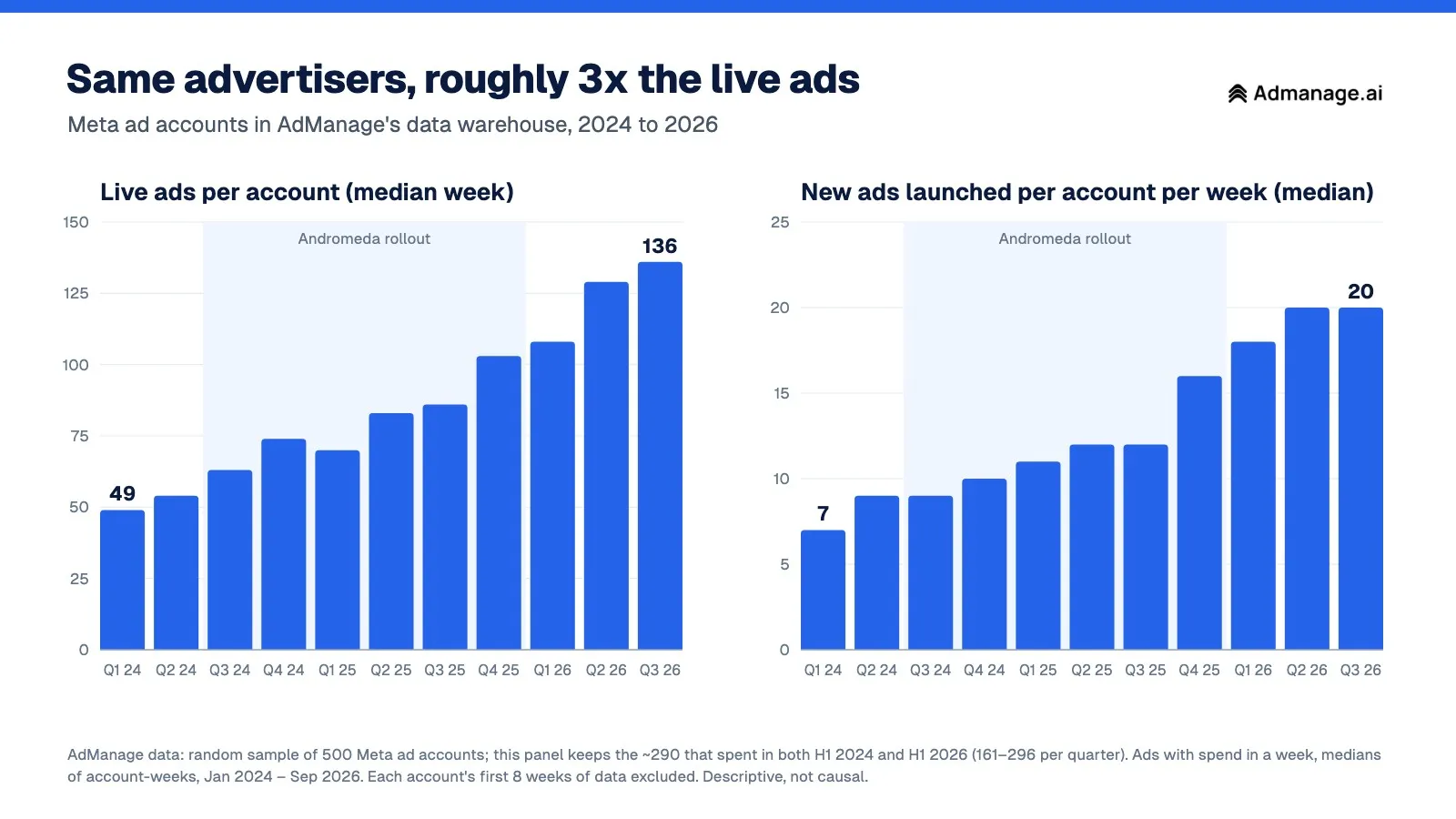
Source: AdManage data, random sample of 500 Meta ad accounts, panel of about 300 that spent in both periods (161–296 per quarter), weeks from January 2024 to September 2026.
Between Q1 2024 and Q3 2026, the median account went from 49 to 136 ads with spend in a typical week, and from 7 to 20 new ads launched per week. Live ad sets rose from 12 to 19, and the median ad set went from 4 to 6 ads with spend. Advertisers are answering retrieval's appetite for options with volume.
Winning ads fatigue faster
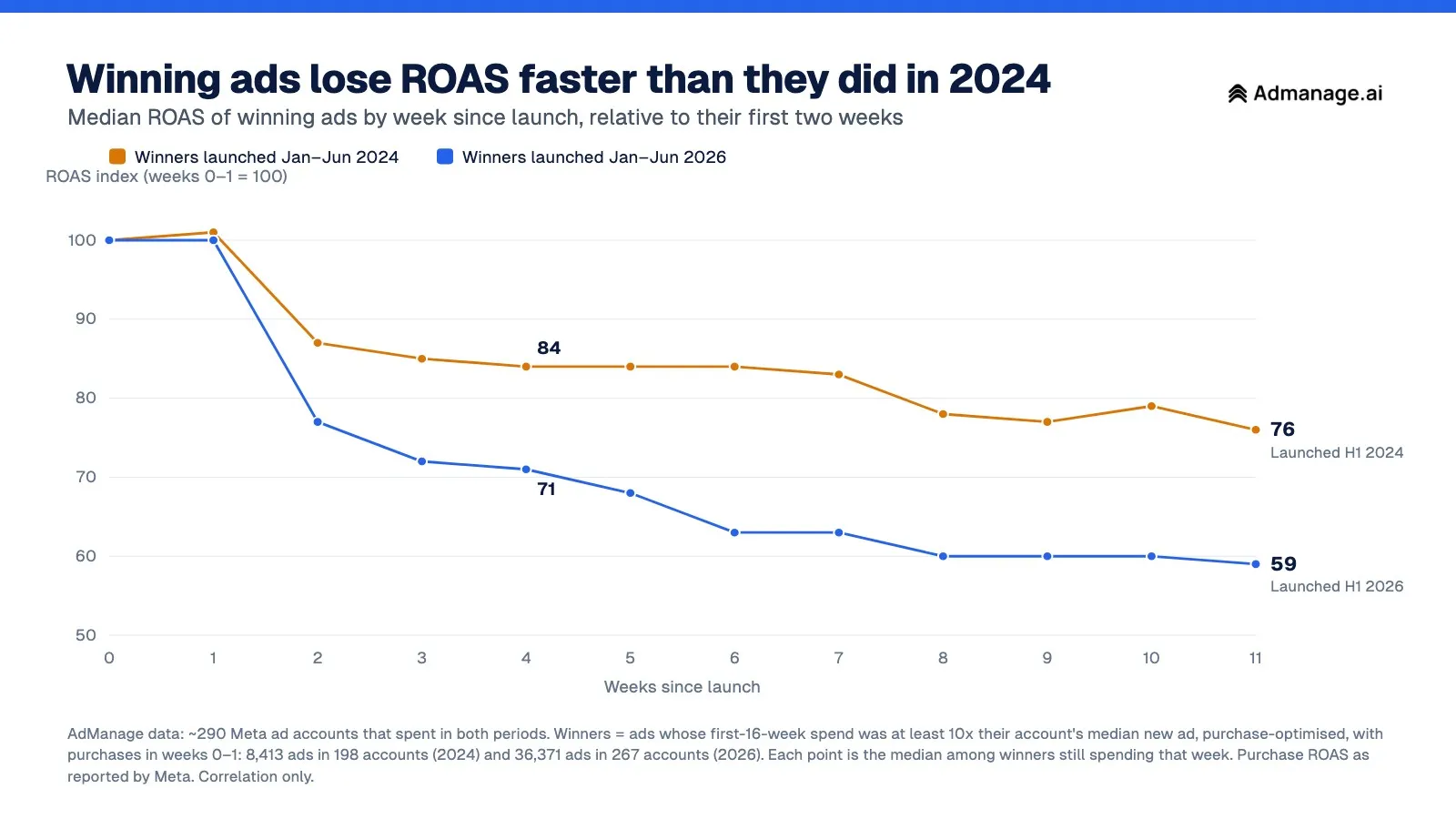
Source: AdManage data, about 300 Meta ad accounts. Winners are ads whose spend in their first 16 weeks was at least 10x their account's median new ad, optimised for purchases, with purchases in weeks 0–1: 8,413 ads in 198 accounts (2024) and 36,371 ads in 267 accounts (2026).
| Ads launched January–June | 2024 | 2026 |
|---|---|---|
| Ads launched (sample) | 94,313 in 230 accounts | 414,260 in 298 accounts |
| Ads that spent in only one week (of their first 16) | 28% | 37% |
| Median weeks with spend, winners (of first 16) | 5 | 3 |
| Winners' ROAS at week 4 vs weeks 0–1 (median) | 84% | 71% |
| Winners' ROAS at week 11 vs weeks 0–1 (median) | 76% | 59% |
Winners now earn their best return in the first two weeks and fall off faster, and a bigger share of new ads barely spend at all. Both fit the retrieval picture: delivery finds an ad's best audience quickly and moves on.
More ads per ad set does not, on its own, change ROAS
| Ads with spend in the ad set that week | Median ROAS index, H1 2024 | Median ROAS index, H1 2026 | Ad set-weeks (2026) |
|---|---|---|---|
| 1 | 0.93 | 0.99 | 6,079 |
| 2–3 | 0.90 | 0.93 | 9,655 |
| 4–6 | 0.91 | 0.92 | 12,786 |
| 7–10 | 0.93 | 0.94 | 9,679 |
| 11–20 | 0.97 | 0.95 | 9,902 |
| 21+ | 0.98 | 0.98 | 6,070 |
ROAS index = the ad set's ROAS that week divided by its account's ROAS that week (1.00 = account average; medians sit just below 1 because higher-spending ad sets tend to have higher ROAS and weigh more in the account average). Purchase-optimised ad sets with at least 2% of their account's weekly spend, same panel of about 300 accounts.
The index barely moves from 1 ad to 21+. Large ad sets did not do worse, but they did not clearly do better either. What an ad set contains matters more than how many ads it holds, which is the argument for counting concepts rather than ads.
How to read these numbers
- Correlation, not causation. Meta changed far more than retrieval between 2024 and 2026: ranking models, Advantage+ campaign structure, attribution and reporting. These charts show what changed alongside Andromeda, not what Andromeda caused.
- The sample is AdManage's. It covers accounts connected to our reporting, which lean towards high-volume advertisers. It is not a random sample of all Meta advertisers.
- Following the same accounts has a cost. Requiring spend in both periods leaves out advertisers who stopped or started in between.
- ROAS is Meta-reported purchase ROAS at each account's attribution setting. We compare ratios within accounts and ads rather than absolute ROAS.
What to change in account structure
None of this needs a dramatic rebuild. These are the changes that follow from how retrieval works:
- Consolidate. Fewer campaigns and ad sets, each with enough budget to clear about 50 conversions a week. Merge ad sets that differ only by interest or lookalike. See how many ad sets per campaign and CBO vs ABO.
- Go broad in prospecting. Use location, age and exclusions as boundaries, and let the creative mix find people. Keep a separate retention or existing-customer budget only where the economics clearly differ.
- Organise by concept, not by audience. Ad names and reporting should tell you which concept, format, persona and hook an ad belongs to, so you can read results at the concept level. A consistent naming convention is what makes that possible.
- Decide where testing happens. Two patterns work. Launch new concepts straight into the main campaign and let delivery decide (simplest, but new ads compete with proven ones). Or run a dedicated testing campaign with fixed budget, then graduate winners into the main campaign (cleaner reads, more setup). Either way, keep winners running under their original post where you can.
- Keep social proof when you scale. Moving a winning ad by its Post ID keeps its likes and comments, instead of starting a fresh post from zero. Our guide to preserving social proof when scaling explains the mechanics.
- Review creative enhancements deliberately. Advantage+ creative enhancements can add more variety for retrieval to work with, and Meta reports gains from features like image generation. Decide which ones suit each brand and account, then apply that choice consistently on every launch.
What to change in the creative testing cadence
Meta's November 2024 guidance gives a simple frame: launch new ads weekly, put 20–30% of budget toward testing, and hold a weekly review between buyers and creative. One of Meta's own examples, Dribbleup, went from three or four new creatives a week to almost 50 while holding performance steady (Meta for Business).
A cadence that fits retrieval looks like this:
| When | What happens |
|---|---|
| Monday | Review last week at concept level: which concepts earned spend, which fatigued, which never got retrieved |
| Tuesday | Brief 3–10 new concepts (not variations) against open gaps: unused formats, personas, angles |
| Wed–Thu | Produce. Build each concept in every placement ratio you run (9:16, 4:5, 1:1) |
| Thursday | Launch the batch. Do not edit for 3–4 days |
| Following week | Cut concepts that did not earn delivery, iterate on the 1–2 that did with 3–5 variations each |
Two rules make this cadence work. First, judge concepts, not ads: a concept that earned no delivery after a fair spend probably did not clear retrieval, which is information in itself. Second, iterate only on winners: variations are the right tool once a concept has proven it reaches people. They are the wrong tool for finding new ones. For frameworks, see our Meta creative testing framework and Meta ad testing guide.
Where launch volume becomes an operations problem
Here is the arithmetic that most Andromeda advice skips. Say a brand launches eight distinct concepts a week, each in three placement ratios, with three primary texts and two headlines, into two ad accounts. That is 24 media files and 16 ads to build, each with the right file in the right placement slot, five pieces of copy, a URL, UTM parameters, an ad name, an identity, enhancement settings and a destination. Double the concepts for Q4 and it is a full day of setup a week, before anyone has looked at results.
The cost is not only time. Manual setup at that volume is where the quiet errors come from: a 4:5 file in the Reels slot, a missing UTM, a name that breaks your concept-level reporting, an enhancement left on for a brand that cannot use it. Those errors corrupt exactly the data you need to judge concepts.
We see the same pattern in our own data. Over the last 90 days, 91% of the roughly 2.68 million ads launched through AdManage went to Meta, across about 1,000 companies. Teams are not asking for more channels first. They are asking to get more distinct Meta ads live, correctly, every week.
This is the part AdManage is built for:
- Bulk launching. Launch hundreds of ads from a Google Drive or Dropbox folder, a Google Sheet or the bulk launcher, into new or existing campaigns and ad sets. See our Facebook ads bulk upload guide.
- Auto-grouping placement formats. Name files with a shared base name and a 9x16, 4x5 or 1x1 tag, and AdManage groups the placements into one ad automatically.
- Post IDs. Relaunch existing posts and ads into new ad sets with their social proof intact.
- Naming and UTMs. Apply naming conventions and UTM templates to every ad, so concept-level reporting works without cleanup.
- Enhancement presets. Save your creative enhancement choices per ad account and apply them on every launch.
- MCP. Brief, build and launch from Claude or ChatGPT with the AdManage MCP, using the same templates and guardrails.
The goal is not more ads for their own sake. It is to make the weekly concept cadence cheap enough that your team spends its time on briefs and analysis, not on setup.
FAQ
What is Meta Andromeda in simple terms?
Andromeda is the part of Meta's ad system that picks a few thousand possible ads for each person out of tens of millions. Only those candidates go on to ranking and the auction. It uses a much larger AI model than before, so it matches ads to people based largely on what the ad itself shows and says.
Is Andromeda the same as the Meta ads algorithm?
It is one part of it. Meta's delivery has a retrieval stage (Andromeda), a ranking stage (models such as GEM and Lattice) and the auction. People often say "the Andromeda update" to mean the whole shift towards creative-led delivery, but technically Andromeda is retrieval.
When did the Andromeda update roll out?
Meta announced Andromeda in December 2024 and says it began introducing the architecture in the second half of 2024. It expanded to Facebook Reels in Q2 2025, and practitioner data puts full rollout around October 2025. Meta has continued to upgrade it through 2026.
Does Meta Andromeda penalise similar ads?
Meta has not documented a penalty or a similarity score. Its retrieval design groups ads the model sees as alike, so similar ads tend to be retrieved for the same people and compete with each other. The effect is less a penalty than a lack of new reach.
How many ads should I put in an ad set after Andromeda?
Enough distinct concepts to give retrieval options, but no more than the budget can evaluate. Meta recommends at least 20 diversified ads in Advantage+ shopping campaigns, while its older guidance for other campaigns is six or fewer per ad set. Size ad sets so each gets roughly 50 conversions a week, and count concepts rather than variations.
Does audience targeting still matter?
Yes, as boundaries: location, age floors, exclusions and placements. Narrow interest targeting matters much less, because retrieval matches creative to people directly. Most prospecting now works best broad, with the creative mix doing the segmenting.
Do ad sets with more ads get better ROAS?
Not in our data. Across about 300 Meta ad accounts in H1 2026, ad sets with 21+ ads had about the same ROAS compared with their account as ad sets with 2–3. How distinct the ads are matters more than how many there are.
What is the difference between Andromeda, GEM and Lattice?
Andromeda is retrieval: it chooses the candidates. GEM is Meta's large ranking foundation model, which teaches the smaller models that score ads. Lattice is an architecture that replaced many small ranking models with larger shared ones. All three were built to handle more ads and more creative variety.
How often should I launch new creatives?
Weekly is Meta's own recommendation, with 20–30% of budget going to testing. The number depends on budget: launch as many distinct concepts as your ad sets can give a fair read in a week, then iterate on the ones that earn delivery.
Sources
Meta (primary sources)
- Meta Andromeda: Supercharging Advantage+ automation with the next-gen personalized ads retrieval engine, Engineering at Meta, 2 December 2024. Source of the screenshots in this post.
- The Creative Advantage: Unlocking the Power of Diversification with Meta Andromeda, Meta for Business, April 2025
- Three steps to optimize your performance with creative diversification, Meta for Business, November 2024
- Meta's Generative Ads Model (GEM): Scaling the central model and compute engine for frontier ads AI, Engineering at Meta, 13 October 2026
- GenRecs Tokenization: Transforming Ads Recommendation at Meta with Stable Model Vocabulary, Engineering at Meta, 19 October 2026
- New AI advancements drive Meta's ads system performance and efficiency, Meta AI, May 2023
- Q2 2025 earnings call transcript and Q3 2026 earnings call transcript, Meta Investor Relations
- About ad auctions, Meta Business Help Center
Practitioner and vendor analyses (directional)
- Meta Andromeda: the ultimate guide to Meta Ads in 2026, Confect. Study of 3,014 ecommerce advertisers using Confect in 2025; vendor data, top and bottom groups defined by ROAS.
- Meta Ads Creative Testing: The 5% Rule, Alex Neiman. Cites Motion's dataset of about 550,000 ads, plus the author's data from six DTC brands.
- Meta Andromeda and Creative Diversification: 7 Examples Explained, Jon Loomer
- Meta says ad sets under 50 weekly conversions cost 28% more per purchase, PPC Land, October 2026
- Facebook to introduce ad limits per Page and Meta drops 250-ad Page cap in some accounts, PPC Land
AdManage data
- Live-ads, fatigue and ad-set analyses: AdManage's ad-level Meta insights warehouse, random sample of 500 ad accounts, panel of about 300 that spent in both January–June 2024 and January–June 2026, weeks from January 2024 to October 2026. Queried 28 October 2026, aggregated, with no account identified. Correlational.
- Share of ads launched to Meta: AdManage launch records, last 90 days to 28 October 2026, about 2.68 million ads across about 1,000 companies. Aggregate only; no customer is identified.
Run the Andromeda cadence without the setup work
AdManage lets performance teams launch hundreds of distinct Meta ads in minutes from a folder or spreadsheet, with placements grouped, Post IDs reused, and naming, UTMs and enhancements applied the same way every time. Read our guide to launching 1,000 Facebook ads in a day, or start a free trial.