
TikTok has several view metrics: the public count on a post, content analytics, profile visits and Ads Manager video metrics. Check which one you are reading before comparing numbers. A video view is not automatically a unique person, a profile visit or a qualified monetisation view.
Quick distinction: watching a video and visiting a profile are different actions. Video and profile view-history features also have separate settings and eligibility rules.
This guide separates the published ad metric definitions from public post-count behaviour, where TikTok does not publish every filtering rule. It also explains what can and cannot be inferred from replays and self-watching.
For ads, TikTok defines “video views” as starts of playback per impression, excluding replays. Two-second, six-second and focused views have different definitions. Do not apply one ad metric definition to every organic post counter or rewards programme.
Use the definitions below with the metric name in your report. Where the public counter’s exact rule is undocumented, avoid relying on a precise threshold or trying to manufacture views.
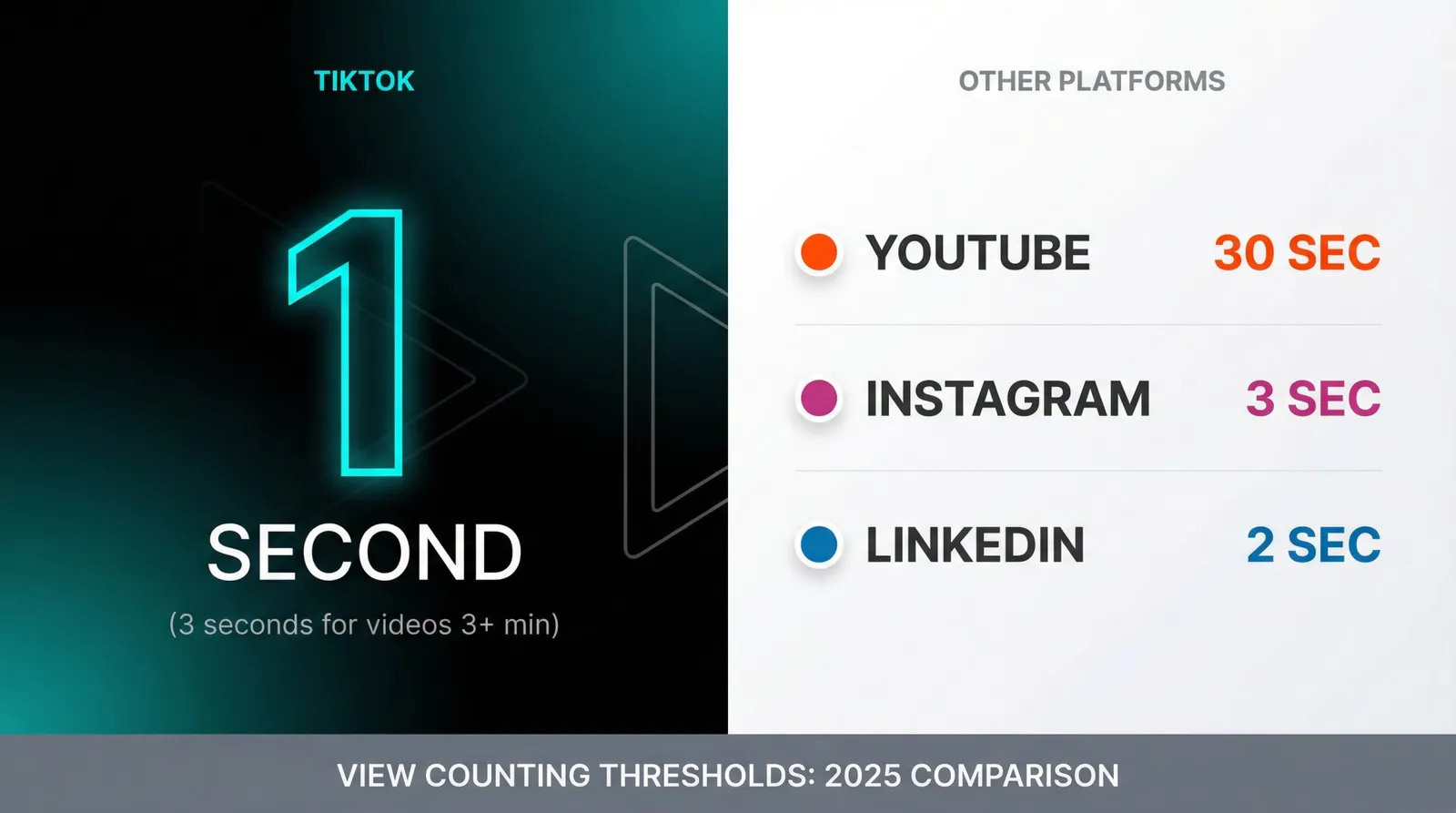
What Counts as a View on TikTok?
The answer depends on the metric. An Ads Manager video view records a start of playback. A public post count, a unique-viewer metric and a programme’s qualified views can follow different rules.
There is no single watch-time threshold that safely describes every TikTok view surface. Keep the report’s metric label with the number.
TikTok’s official video play metrics reference defines the ad metrics. It should be your reference for paid campaign reporting rather than a general claim that every view requires one second.
A playback count alone does not establish attention or intent. Pair it with watch duration, completion, engagement and the relevant conversion outcome.
This article does not establish a separate three-second rule for all organic videos longer than three minutes. Use the documented definition for the metric or programme you are measuring.
How Long Do You Have to Watch a TikTok for It to Count as a View?
For paid reporting, distinguish a video start from a two-second or six-second view. For an organic public counter, TikTok’s ad glossary does not establish a universal minimum duration. Avoid treating an unverified one-second rule as a guarantee.
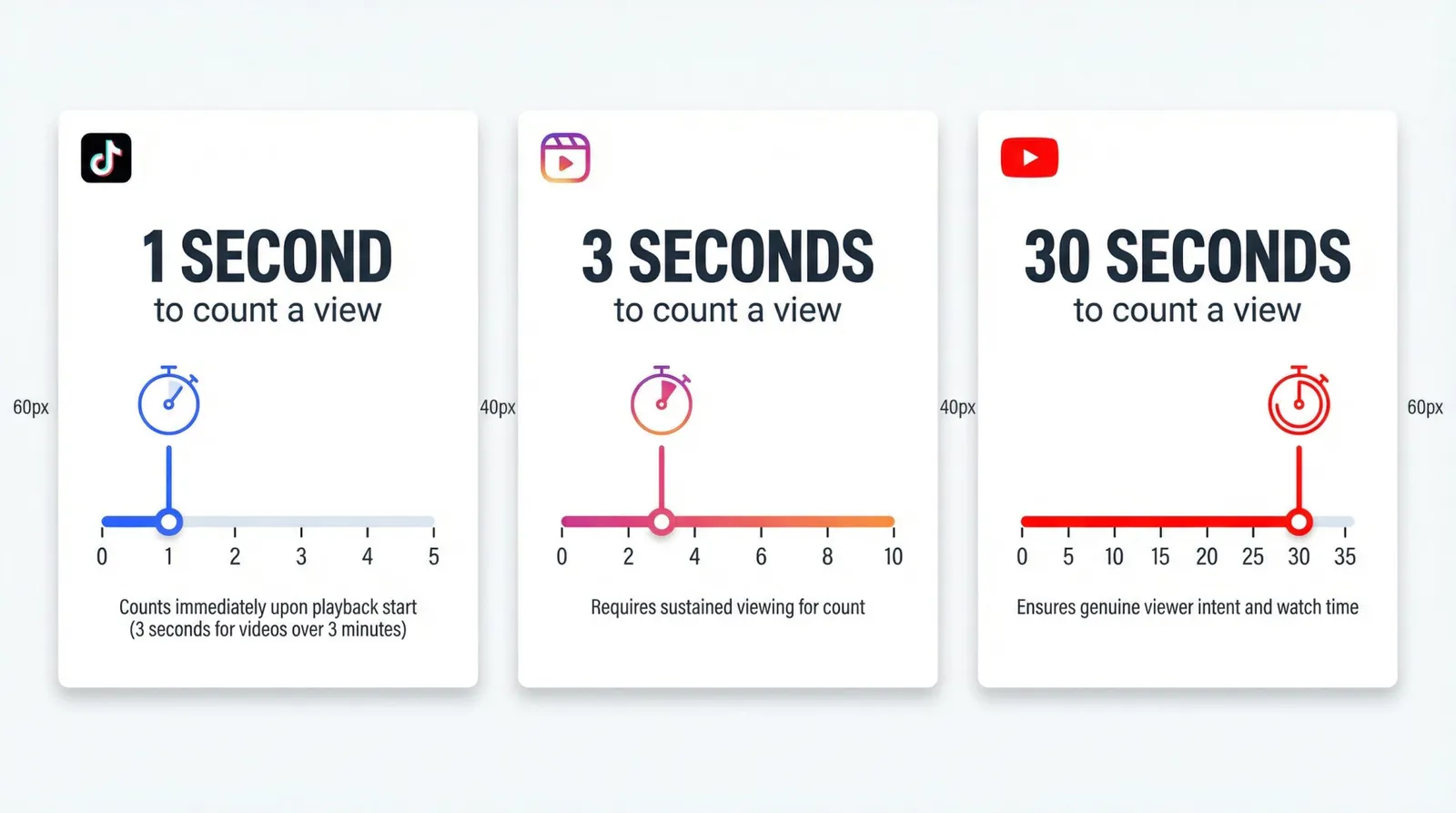
Compare metrics with the same definition. An impression, a playback start, a completed watch and a unique viewer each answer a different question.
TikTok View Metrics Compared
Use this table to identify the metric before comparing reports.
| Metric | What to check | Interpretation |
|---|---|---|
| Public post views | Post counter and content analytics | Do not assume each view is a distinct person |
| Ad video views | Playback starts per impression; replays excluded | Use the Ads Manager definition |
| 2-second ad views | At least two seconds in an impression session | A stricter metric than playback starts |
| 6-second ad views |
Two reports can both be accurate while measuring different events. Keep definitions, date range and paid-versus-organic status aligned.
Cross-platform comparisons need the same care. Do not assume every YouTube, Instagram or TikTok format uses a single fixed view threshold.
For a campaign comparison, use equivalent watch-duration metrics where available and report conversion outcomes separately. Raw view totals alone are not an efficiency comparison.
What Counts as a Qualified View for Creator Rewards?
TikTok’s Creator Academy guide, updated 18 August 2026, separates qualified views from a post’s public counter. It specifies a five-second watch requirement, one counted view per account, and exclusions for paid, fraudulent and disliked views. It also includes eligible Search views watched for at least 30 seconds.
The guide lists eligible viewing regions: the United States, Mexico, Brazil, South Korea, Japan, Germany, the United Kingdom and France. Ads, paid promotions, sponsored content and View Boost Benefit views do not qualify under those rules. Check the current programme guidance for your own eligibility.
For example, 10,000 public views do not automatically mean 10,000 qualified views or a fixed payment. Neither the five-second programme rule nor the Search threshold should be applied as a universal definition of every organic video view.
Does Watching Your Own TikTok Count as a View?
Do not count self-watching as an audience-growth strategy. TikTok does not provide a universal public-counter filtering specification here that would justify a precise guarantee for every self-view.
Public counts can be delayed or adjusted, and a small counter change is not a controlled test of filtering. Use audience and content analytics to evaluate genuine distribution.
A different account or device does not guarantee that a play is a valid or monetisable view. Programme rules and invalid-traffic checks can differ from the public counter.
For paid reports, use the platform’s documented metric definition and avoid using repeated manual plays to validate campaign reach.
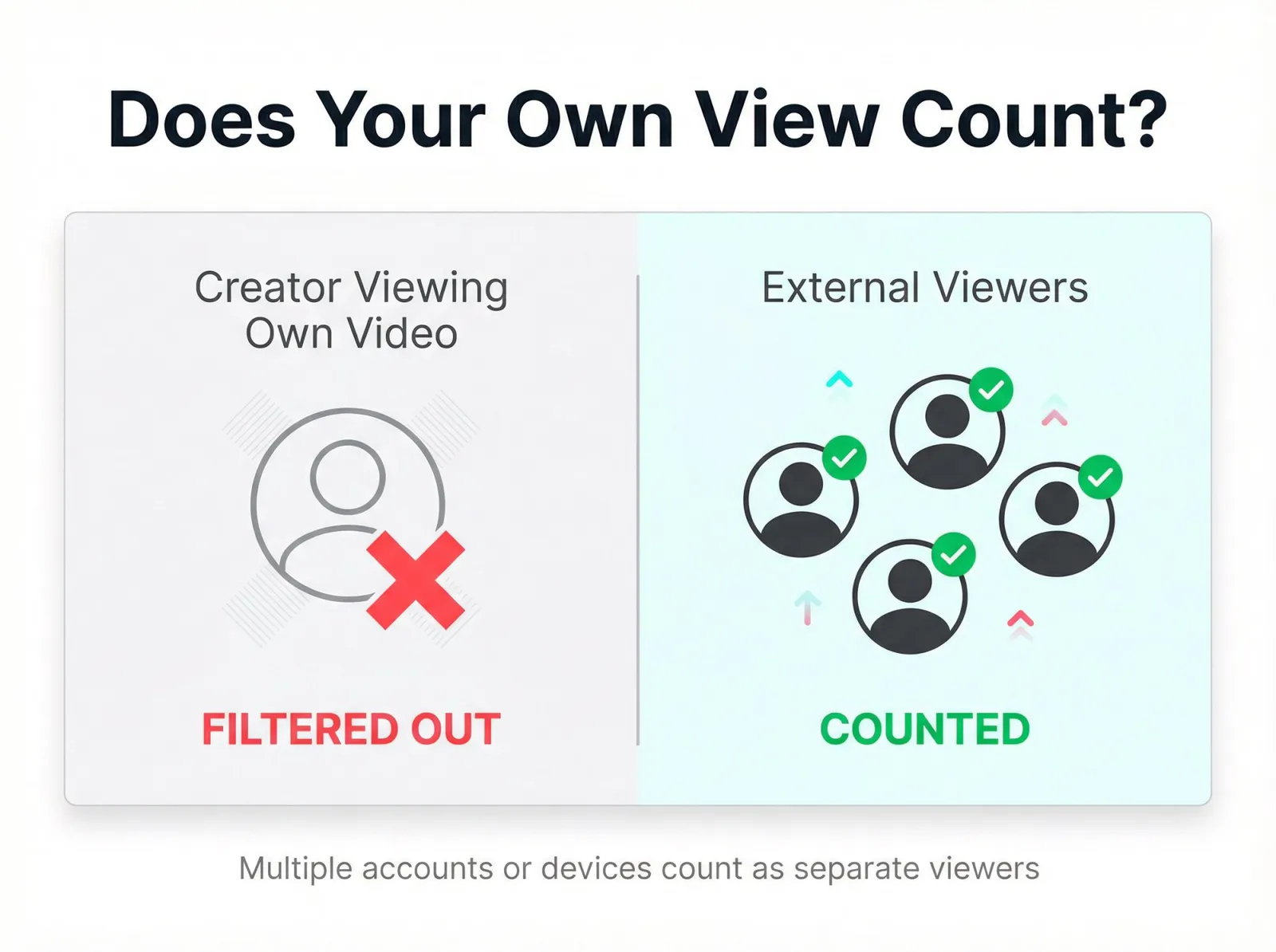
To review your content, preview it normally. To assess performance, use a consistent reporting window and the available viewer and engagement data.
Does Watching a TikTok Count as a Profile View?
Quick answer: No. Watching someone's video counts as a video view, not a profile view. Those are two separate metrics on TikTok.
A profile view is counted only when someone actually taps through to your profile page and lands on your grid. Scrolling past your clip in the For You feed, or watching it all the way through, never registers as a profile visit. So the person has to make the extra move of clicking your username or avatar to open your profile.
TikTok provides separate profile and post view-history controls. Its post view-history help page describes when some viewers may be visible. A public view total is not a complete list of viewer identities.
For marketers, profile visits can indicate further interest after a video, but neither a view nor a profile visit proves purchase intent. Measure the next relevant action.
Do Replays and Loops Count as Views on TikTok?
Repeat viewing can make total plays differ from distinct viewers, but do not assume every rapid organic loop is guaranteed to add a valid view.
For Ads Manager video views, TikTok explicitly excludes replays within the impression. That paid definition differs from common claims about organic loops.
Use unique-viewer data where available when your question is how many people watched. Use play time and retention when your question is how much attention the content received.
TikTok does not publish every public-counter filter in the sources used here. An undocumented cap or a guaranteed unlimited-loop rule would be speculation.
Repeated playback should therefore be interpreted using the particular report and its definition, not as a method for increasing reach.
What Is the Difference Between Unique Viewers and Total Views?
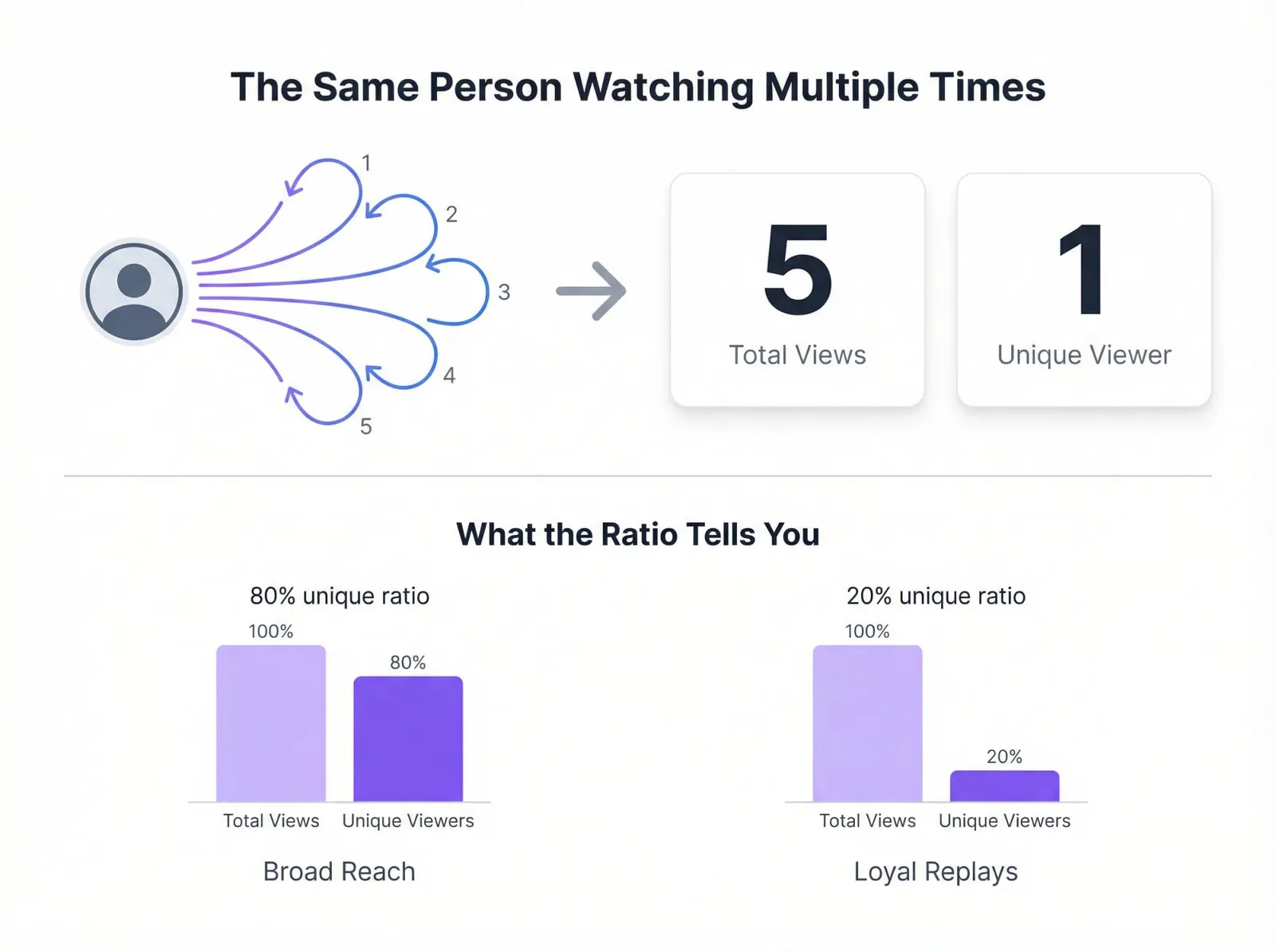
Total views and distinct viewers measure different things. The difference depends on the report definition, rather than a guaranteed number of counted replays.
In an illustrative analytics system that counts repeats, one person could generate five plays and one unique viewer. Check whether the specific TikTok metric you use includes those repeats.
For organic analytics, use TikTok Studio in the main app. The retired Pro account label is not the current setup requirement. Available metrics and reporting periods can vary.
Open Profile → Menu → TikTok Studio → Analytics and inspect the post-level metrics available for your account.
Key pattern: The ratio between unique viewers and total views tells you something important. A high proportion of unique viewers means you're reaching a broad audience. A low unique-to-total ratio means the same fans are watching multiple times. Both scenarios can be valuable, but they mean different things for your strategy.
Why TikTok View Counts Look Higher Than Other Platforms
Autoplay, format and measurement definitions can change the relationship between views and attention. A higher raw count does not on its own establish better performance.
High view counts with low watch time are incredibly common on TikTok. You might see a video hit 100,000 views but have minimal likes, comments, or shares. This often means many users saw the start of your video and immediately swiped away. TikTok still counted those as views, even though viewers didn't stick around.
Inspect retention to find where people leave. A drop early in a video is a useful creative-testing signal, not proof of a fixed algorithmic cutoff.
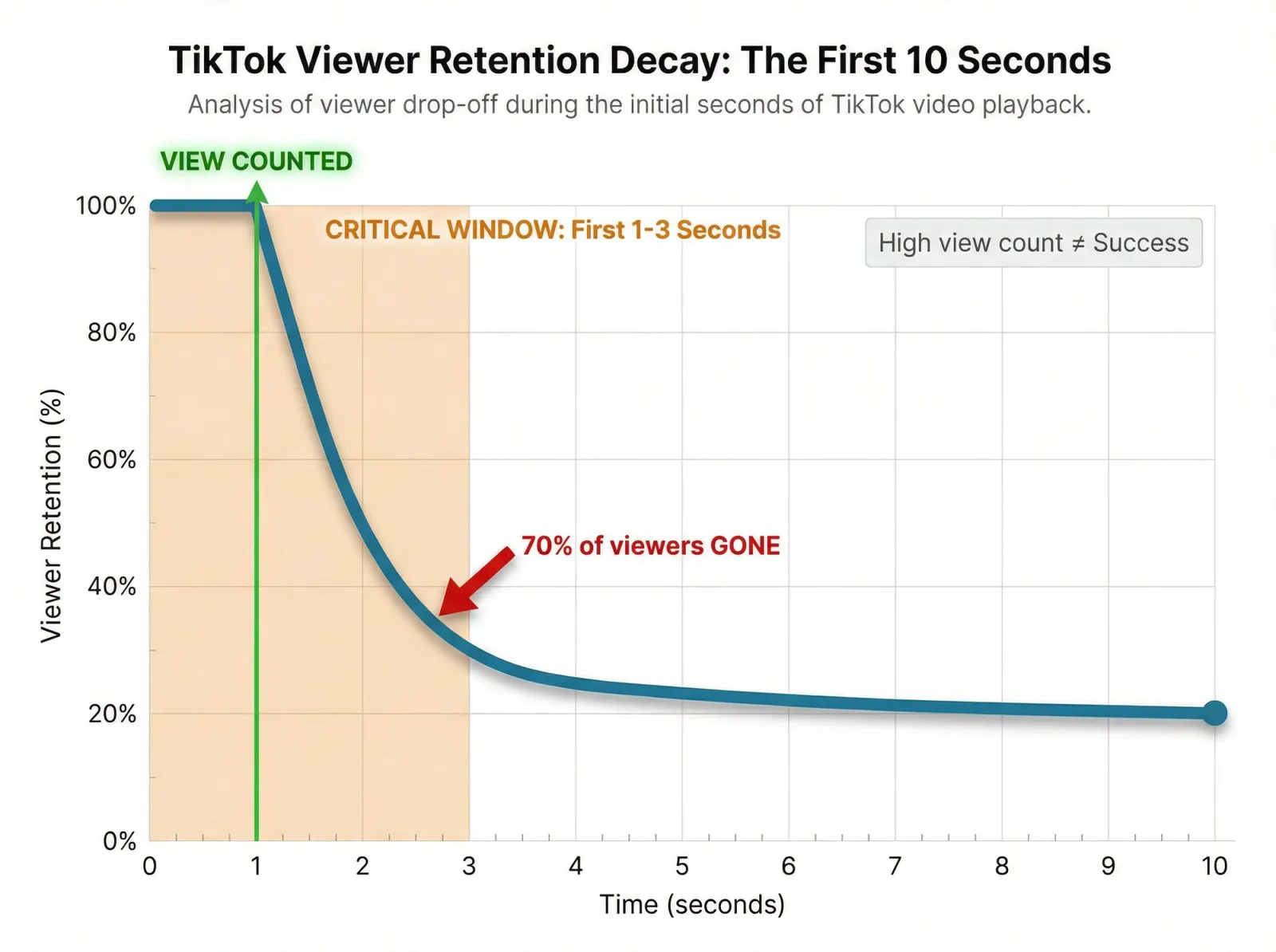
Critical insight: TikTok counts views liberally but rewards videos that hold attention. A high view count with low average watch time is a warning sign, not a success metric.
Why One TikTok View Doesn't Equal One YouTube View
One TikTok view is not automatically equivalent to one YouTube view. Compare the metric definitions for the particular format and report.
Avoid converting views between platforms using a made-up ratio. Compare watch duration, completion and conversion outcomes, or use our Facebook Ads vs TikTok Ads guide for the broader planning context.
This is why smart marketers track average watch time, completion rate, and engagement alongside raw view counts. You need the full picture.
Are TikTok Views Fake? Understanding Bot Traffic and View Quality
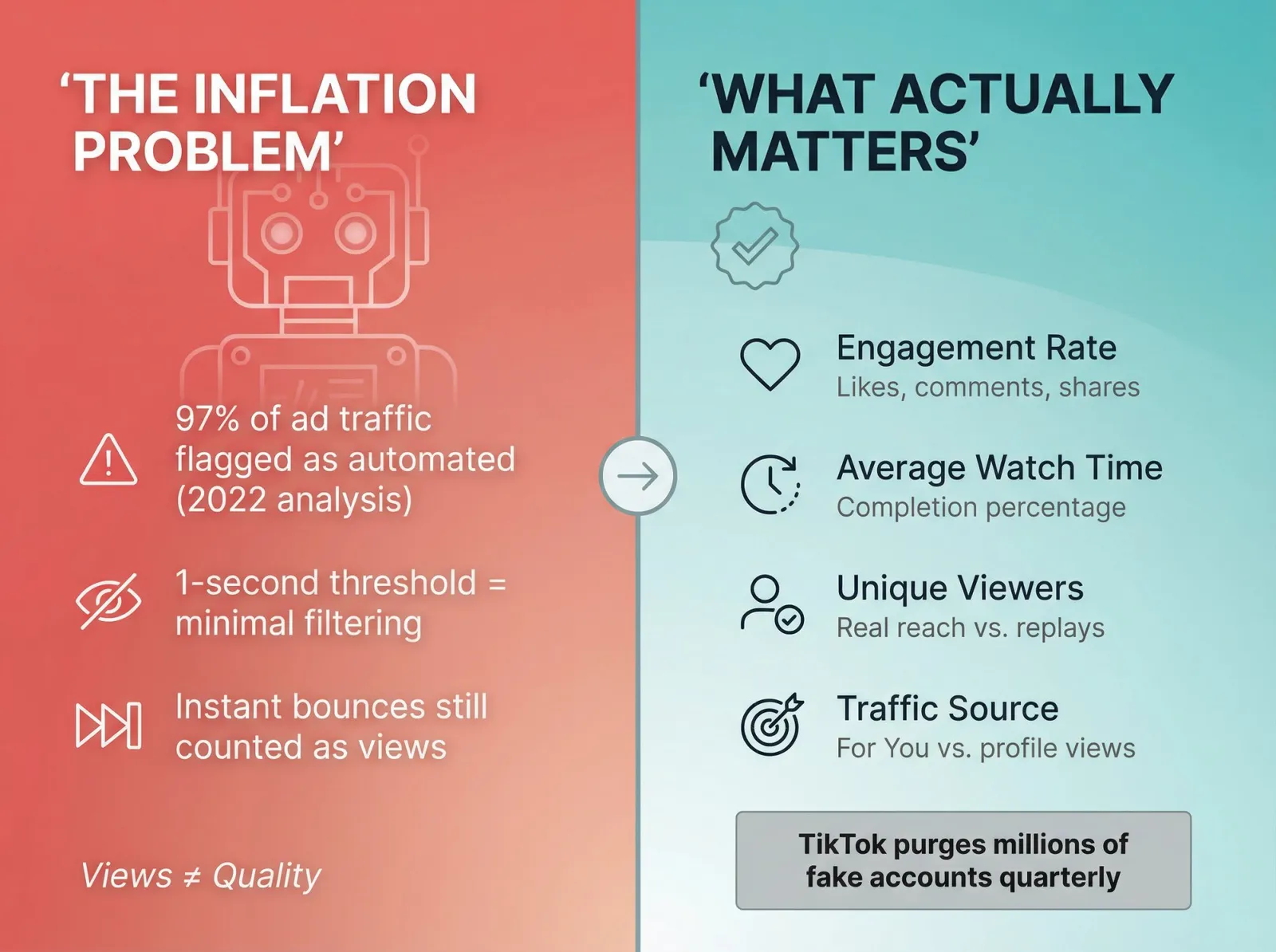
A view count alone cannot establish how much traffic is automated. Do not generalise a fraud estimate from a specific test to all TikTok traffic.
Investigate suspicious patterns using traffic sources, retention, engagement and downstream outcomes. A high count or a short watch duration by itself does not prove fraud.
The takeaway: Focus on engagement signals to see if your views came from real, interested people. Views alone don't prove anything about content quality or audience interest.
How Do TikTok Ad Views Work? Paid vs Organic View Counting
If you're running TikTok ads, the view counting rules get more nuanced. TikTok's advertising platform handles views differently from organic content, and if you're new to it, our walkthrough on how to use TikTok Ads Manager covers the setup.
In TikTok Ads Manager, a video view for an ad is counted when the video starts playing, just like organic content. Replays or loops within the same ad impression don't count as additional views. This prevents double-counting in your performance metrics.
Ad views in reports are capped at one per viewer per exposure. If someone sees your ad and it loops because they lingered on it, TikTok counts that as one impression and one video view, not multiple views.
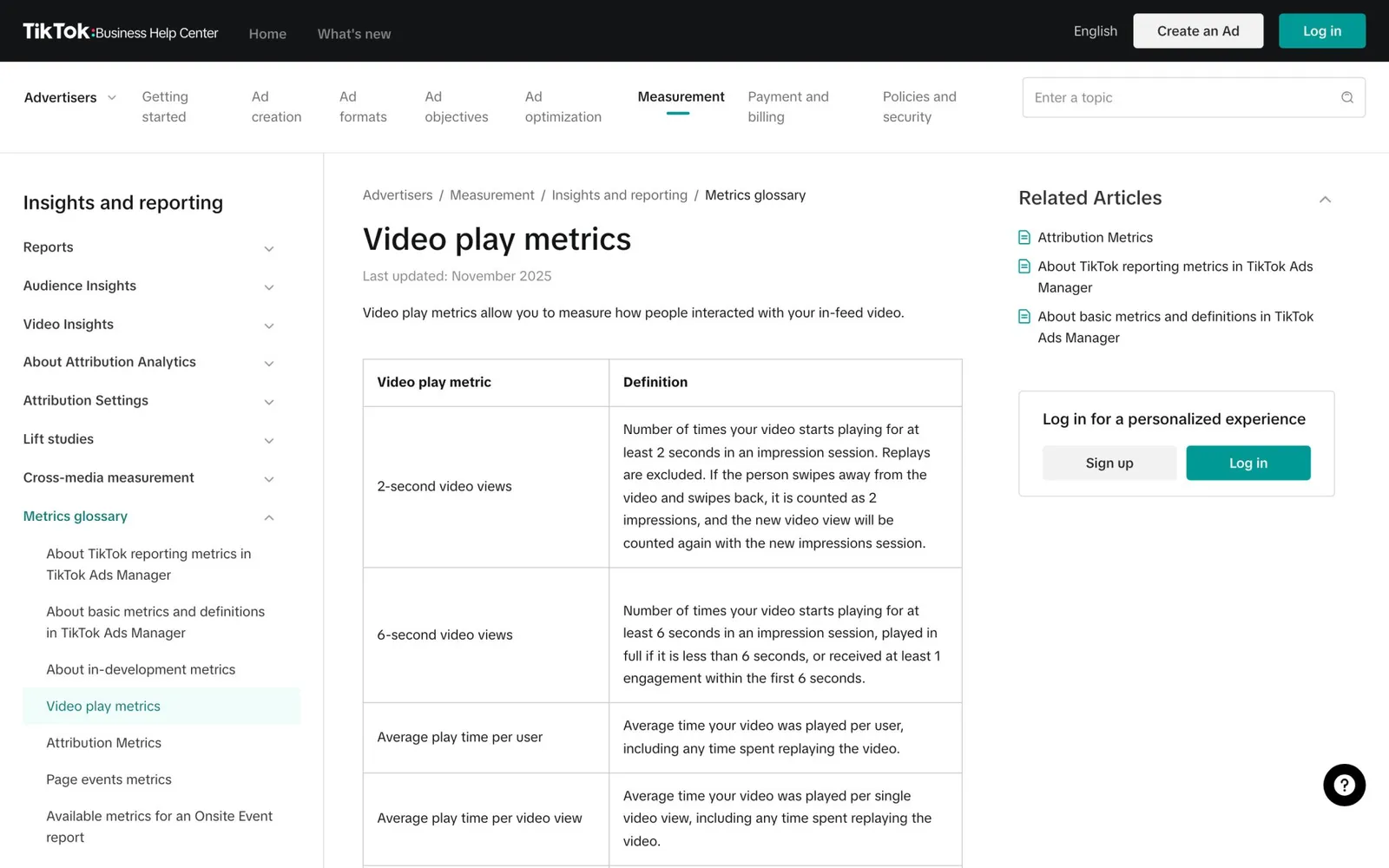
What TikTok Ad View Metrics Actually Mean
TikTok provides more granular data for ads to help you understand view quality. Common metrics include:
• 2-second views: how many times people watched at least 2 seconds
• Six-second ad views: consult the glossary for duration, completion and engagement conditions; the metric is not simply six seconds watched in every case.
• 100% completions: how many times people watched the entire ad
Do not label video views as impressions or infer rewatching from view rate alone. Keep the report’s definitions and denominators explicit when interpreting any difference.
What Are Focused Views on TikTok Ads?
TikTok’s video-views objective uses focused-view options. Review the current objective documentation for duration, interaction and billing conditions.
These are tracked as Focused Views with their own metrics (6-second focused views, 15-second focused views, etc.). The principle is to optimize for attentive views, not just instant impressions. This reflects TikTok's recognition that not all views are created equal.
How Do Spark Ads Views Work on TikTok?
Things get interesting for performance marketers with TikTok Spark Ads. Spark Ads are unique because they use an organic TikTok post as the ad creative. This could be your own post or a creator's post that you've gotten permission to promote.
The key difference: All the views and engagement from a Spark Ads campaign accumulate on the original video's public count. So if you take a TikTok with 10,000 organic views and run it as a Spark Ad, you might end up with 500,000 total views on that video after the campaign.
Those additional 490,000 views came from paid distribution, but they count on the video's public view total just like organic views. This is completely different from standard In-Feed ads, which use separate ad-only videos that don't appear on your profile.
Spark Ads can combine paid promotion with an existing post’s social proof. Keep paid and organic outcomes separate when evaluating the campaign.
For paid Spark Ads reporting, use the Ads Manager metric definition. Do not assume that public post totals and paid report totals count every replay in the same way.
How to Manage TikTok Ad Views at Scale with AdManage
If you're running serious TikTok ad campaigns (not just boosting one or two posts), you quickly run into operational challenges. Managing hundreds of ad variations, tracking performance across multiple accounts, maintaining consistent naming conventions, and preserving social proof through Post IDs becomes a massive time sink.
This is where AdManage comes in.
AdManage is built specifically for performance marketers who need to launch and test hundreds or thousands of ad variations across Meta and TikTok. Instead of manually creating each ad in TikTok Ads Manager (which takes about 10 minutes per ad, according to industry benchmarks), you can bulk-launch entire TikTok campaigns with consistent structure.
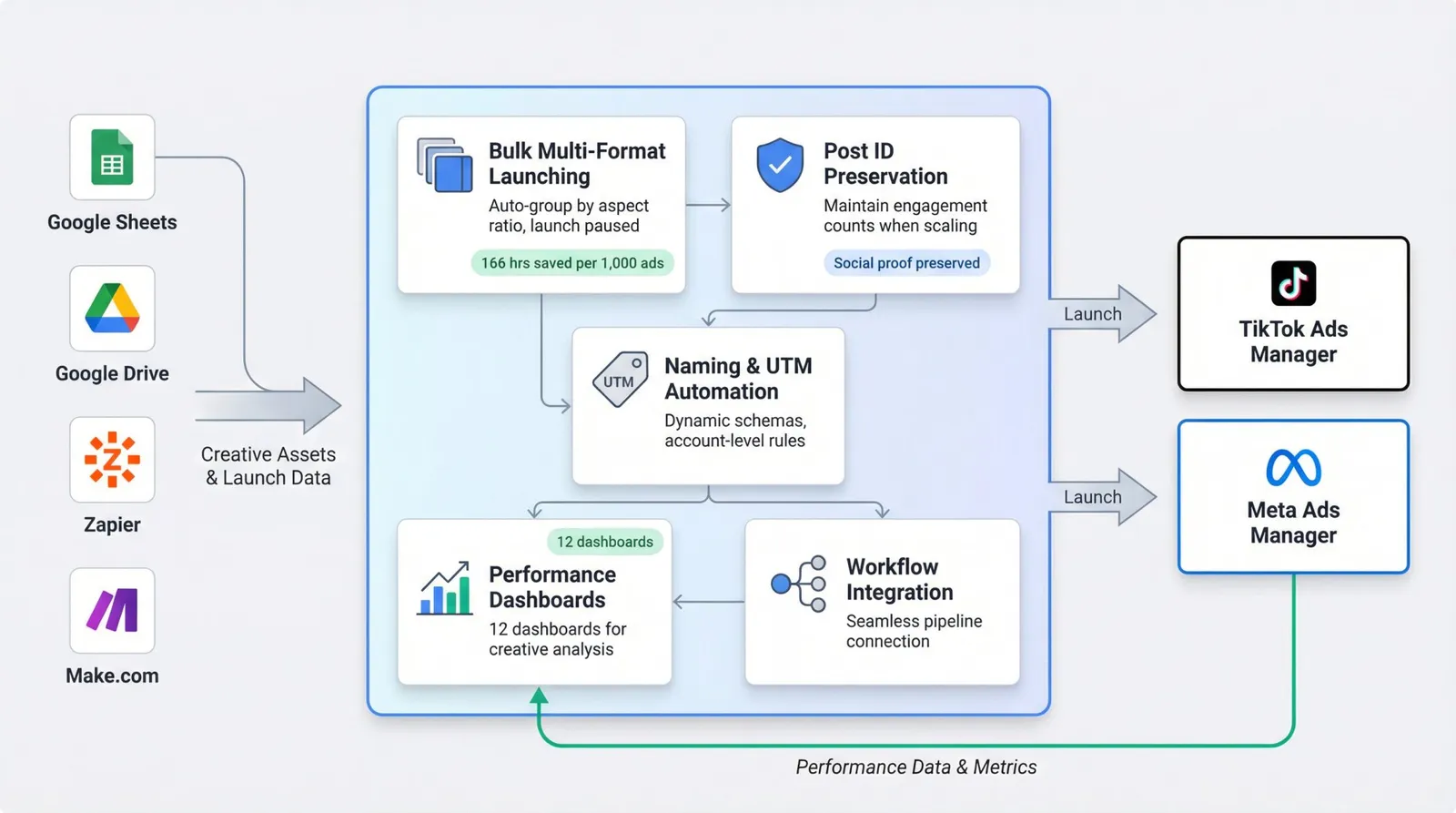
AdManage helps with TikTok specifically:
→ Bulk Multi-Format Launching
Push the same creative assets to TikTok in one batch. AdManage automatically groups creatives by aspect ratio and can launch ads in paused state for approval workflows.
→ Post ID Preservation
Just like Spark Ads build social proof by accumulating views on original posts, AdManage supports launching with Post IDs to preserve engagement counts when scaling winners. This is critical if you're trying to maintain authenticity while expanding reach.
→ Naming Conventions and UTM Management
Every ad needs consistent naming conventions for proper tracking. AdManage enforces dynamic naming schemas and account-level UTM rules, so you don't have to manually configure each variant.
→ Performance Dashboards
AdManage provides 12 dashboards for creative performance analysis. When you're tracking view metrics across dozens of TikTok campaigns, having a unified view of what's working (and what's not) is essential.
→ Integration with Your Workflow
Connect via Google Sheets, Drive, Zapier, or Make.com. AdManage fits into your existing creative pipeline instead of forcing you to adopt a new system.
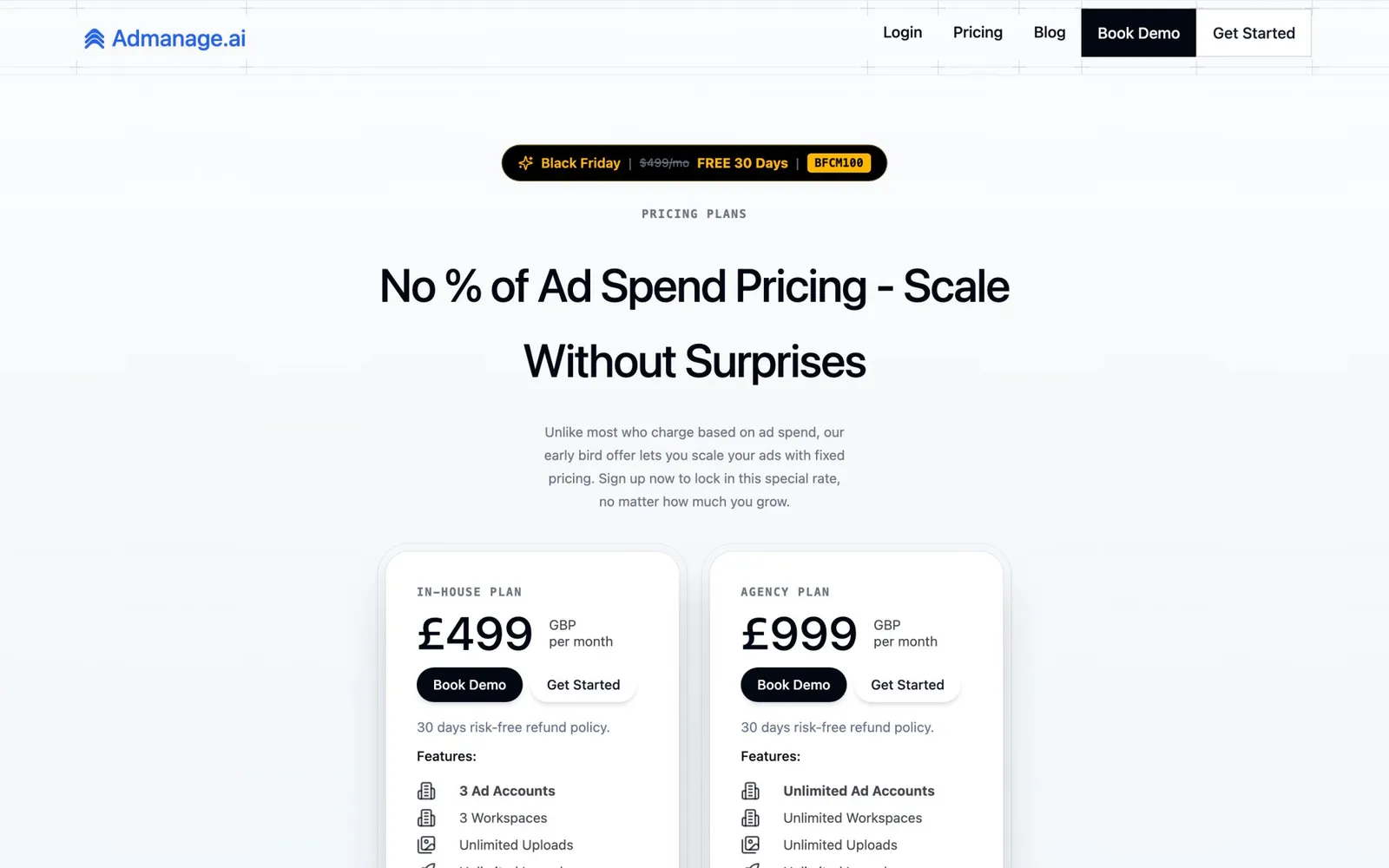
AdManage uses subscription pricing rather than a percentage of media spend. Evaluate any operational savings with your own launch timings, labor rate and the work still needed for preparation, review and error handling. A calculator scenario is not measured labor savings or guaranteed ROI. Check current plans and account allowances on the pricing page.
If you're trying to understand which ad variations are generating quality views (not just high view counts with low engagement), AdManage's reporting makes it easy to spot patterns across hundreds of tests.
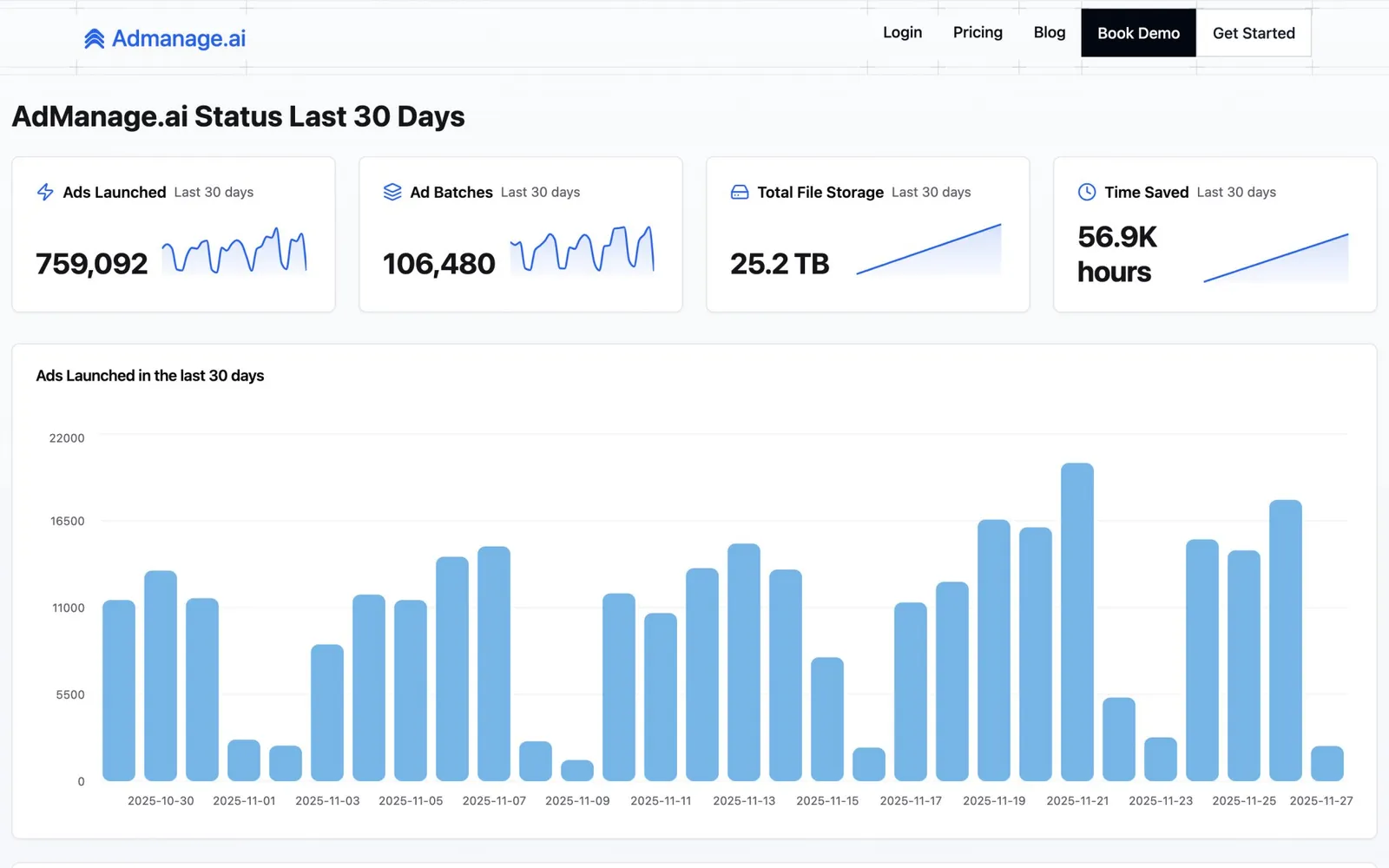
AdManage's live platform statistics show current launch activity. Rolling totals change, so check the live page for current figures. Any hours-saved total is an estimate based on a manual-work assumption, rather than measured labor saved for every advertiser.
What Metrics Matter More Than TikTok View Counts?
View counts are just one data point. If you're serious about TikTok performance, here are the metrics that actually matter:
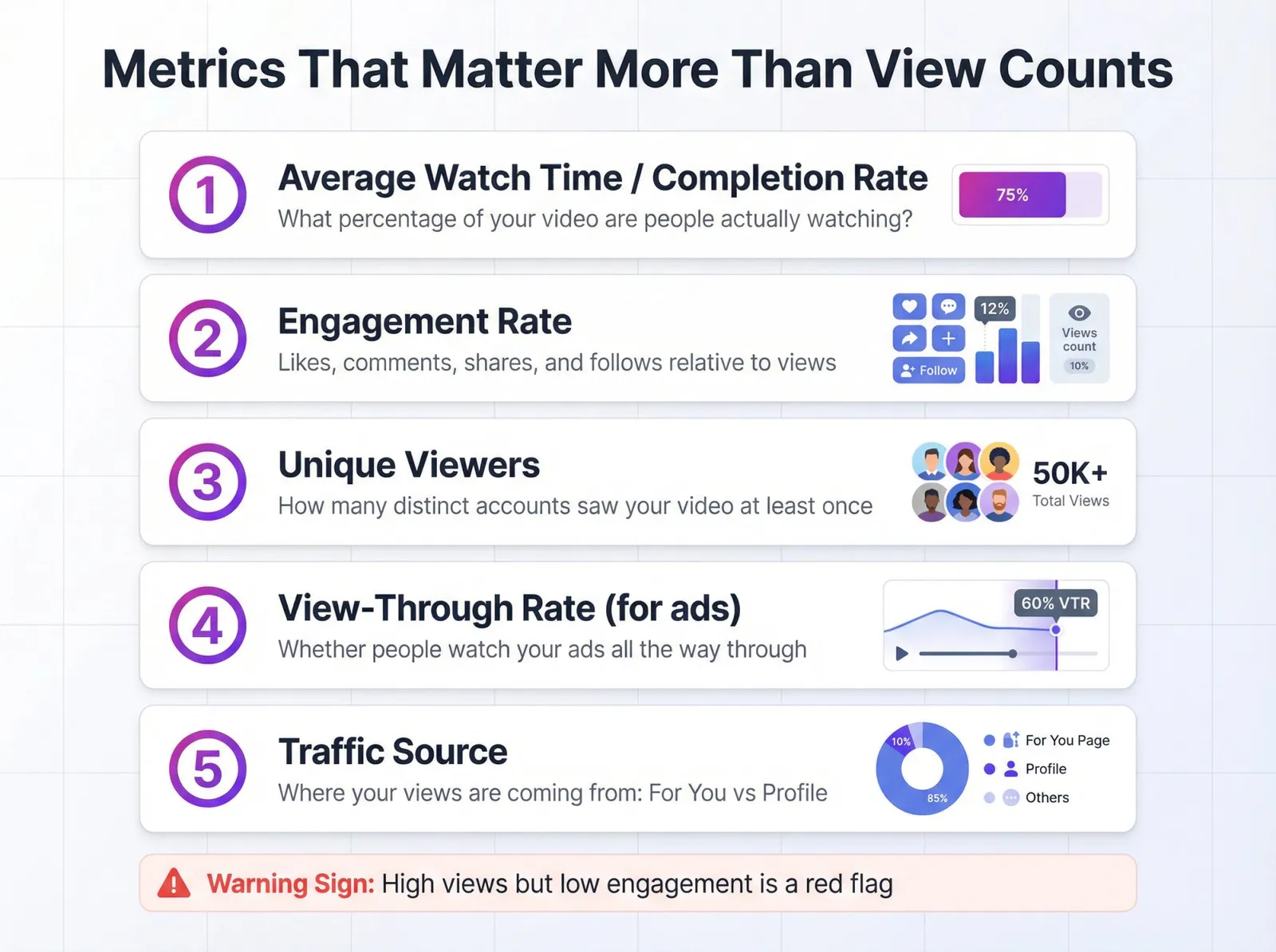
① Average Watch Time / Completion Rate
What percentage of your video are people actually watching? A video with 50,000 views and 20% average watch time is underperforming compared to one with 20,000 views and 70% watch time.
② Engagement Rate
Likes, comments, shares, and follows relative to views. This shows whether viewers found your content valuable enough to interact with it.
③ Unique Viewers
As we covered earlier, this tells you if you're reaching new people or just getting replays from existing fans.
④ View-Through Rate (for ads)
In Ads Manager, this shows whether people are watching your ads all the way through or dropping off immediately.
⑤ Traffic Source
Where are your views coming from? For You page views indicate algorithm success. Profile views suggest people are actively seeking your content.
Warning sign: When you see high views but low engagement, that's a red flag. It usually means your hook captured attention for the first second (generating the view count), but the content didn't deliver on that promise. TikTok's algorithm will notice this pattern and throttle your reach.
Common Questions About TikTok View Counts
Q: If someone scrolls past my TikTok almost immediately, does it still count as a view?
For Ads Manager, distinguish playback starts from duration-based metrics. A brief play is not evidence that someone watched the full message; organic counters should be interpreted separately.
Q: Does pausing or muting the video affect the view count?
Muted playback and pausing do not turn every metric into the same event. Use the specific metric definition and check actual play time or completion when attention matters.
Q: If a video is embedded outside TikTok or shared via link, do those views count?
For shared links and embeds, check the post’s analytics and the metric you are reporting. A link click, an embed loading and a video actually playing are different events. Do not assume every external visit adds a valid public view.
Q: Does TikTok ever remove views or freeze view counts like YouTube does?
Public counters and analytics can refresh at different times and may be adjusted. A temporary pause or small drop does not identify the cause on its own. Check processing, visibility and account notices before drawing conclusions.
Q: How many views do I need to start making money on TikTok?
Monetisation programmes use their own eligibility and qualified-view rules, which can vary by region. A public view count alone cannot establish eligibility or payout; check the current programme terms inside TikTok.
Q: Do views matter for the TikTok algorithm?
Yes, but not in isolation. The algorithm cares about engagement rate and behavior signals. A view is just the first step. The algorithm pays much more attention to completion rate, re-watches, likes, shares, comments, and follows. High views with low engagement won't get algorithmic love.
Q: What's a "good" view count for my niche?
This varies wildly by niche, follower count, and content type. A small business account with 1,000 followers getting 5,000 views per video is doing extremely well. A lifestyle influencer with 100,000 followers would consider 5,000 views underperforming. For context on where the typical account lands, our breakdown of average TikTok views has real benchmarks. Focus on your engagement rate and growth trajectory rather than comparing raw numbers to others.
Q: How long does it take for views to update?
Counters and analytics can update on different schedules. If a post remains at zero, check visibility, processing and account notices before assuming a distribution penalty. See our guide to live TikTok follower counters.
Q: Can I see who viewed my video?
Some eligible accounts can use post view history to see certain viewers. The feature is conditional and does not expose every viewer; it is separate from profile view history.
Q: Why did my views suddenly stop increasing?
Check post visibility, processing and account notices, then compare analytics over a consistent period. A flat counter alone does not diagnose a shadowban or identify its cause.
How to Get More Views on TikTok: Proven Strategies
Understanding how views are counted is one thing. Getting more of them (and making them meaningful) is another. What actually works:
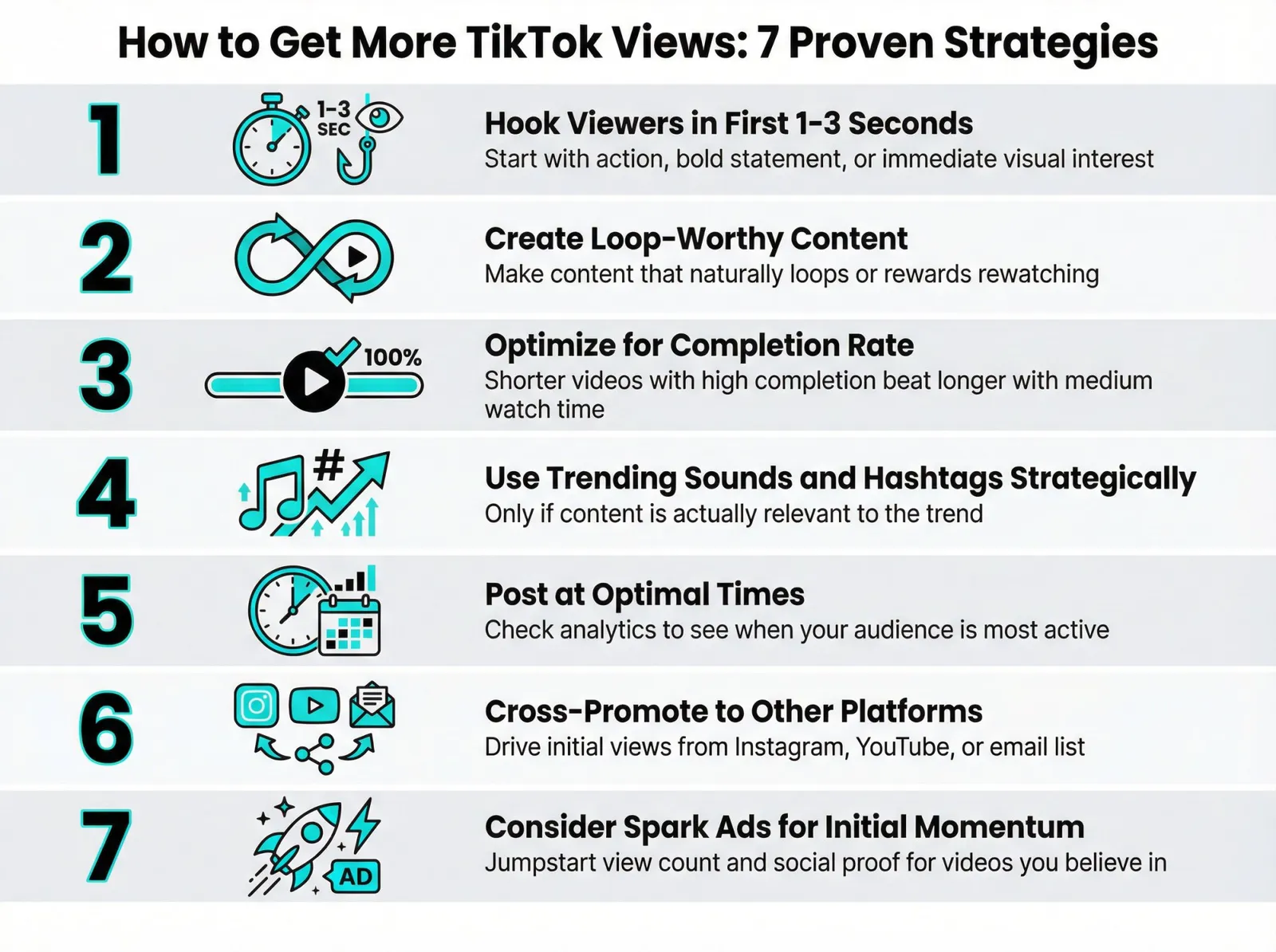
• Hook Viewers in the First 1-3 Seconds
Since TikTok counts views instantly, you need to make those first moments count if you want people to stick around. Start with action, a bold statement, or immediate visual interest. No slow builds or long intros.
• Create Loop-Worthy Content
Since loops count as views, content that naturally loops or makes people want to rewatch (tutorials, satisfying visuals, details you might miss first time) can significantly boost your view counts.
• Optimize for Completion Rate
The algorithm rewards videos people watch all the way through. Shorter videos with high completion rates often outperform longer videos with medium watch times.
• Use Trending Sounds and Hashtags Strategically
This helps you get initial distribution, but only if your content is actually relevant to those trends. Knowing how to find trending sounds on TikTok early is half the battle. Random trending sounds won't help if your video doesn't fit.
• Post at Optimal Times
When your specific audience is most active varies. Check your analytics to see when your followers are online, then test posting at different times.
• Cross-Promote to Other Platforms
Driving initial views from your Instagram, YouTube, or email list can give TikTok's algorithm the early signal it needs to start showing your content to new audiences.
• Consider Spark Ads for Initial Momentum
If you have a video you believe in, promoting it with Spark Ads can jumpstart the view count and social proof, which can lead to organic growth if the content resonates.
Final Takeaway: What TikTok View Counts Really Mean
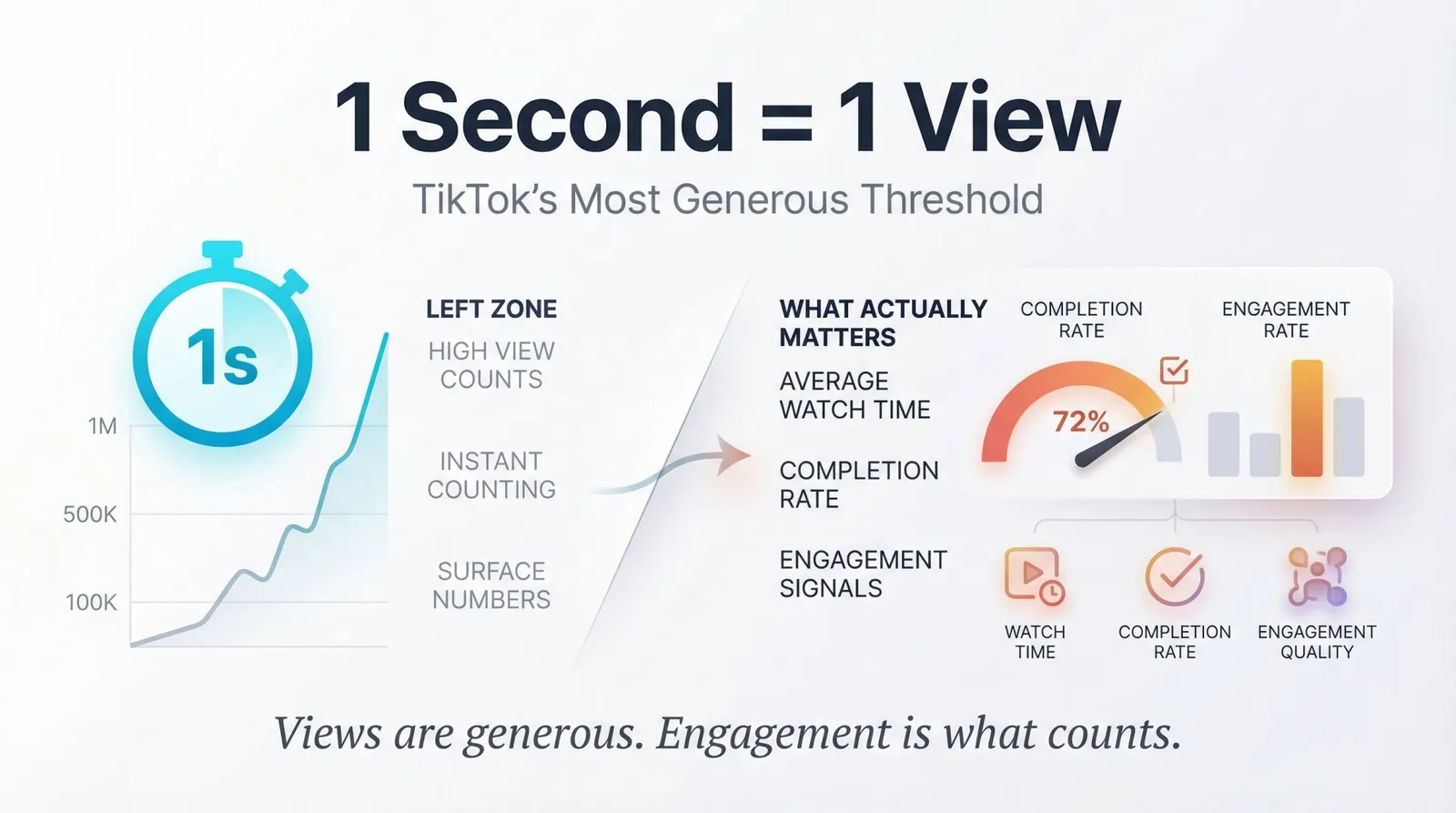
TikTok view counts need context: public post totals, ad video metrics, unique viewers and qualified views are different measurements. Keep the metric definition with the number.
But those view numbers are only valuable if they represent genuine audience interest. High views with low watch time and minimal engagement aren't success. They're a warning sign that your hook is working but your content isn't delivering.
Focus on creating content that holds attention beyond that first second. Track your completion rates, engagement metrics, and unique viewers alongside total views. And if you're running campaigns at scale, make sure you have systems like AdManage to efficiently launch, track, and optimize across hundreds of variations.
The platform will give you the views. Your job is making sure they actually mean something.
For performance marketers managing large-scale TikTok campaigns, AdManage handles the operational complexity so you can focus on identifying winning ads faster and optimization. Learn how bulk launching and social proof preservation can compress your workflow from hours to minutes.

Cedric Yarish is a Meta ads expert, performance marketer and product builder with 10+ years of experience across Photoroom, Nextdoor and MVF. At Photoroom, he led user acquisition with more than $1 million in monthly ad spend and a creative operation producing 400 ads a month across 30 languages.
Today, he leads product and engineering at AdManage, the platform he co-founded with his brother Raphael to help marketers launch, test and manage ads at scale. Meta has quoted him on its developer blog and invited him to speak on its Partner API Panel in New York. His insights on creative testing and advertising automation have also featured in RevenueCat and In Growth We Trust.
Full founder bio & interviews