
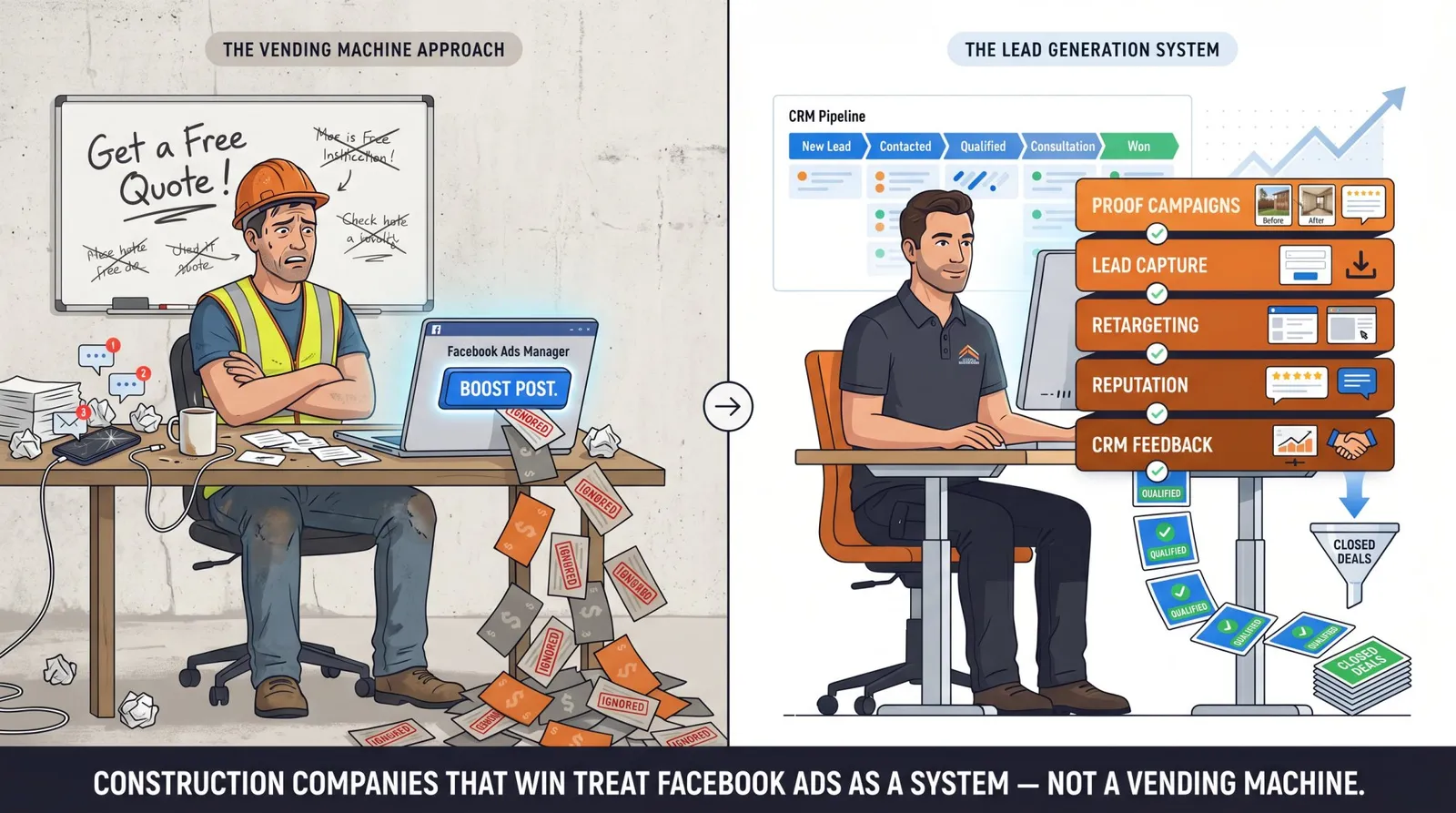
Most construction companies that try Facebook ads walk away disappointed. The leads come in cheap, the phone rings a few times, and then sales starts ignoring the notifications because nine out of ten are people who barely remember submitting a form. That's not a Facebook ads problem. That's a system problem.
The construction companies winning with Facebook and Instagram in 2026 aren't just buying names and phone numbers. They're showing project proof before anyone asks for a quote. They're qualifying buyers before sending them to sales. They're retargeting people who spent time on their project gallery. They're feeding appointment and close data back to Meta so the algorithm learns what a real project opportunity looks like. And they're doing all of this consistently enough that their ad account compounds over time.
A homeowner planning a $60,000 kitchen renovation, a property manager sourcing a commercial build-out contractor, and a homeowner who needs storm-damage roof work are all technically "construction leads," but they don't behave the same way. They have different timelines, different trust barriers, different project values, and completely different buying triggers. A single campaign with a generic "get a free quote" offer doesn't serve any of them well.
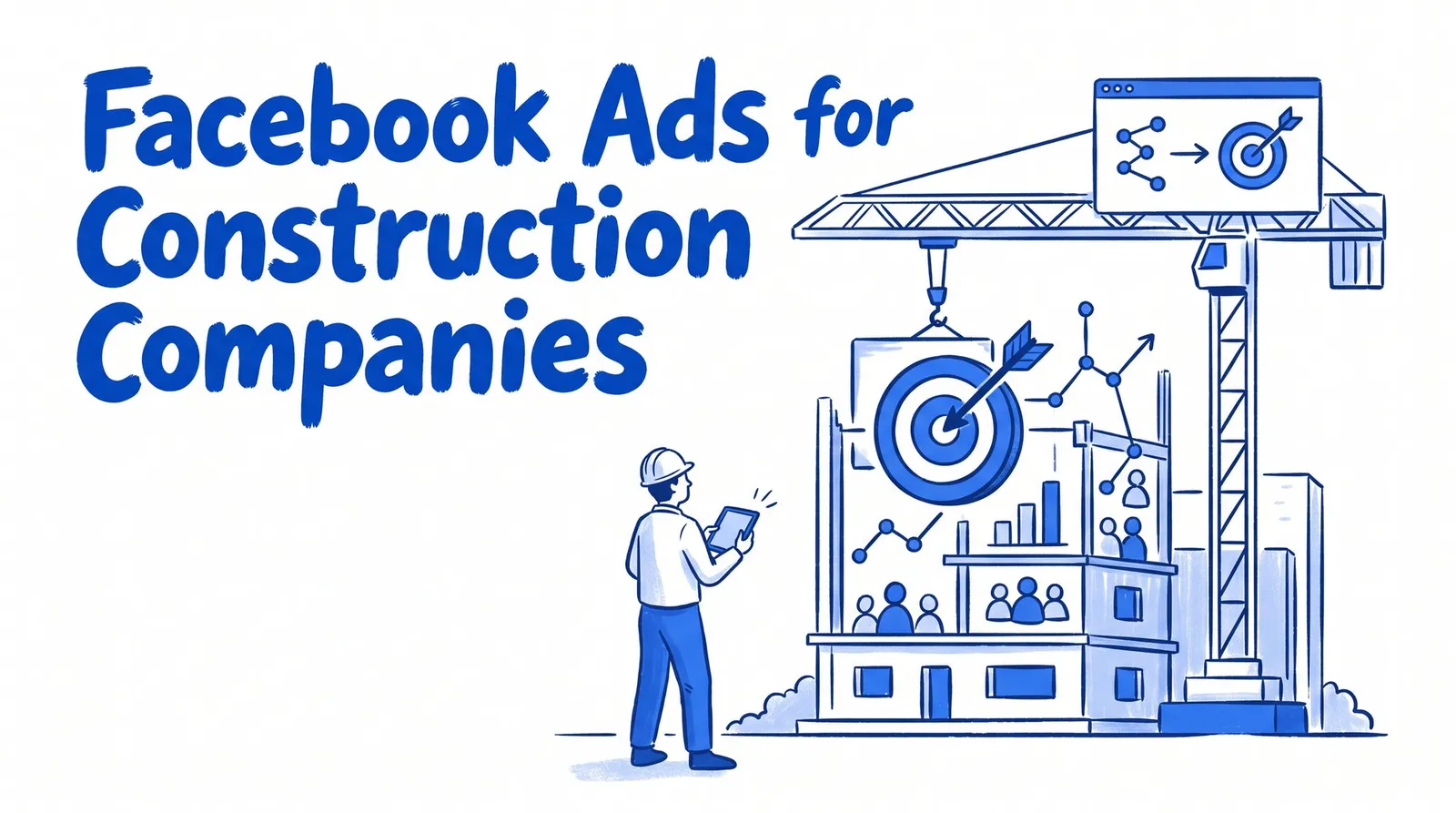
This guide walks through everything it takes to build a Facebook ads system for construction lead generation in 2026: campaign structure, targeting, creative, lead forms, landing pages, follow-up, measurement, optimization, compliance, and a 30-day launch plan. We've built AdManage by working with performance marketing teams running paid social at scale, and the patterns we've seen in construction are consistent. The companies that succeed treat it as an integrated lead system. The ones that fail treat it like a vending machine.
Benchmarks cited throughout are current as of April 2026 and should be treated as directional planning data, not guaranteed performance. Your costs will vary by trade, location, project value, seasonality, offer quality, and follow-up speed.
Why Facebook Ads Still Work for Construction Companies in 2026
The reach alone makes it hard to ignore. Pew Research Center's 2025 social media study found that 71% of U.S. adults use Facebook. Meta reported 3.58 billion average daily active people across its family of apps in December 2025, up 7% year over year.
But reach is just the starting point. For construction companies, the more important insight is when that reach matters.
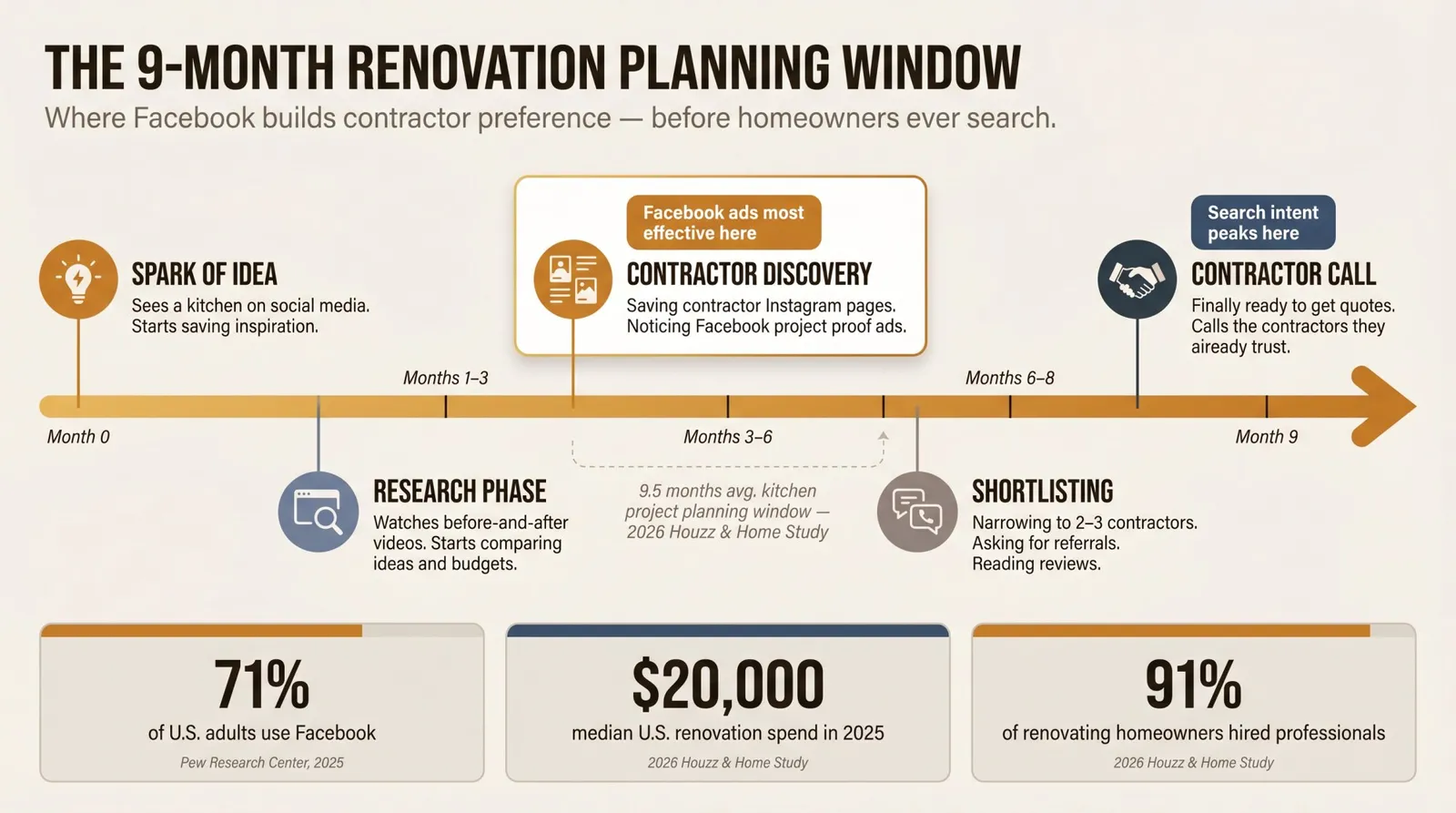
Construction purchases don't happen fast. The 2026 U.S. Houzz & Home Study, reported April 24, 2026, found that 54% of U.S. homeowners undertook renovation projects in 2025, with median renovation spend of 20,000** and the top 10% of projects reaching **150,000 or more. Kitchen projects specifically involved an average of 9.5 months of planning. The same study reported that 91% of renovating homeowners hired professionals.
That planning window is where Facebook is most valuable. A homeowner thinking about a kitchen remodel in September might not call a contractor until May. During those eight months, they're saving ideas, watching before-and-after videos, comparing local contractors, thinking about budgets, and forming preferences about who they'd trust with their home. Facebook and Instagram are part of that research process. The contractor who shows up consistently during that window with compelling proof (real photos, real projects, owner-facing video) gets the call when the buyer is finally ready.
Facebook isn't a replacement for search ads, SEO, Google Business Profile, or referrals. It's the paid social layer that creates and shapes demand before the buyer is ready to search. Used alongside other channels, it makes everything else more effective.
Residential vs. Commercial Construction Buyers: Who You're Actually Advertising To
Before building any campaign, it helps to be clear on who you're actually advertising to. Construction buyers split into two very different groups, and the Facebook ads strategy for each looks meaningfully different.
Residential buyers (homeowners) are driven primarily by a combination of emotional motivation and project readiness. They're thinking about how the space will feel, whether the contractor will be trustworthy in their home, and whether the project fits their budget. The buying cycle can run 3 to 12 months for significant renovations. Facebook and Instagram work exceptionally well for this audience because the visual nature of the platforms matches how homeowners evaluate contractors: through photos, videos, and social proof. If roofing is your primary trade, we've put together a dedicated roofing contractor Facebook ads guide that goes deeper on roofing-specific creative, targeting, and offer strategy.
Commercial buyers (property managers, business owners, developers, tenant improvement decision-makers) are more ROI-focused and often work on longer, more structured procurement timelines. They typically need multiple stakeholders to agree, and they're evaluating not just capability but capacity, licensing, insurance, and track record with similar project types. Facebook ads can work for commercial construction, but they typically function as one layer in a multi-channel approach that also includes LinkedIn, search ads, email outreach, and direct relationship development. If your commercial pipeline crosses into real estate or property development, our Facebook ads guide for real estate covers the overlap between property and construction marketing effectively.
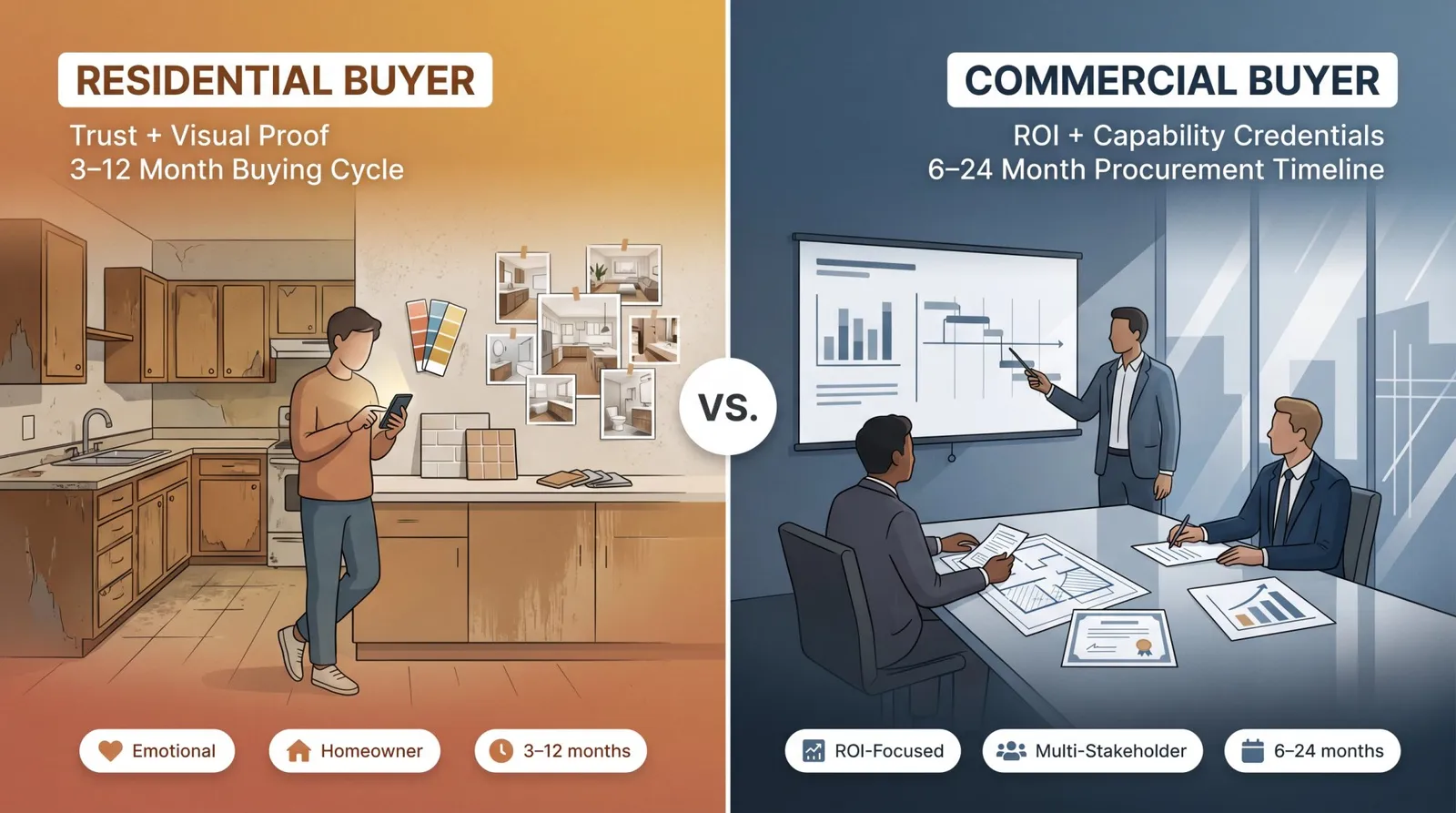
| Residential | Commercial | |
|---|---|---|
| Decision driver | Trust + visual proof | ROI + capability credentials |
| Buying cycle | 3-12 months | 6-24 months |
| Primary channels | Facebook / Instagram | LinkedIn + Facebook + search |
| Best ad creative | Before/after, owner video, testimonials | Case studies, project portfolios, process proof |
| Best offer | Free consultation / estimate / inspection | Discovery call, build-out consultation |
| Lead form type | Higher Intent Instant Form | Landing page with strong qualification |
The strategy in most of this guide applies most directly to residential construction and the trades that serve homeowners. Commercial contractors should adapt accordingly, especially the campaign objectives, targeting approach, and qualification questions.
Facebook Ads Benchmarks for Construction in 2026
Benchmarks are useful as starting points, but they're frequently misused.
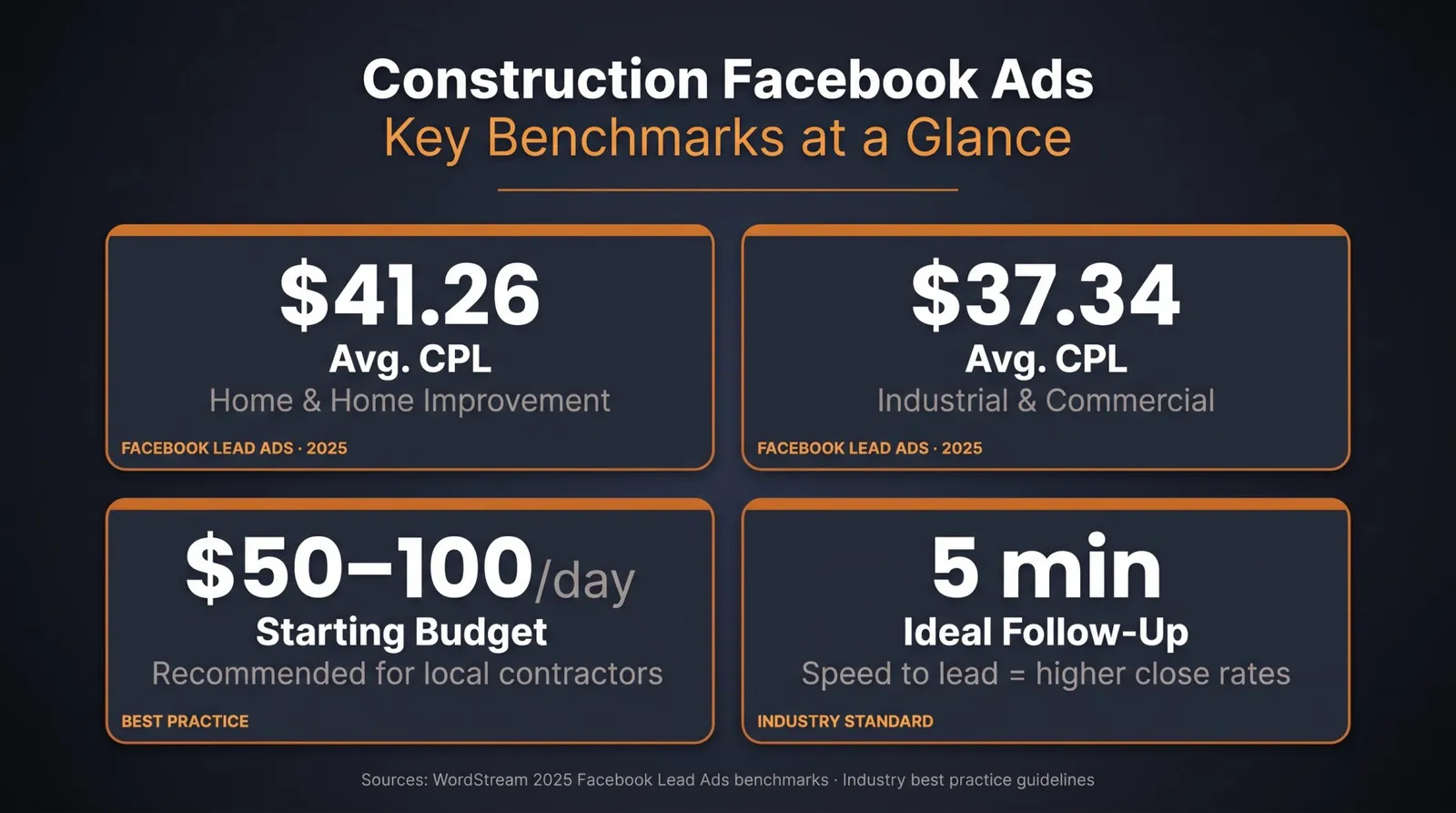
Published industry benchmarks from September 15, 2025 reported that Lead Ads campaigns averaged a 1.92 CPC, 2.59% CTR, 7.72% conversion rate, and 27.66 cost per lead across all industries. For Home & Home Improvement specifically, the numbers were a 2.23 CPC, 1.94% CTR, 5.22% conversion rate, and 41.26 cost per lead. For Industrial & Commercial, they reported a 1.80 CPC, 2.08% CTR, 9.34% conversion rate, and 37.34 cost per lead. You can see how these stack up against your own campaigns in our full breakdown of Facebook ads cost-per-lead benchmarks by industry.
For context, search advertising industry data updated February 23, 2026, shows search ads costing far more per lead: the average home-services search CPL was **90.92** and CPC was 7.85. Construction and Contractors (General category) averaged 165.67 CPL** on search. Roofing & Gutters averaged **228.15 CPL.
| Channel / Category | Avg. CPL | Source Date | How to Use It |
|---|---|---|---|
| Facebook Lead Ads, all industries | $27.66 | Sept 15, 2025 | Broad baseline, not construction-specific |
| Facebook Lead Ads, Home & Home Improvement | $41.26 | Sept 15, 2025 | Relevant for remodelers, roofing, windows, residential contractors |
| Facebook Lead Ads, Industrial & Commercial | $37.34 | Sept 15, 2025 | Directional for commercial contractors |
| Search Ads, Home Services average | $90.92 | Updated Feb 23, 2026 | Search is higher intent but more expensive |
| Search Ads, Construction & Contractors General | $165.67 | Updated Feb 23, 2026 | Useful comparison for general contractors |
| Search Ads, Roofing & Gutters | $228.15 | Updated Feb 23, 2026 | Competitive roofing market context |
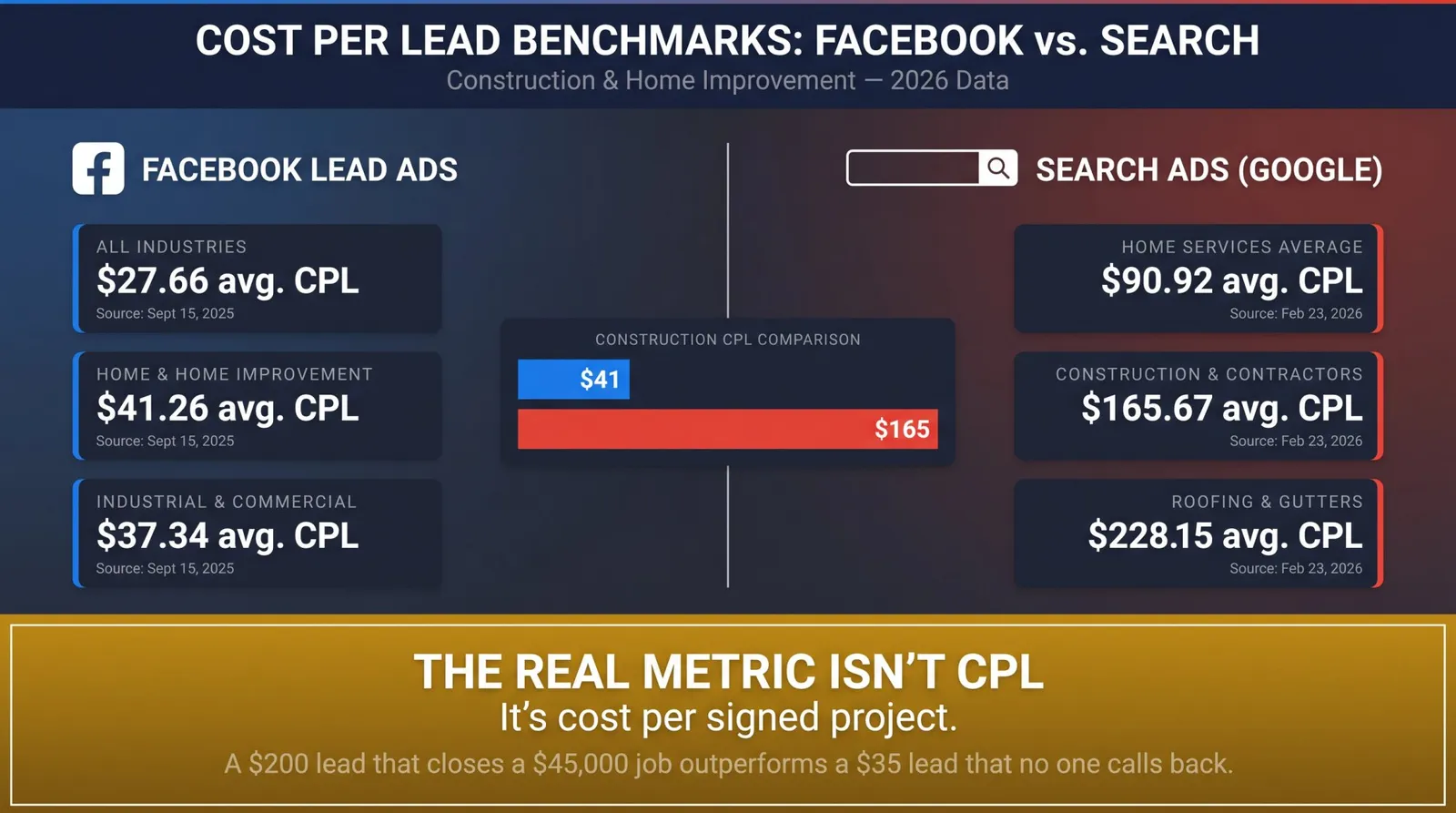
The mistake most contractors make is treating raw CPL as the success metric. A 35 lead is terrible if nobody calls for three days and the prospect has already booked with a competitor. A 200 lead is excellent if it turns into a $45,000 project with a 35% margin.
The real comparison isn't Facebook CPL vs. Google CPL. It's cost per signed job.
How to Calculate Your Maximum CPL for Construction Facebook Ads
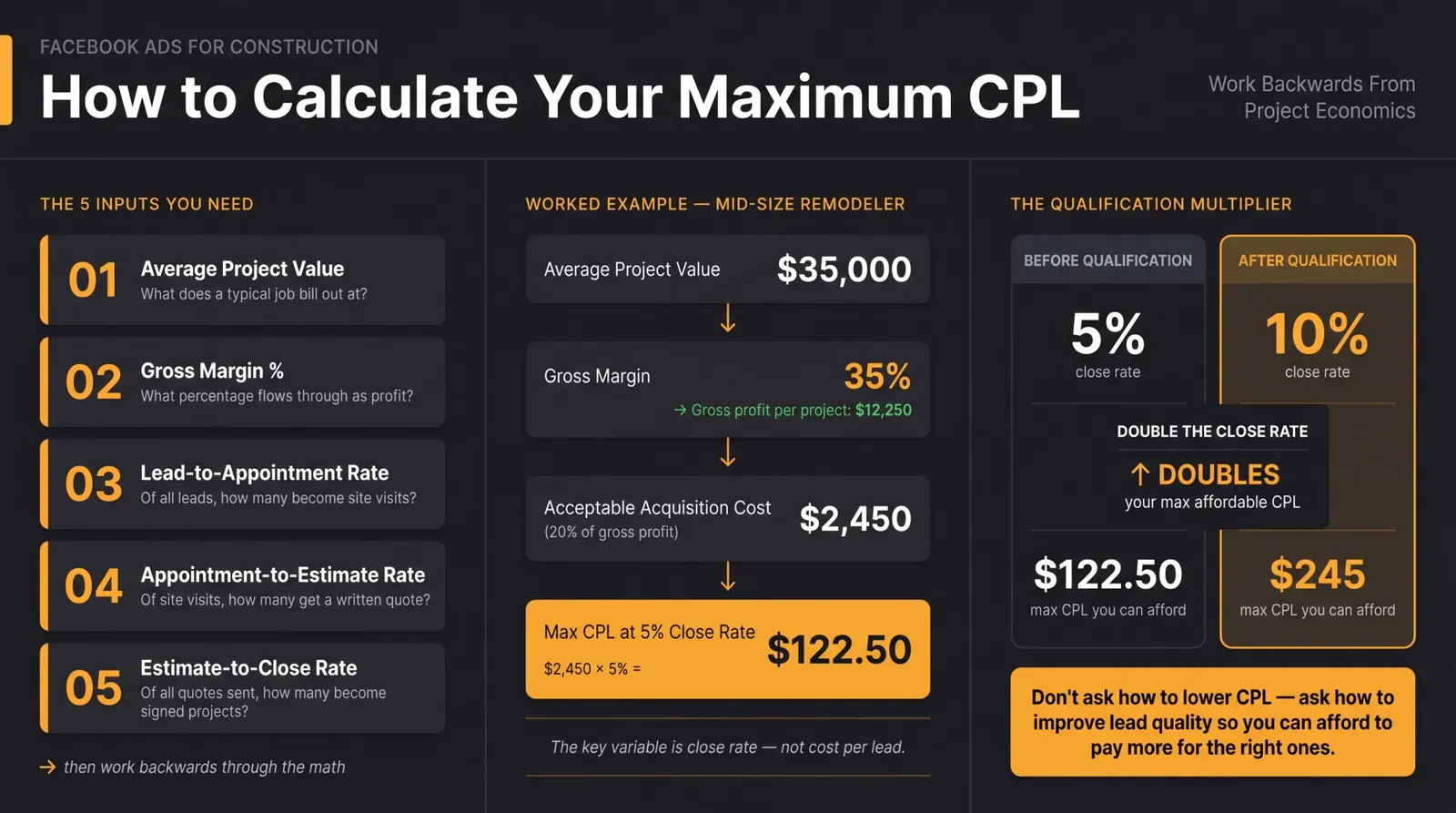
Before launching any campaign, define what a lead is actually worth to your business. These are the five numbers you need:
- Average project value
- Gross margin
- Lead-to-appointment rate
- Appointment-to-estimate rate
- Estimate-to-close rate
Then work backwards.
Example: Mid-size remodeling company
Assume an average project value of $35,000, gross margin of 35%, and a raw lead-to-close rate of 5%.
Gross profit per project: $12,250
Acceptable acquisition cost (20% of gross profit): $2,450
Max CPL at 5% close rate: 2,450 × 5% = **122.50**
Now, if better qualification lifts the close rate from 5% to 10%:
Max CPL at 10% close rate: 2,450 × 10% = **245**
That's why improving lead qualification isn't just a sales problem. It directly changes the economics of every ad dollar. Meta's Instant Forms support a Higher Intent form type designed to produce more intentional leads, and our Facebook ads budget calculator can help you work backwards from your project value and margins to a defensible maximum CPL.
The right question for construction advertisers isn't "how do I lower my CPL?" It's: "how do I improve the quality of leads so I can afford to pay more for the right ones?"
How to Structure Facebook Ad Campaigns for Construction Lead Generation
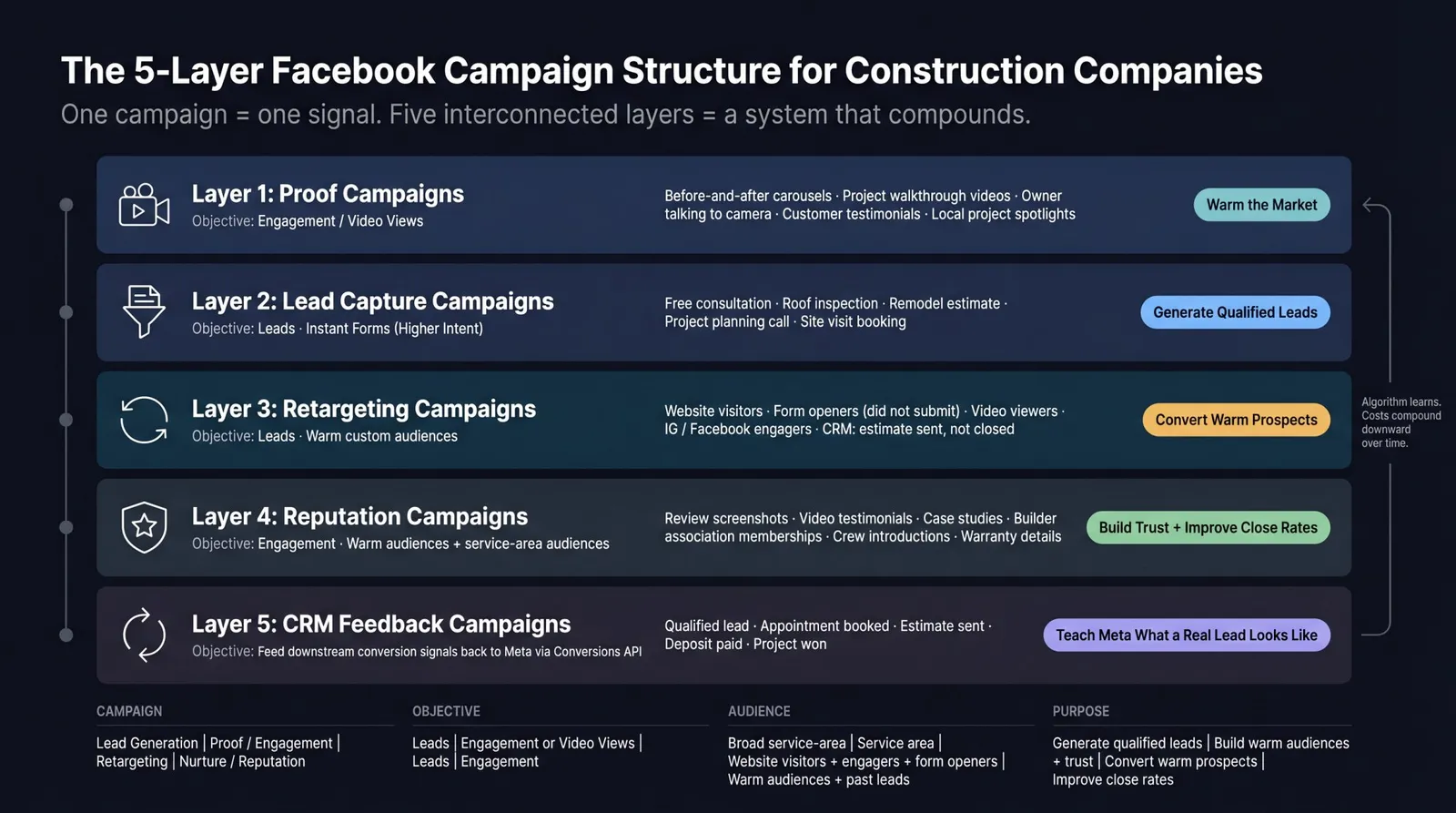
Most construction companies run one campaign: a basic lead generation campaign with a generic offer. The accounts that consistently generate profitable projects run five interconnected layers.
Layer 1: Proof Campaigns
These ads show completed work, not claims. Their job is to warm up the market and build trust before anyone asks for a quote.
What to use:
- Before-and-after carousels
- 15-30 second project walkthrough videos
- Jobsite progress clips
- Owner or project manager talking to camera
- Customer testimonial clips
- "What this project included" educational content
- Local project spotlights
The goal isn't always an immediate lead. The goal is to build a pool of people who watched, clicked, or engaged with project content, and then retarget them with a specific offer. This pool becomes your highest-converting retargeting audience.
Layer 2: Lead Capture Campaigns
These are your core lead generation campaigns. Meta's Leads objective is designed to find people likely to become customers, and their lead ads product supports Instant Forms inside Facebook and Instagram.
The best offers for construction are specific:
→ Free design consultation
→ Free roof inspection
→ Free storm-damage assessment
→ Free remodeling estimate
→ Free project planning call
→ "See what your project could cost"
→ "Book a site visit"
→ "Check availability for your area"
"Contact us" and "Learn more" are not offers. Construction leads need a reason to act now.
Layer 3: Retargeting Campaigns
Retargeting should reach people who've already shown interest: website visitors, project gallery viewers, pricing page visitors, Facebook and Instagram engagers, video viewers, Instant Form openers who didn't submit, past leads that didn't book, and CRM segments like "estimate sent but not closed." Getting your retargeting audiences set up correctly from the start makes the difference between a retargeting campaign that compounds and one that quietly burns budget.
Retargeting creative should answer objections directly: "Are you licensed and insured?" "Can I see your past work?" "How long will it take?" "Do you offer financing?" "What happens after I request a quote?" These are the questions holding warm prospects back from converting.
Layer 4: Reputation Campaigns
For high-ticket construction, reputation often matters more than the initial offer. Use ads featuring review screenshots, video testimonials, case studies, builder association memberships, warranty details, process breakdowns, and crew introductions. Run these to warm audiences and service-area audiences as ongoing trust builders.
Layer 5: CRM Feedback Campaigns
The best Meta accounts don't stop at form submissions. They send downstream CRM events back to Meta: qualified lead, appointment booked, appointment completed, estimate sent, deposit paid, project won. Connecting these signals is one of the most impactful Facebook ads automation workflows a construction advertiser can set up.
Meta's Conversions API is designed to improve measurement and attribution across the customer journey. This matters more now than it did a year ago. As of April 2026, Meta has changed access to the Conversion Leads performance goal for new campaign creation when there's no Conversions API integration. If you're serious about lead generation optimization, connecting your CRM to Meta via CAPI isn't optional.
The recommended starter structure for most construction companies (before you start thinking about campaign budget optimization vs. ad set budget strategies, nail the structure first):
| Campaign | Objective | Audience | Offer | Purpose |
|---|---|---|---|---|
| Campaign 1: Lead generation | Leads | Broad service-area | Estimate, consultation, inspection, quote | Generate qualified leads |
| Campaign 2: Proof / engagement | Engagement or video views | Service area | Project proof, case studies, videos | Build warm audiences + trust |
| Campaign 3: Retargeting | Leads | Website visitors, engagers, form openers | Stronger CTA, proof, objection handling | Convert warm prospects |
| Campaign 4: Nurture / reputation | Engagement | Warm audiences, past leads | Reviews, testimonials, process | Improve close rates |
How to Target Construction Leads on Facebook in 2026
Meta targeting has changed significantly. The strongest construction accounts now rely less on hyper-specific interest targeting and more on five things:
Strong creative signals. Your ad creative IS part of your targeting. If you show a luxury kitchen remodel, Meta's algorithm learns that people who respond to that ad type are your audience. A roofer showing before/after storm damage repairs will naturally attract the homeowners who have roofing concerns.
Broad service-area targeting. Construction is local or regional. Your first targeting constraint is geography: cities, counties, service radius, specific markets, regions where your crews actually operate. Don't advertise where you can't profitably service leads.
First-party data. Upload or sync past customers, past estimates, open opportunities, newsletter subscribers, website visitors, project gallery viewers, and lead form openers. These audiences improve retargeting, exclusions, and lookalike expansion.
Advantage+ Audience. Meta describes this as using advanced AI to find relevant audiences. Let the algorithm expand beyond your set parameters when creative and conversion data support it. Before you lean into it fully, it's worth understanding how Advantage+ affects your creative decisions, particularly whether to let Meta modify your construction before/after assets or keep manual control.
Offline conversion signals. See Layer 5 above. The more qualified conversion signals you send back to Meta, the better it can find more people like your best customers.
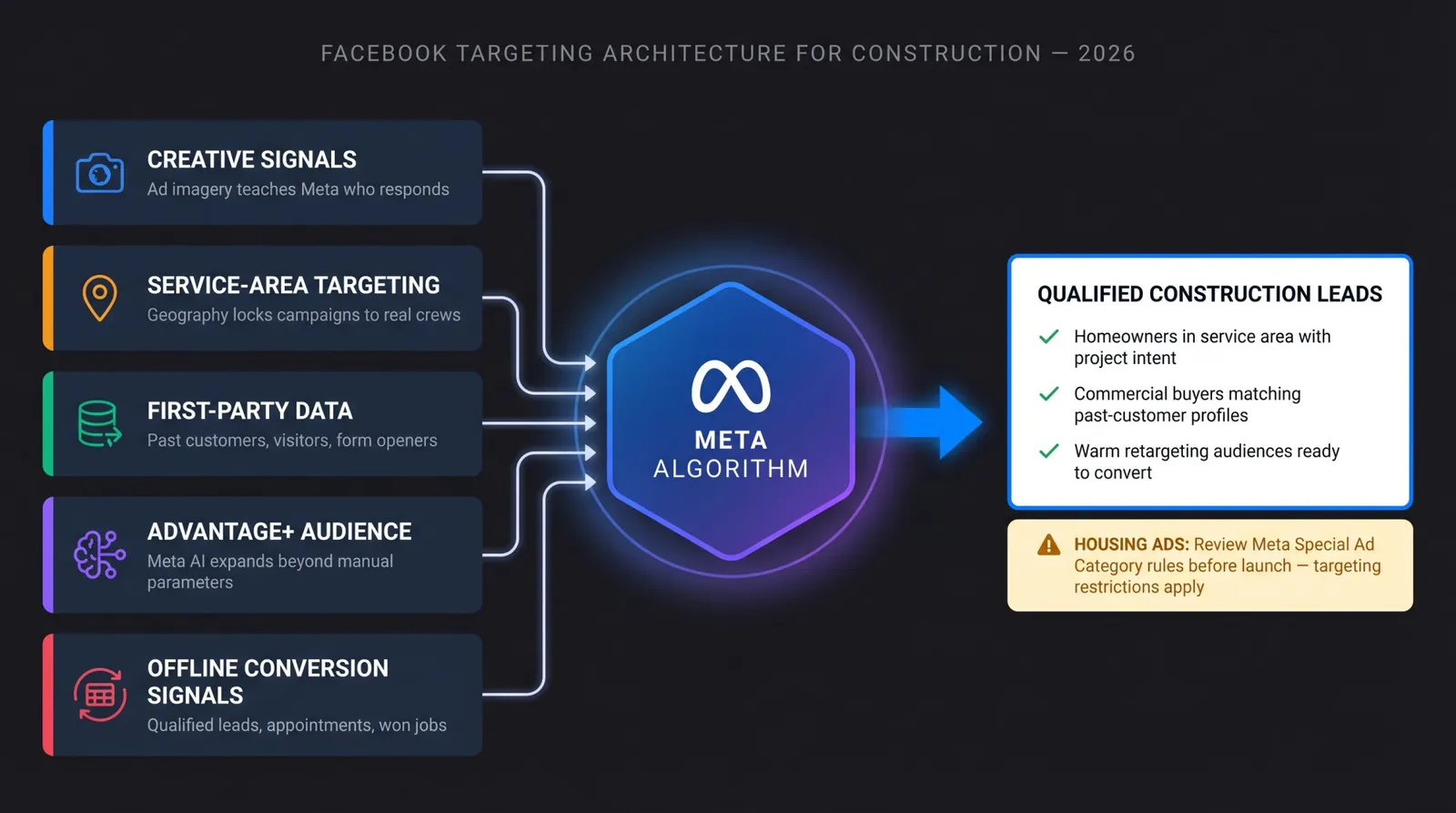
A critical note on compliance: Construction companies need to be careful with Meta's Special Ad Category rules. Meta states that advertisers running ads about housing need to specify Special Ad Categories, and describes housing ads as ads that promote or directly link to a housing opportunity or related service. When a Special Ad Category applies, targeting options are restricted.
Whether your construction ad qualifies as a housing ad depends on the offer, ad copy, landing page, and business model. A roof repair ad, a bathroom remodel ad, and a custom-home community ad may not be treated the same. Don't try to bypass Meta's rules. If your ad promotes or directly links to a housing service, sale, or related context, review Meta's current policy and choose the appropriate category. This is not legal advice. For high-risk categories, get platform-policy review before launch.
What your copy should and shouldn't look like: Meta's advertising standards prohibit ads that assert or imply personal attributes.
Avoid:
- "Is your house falling apart?"
- "Are you drowning in repair bills?"
- "Do you live in a damaged home?"
- "Bad credit? We can finance your remodel."
Use instead:
- "Roof inspections available in [City] after recent storms."
- "Planning a kitchen remodel this year? See recent projects and request a consultation."
- "Licensed remodeling team serving [Service Area]."
- "Commercial build-out consultations available for offices, retail, and medical spaces."
The difference: speak to the service and outcome, not to a sensitive personal attribute or fear-based assumption about the viewer.
What Facebook Ad Creative Actually Works for Construction Companies
Construction advertising is proof advertising. Full stop.
Before anyone talks to your sales team, they're asking themselves: Have you done this kind of project before? Do your projects look good? Are you legitimate? Can you handle my budget and timeline? Will you respect my home? Your creative should answer those questions before the prospect ever reaches a form.
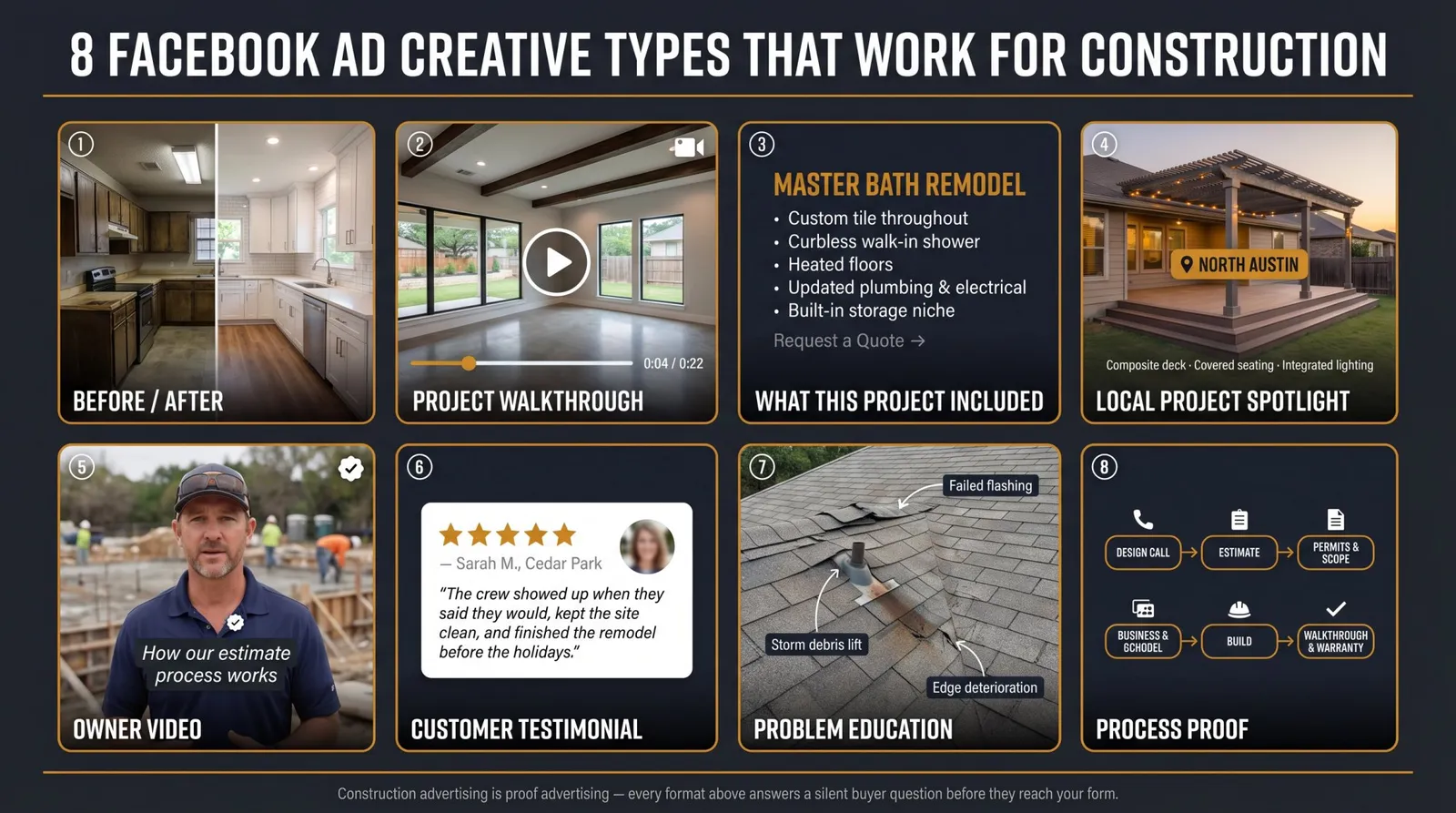
8 Facebook Ad Creative Types That Work Best for Construction
① Before-and-after transformations. Best format: carousel, short video, or split-screen image. Works for kitchens, bathrooms, exterior renovations, decks, concrete, roofing, basements, outdoor living, commercial interiors.
② Project walkthroughs. A 20-second video of a real finished project often beats a polished stock-style ad. Structure: first 2 seconds = strongest finished shot, next 5 = the starting problem, next 8 = key improvements, final 5 = CTA. Authenticity beats production quality here.
③ "What this project included." This works because homeowners often don't know what they're buying. "This bathroom remodel included custom tile, a curbless shower, heated floors, new lighting, plumbing updates, and built-in storage." Specificity builds credibility.
④ Local project spotlights. Mention the service area when relevant. "Recent deck rebuild in North Austin. Composite decking, covered seating area, integrated lighting, and code-compliant railings."
⑤ Owner or project manager videos. A trusted human face frequently outperforms polished creative. Topics that convert: "What to ask before hiring a remodeler," "How our estimate process works," "Why roof quotes vary so much," "How we handle permits."
⑥ Customer testimonials. Use customer language, not sales language. A testimonial that says "The crew showed up when they said they would, kept the site clean, and finished before the holidays" converts better than any claim about being "the best in [City]."
⑦ Problem education. Works especially well for roofing, foundations, water damage, windows, siding, and exterior trades. "Three signs your roof flashing may be failing." "When is cabinet refacing not enough?" These ads attract people with the problem you solve.
⑧ Process proof. High-ticket buyers worry about chaos. Walk them through your process: design consultation, estimate, scope and selections, permits, schedule, site prep, construction, punch list, final walkthrough, warranty. Showing the process removes a major objection before the sales call.
Best Facebook Ad Formats for Construction Companies
AdManage's Meta workflow supports all of the formats construction advertisers commonly need, including lead-gen ads, carousel, collection, flexible ads, partnership ads, Post ID workflows, multi-language launches, and bulk launching across Meta placements.
| Format | Best Use |
|---|---|
| 9:16 video | Reels, Stories, vertical project walkthroughs |
| 4:5 image/video | Feed placements, before/after, testimonials |
| Carousel | Before/after sequences, project stages, service categories |
| Instant Form ads | Estimate requests, consultations, inspections |
| Retargeting video | Trust, process, objection handling |
| Testimonial ads | Warm audiences and high-ticket services |
| Lead form + scheduling CTA | Consultation and site-visit booking |
How to Write Facebook Ad Copy for Construction
A simple formula that works across construction types:
Outcome + proof + qualifier + CTA
"Planning a kitchen remodel in Denver? See recent design-build projects from our licensed remodeling team, then request a consultation to discuss budget, timeline, and availability."
That's it. Outcome (kitchen remodel), proof (recent design-build projects), qualifier (budget, timeline, availability), CTA (request a consultation).
Strong construction CTAs: Request an estimate, Book a consultation, Schedule a site visit, Check availability, Get a project quote, Request a roof inspection, Plan your remodel, Talk to a project specialist, See if your project is a fit, Get a custom proposal.
Weak CTAs to avoid: Submit, Contact us, Learn more, Click here. None of these tell the buyer what they're getting.
Instant Forms vs. Landing Pages: Which Works Best?
Both have a place. The right choice depends on the project type.
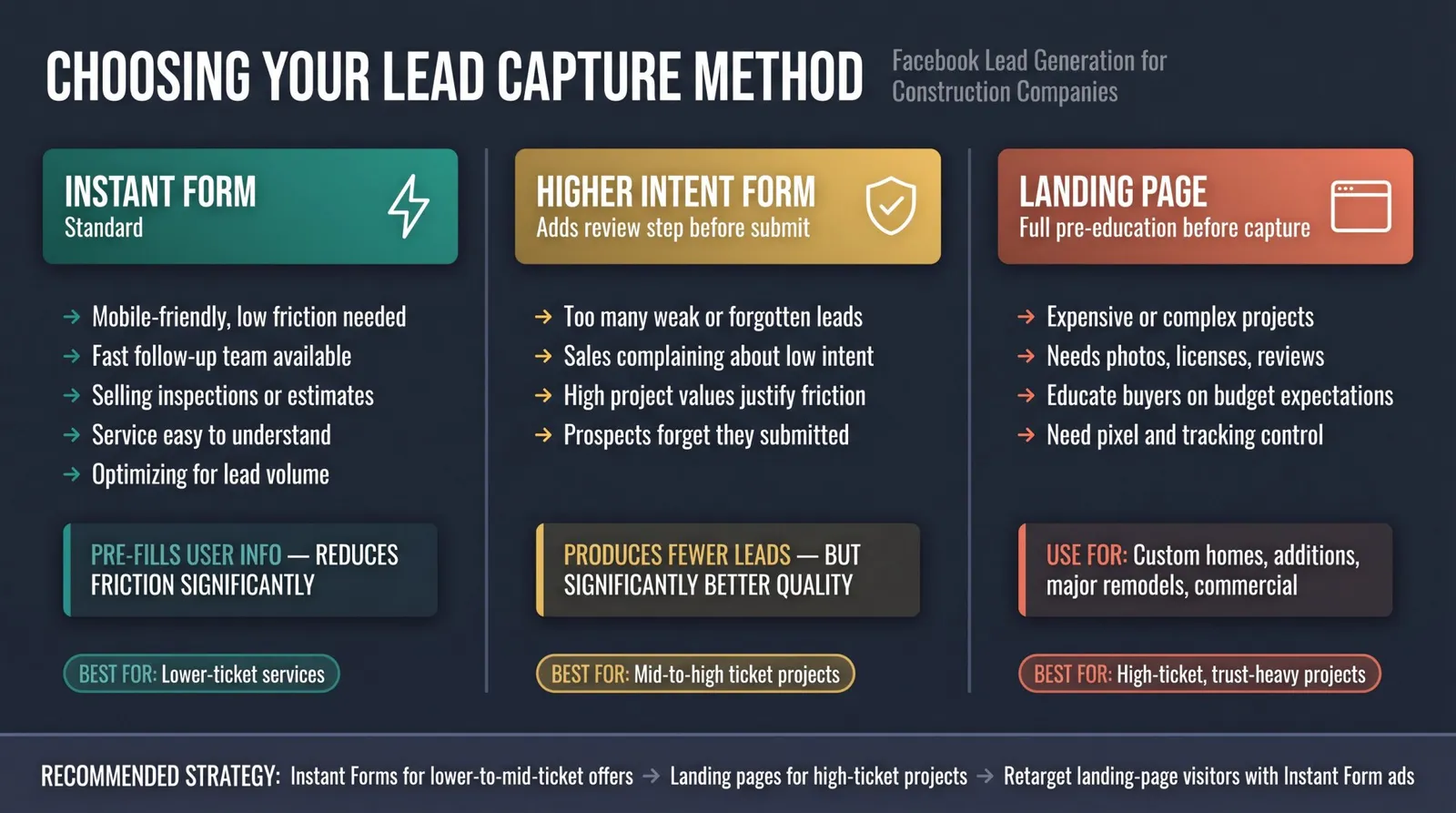
Use Facebook Instant Forms when:
- You want mobile-friendly lead capture with lower friction
- You have a strong follow-up team ready to call within minutes
- You're selling inspections, estimates, consultations, or quote requests
- The service is easy to understand without extensive proof
- You want Meta to optimize for lead volume quickly
Instant Forms pre-fill user information, which reduces friction significantly. Note that Meta requires a privacy policy URL for any advertiser using Instant Forms.
Use Higher Intent Instant Forms when:
- You're getting too many weak leads
- People forget they submitted a form
- Sales teams complain about low intent
- Project values are high enough to justify a slightly higher-friction experience
The Higher Intent form type adds a review step so prospects confirm their information before submitting. It produces fewer but better leads.
Use landing pages when:
- The project is expensive or complex (custom homes, additions, major remodels, commercial work)
- You need to show many photos, case studies, licenses, and reviews before asking for contact information
- You want to pre-educate buyers about the project type and set budget expectations
- You need more control over tracking, pixel events, and qualification
Our recommended approach: Use Instant Forms for lower-to-mid-ticket service offers. Use landing pages for high-ticket, complex, or trust-heavy projects. Retarget landing-page visitors with Instant Form ads. Retarget Instant Form openers (who didn't submit) with proof and testimonials.
How to Build a Facebook Lead Form That Qualifies Construction Leads
A construction lead form needs to do two things: reduce friction enough that qualified buyers complete it, and add enough qualification that unqualified buyers self-select out. That's a tighter balance than most contractors get right on the first try.
For most construction companies, start with a Higher Intent form with a review step. This reduces accidental submissions and improves the quality of conversations sales teams have.
Recommended form structure:
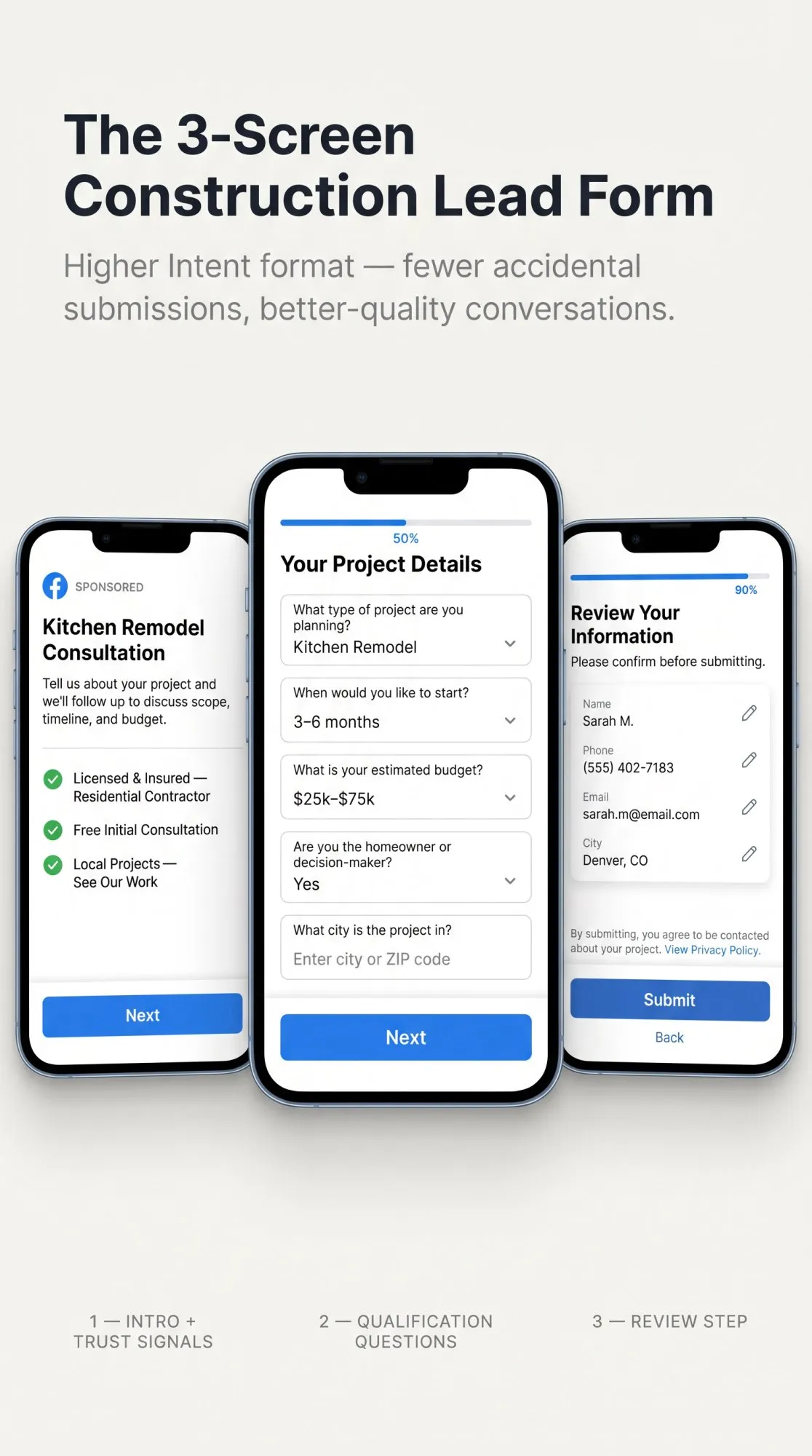
Intro screen: One short paragraph: "Tell us about your project and our team will follow up to discuss scope, timeline, budget, and availability." Include 2-3 trust points: licensed and insured, local project experience, free initial consultation, warranty-backed work.
Contact fields: Full name, email, phone number, city or ZIP code.
Qualification questions:
| Question | Why It Matters | Example Answers |
|---|---|---|
| What type of project are you planning? | Routes lead to the right team | Kitchen, bath, roof, deck, addition, commercial |
| Where is the project located? | Confirms service area | City, ZIP, neighborhood |
| When would you like to start? | Reveals urgency | ASAP, 1-3 months, 3-6 months, 6+ months |
| What is your estimated budget? | Filters poor-fit leads | Under 10k, 10k-25k, 25k-75k, 75k+ |
| Are you the homeowner or decision-maker? | Improves sales efficiency | Yes, no, shared decision |
| What best describes your stage? | Helps sales approach | Researching, comparing quotes, ready for estimate |
| Best time to call? | Improves contact rate | Morning, afternoon, evening |
Don't ask all of these at once in your first test. Start with 4-6 questions, then add or remove based on the lead quality feedback your sales team gives you.
Privacy and consent: If you plan to call or text leads, your consent language, CRM process, and follow-up practices need to be reviewed carefully. In 2025, the U.S. Eleventh Circuit vacated the FCC's one-to-one consent rule before its effective date, but advertisers still need proper prior express written consent for covered marketing calls and texts. This is not legal advice. If you use automated dialing, SMS, or multi-company lead routing, get legal review.
The thank-you screen is a conversion opportunity. Don't waste it. Use: "Thanks, we received your project request. For faster scheduling, call us now or book a time below." Add a call button, booking link, project gallery link, "what happens next" explanation, and expected response time.
Lead offer quality matters as much as form structure.
Strong offers that produce better construction leads:
| Offer | Best For | Why It Works |
|---|---|---|
| Free project consultation | Remodelers, custom builders, commercial contractors | Positions the call as planning, not a commodity quote |
| Free estimate | Roofing, windows, decks, concrete, exterior trades | Simple and expected |
| Free inspection | Roofing, storm damage, foundations, restoration | Works when there's urgency or visible damage |
| Design consultation | Kitchens, baths, additions, design-build | Attracts higher-intent homeowners |
| Budget planning call | High-ticket remodels, custom homes | Filters people who need scope guidance |
| Availability check | Seasonal trades and busy contractors | Creates urgency without fake scarcity |
Avoid: "Sign up for updates," "Download our brochure," "Learn more," "Contact us," "Best contractor near you." Construction buyers are trying to solve a project problem, not subscribe to something.
10 Ready-to-Use Facebook Ad Examples for Construction Companies
These are starting points. Localize them by service area, project type, proof, and offer before running them.
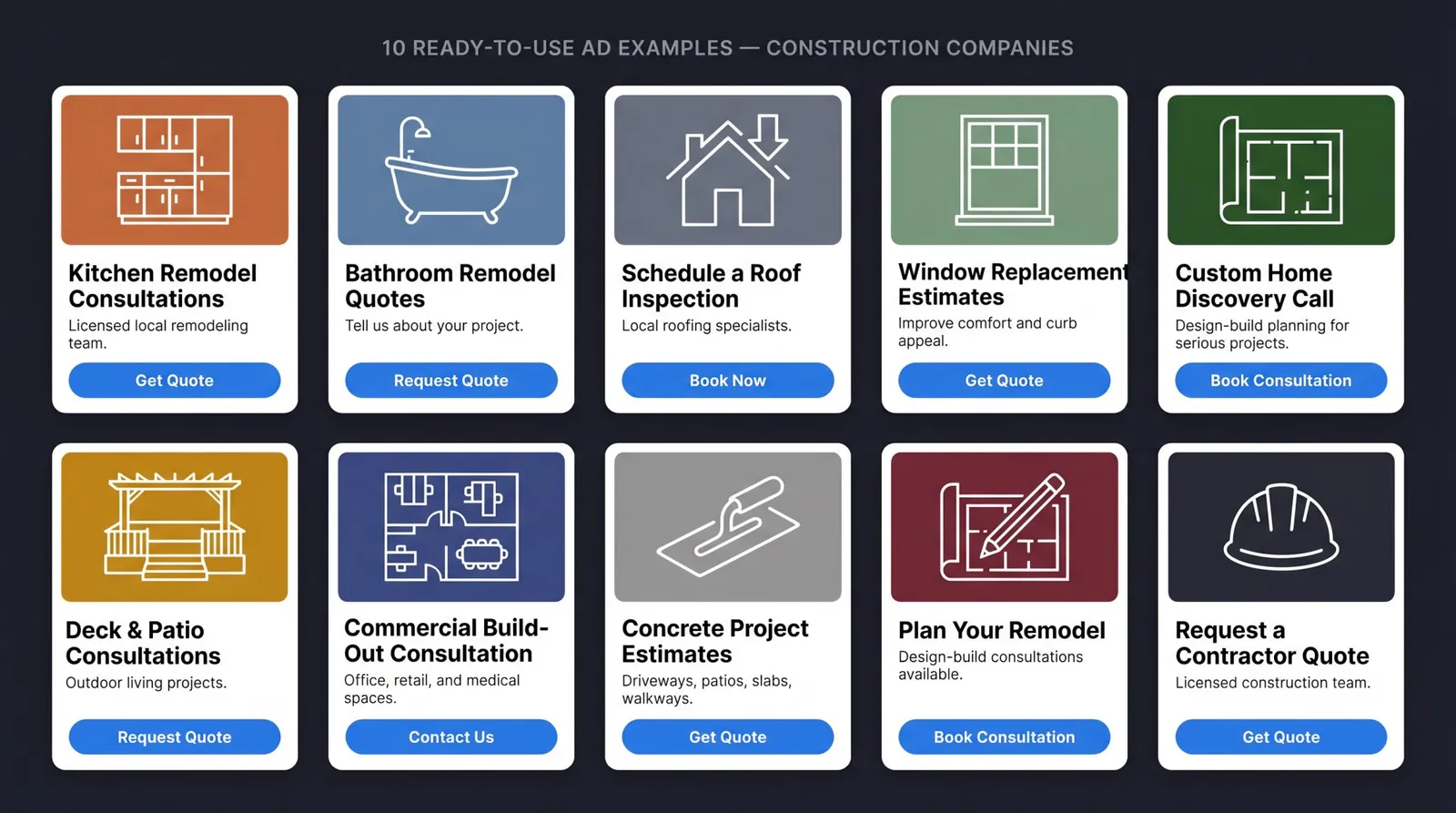
1. Kitchen Remodeler
Primary text: Planning a kitchen remodel this year? See recent kitchen projects completed by our design-build team, then request a consultation to discuss layout, budget, selections, and timeline.
Headline: Kitchen Remodel Consultations
Description: Licensed local remodeling team.
CTA: Get Quote
Lead form questions: What type of kitchen project are you planning? / What is your estimated budget range? / When would you like to start? / What city is the project in? / Are you the homeowner or decision-maker?
2. Bathroom Remodeler
Primary text: From outdated bathrooms to clean, functional spaces built for daily use. View recent bathroom remodels and request a quote from our local remodeling team.
Headline: Bathroom Remodel Quotes
Description: Tell us about your project.
CTA: Request Quote
Lead form questions: Full remodel or partial update? / Shower, tub, vanity, flooring, or full layout change? / Budget range? / Timeline? / Project ZIP or city?
3. Roofing Company
Primary text: Need a roof inspection after recent weather? Our licensed roofing team serves [Service Area] with inspections, repair recommendations, and replacement estimates.
Headline: Schedule a Roof Inspection
Description: Local roofing specialists.
CTA: Book Now
Lead form questions: What issue are you seeing? / Approximate roof age? / Insurance claim involved? / Property address or service city? / Best time to call?
4. Window and Door Company
Primary text: Drafty rooms, outdated windows, or exterior doors that no longer seal properly? Request a window and door consultation for your home in [Service Area].
Headline: Window Replacement Estimates
Description: Improve comfort and curb appeal.
CTA: Get Quote
Lead form questions: Windows, doors, or both? / How many openings? / What is your timeline? / What city is the home in? / Are you ready for an in-home estimate?
5. Custom Home Builder
Primary text: Planning a custom home? Our team helps homeowners move from early ideas to buildable plans, budgets, selections, and construction. Request a discovery call to see if your project is a fit.
Headline: Custom Home Discovery Call
Description: Design-build planning for serious projects.
CTA: Book Consultation
Lead form questions: Do you already own land? / Estimated build budget? / Desired start timeline? / Preferred location? / Have you worked with an architect?
6. Deck and Outdoor Living Contractor
Primary text: Create an outdoor space built for weekends, family, and year-round use. See recent deck and covered patio projects, then request a consultation.
Headline: Deck & Patio Consultations
Description: Outdoor living projects in [Area].
CTA: Request Quote
Lead form questions: Deck, patio cover, pergola, or outdoor kitchen? / New build or replacement? / Approximate budget? / Timeline? / Project city?
7. Commercial Tenant Improvement Contractor
Primary text: Opening, expanding, or renovating a commercial space? Talk with our tenant improvement team about build-out scope, schedule, permits, and budget planning.
Headline: Commercial Build-Out Consultation
Description: Office, retail, and medical spaces.
CTA: Contact Us
Lead form questions: What type of space is this? / Square footage? / Lease signed or still evaluating? / Desired opening date? / Project location?
8. Concrete Contractor
Primary text: Need a new driveway, patio, walkway, or slab? Request a concrete estimate from a local team that handles prep, forming, pouring, and finish work.
Headline: Concrete Project Estimates
Description: Driveways, patios, slabs, walkways.
CTA: Get Quote
Lead form questions: What type of concrete project? / Approximate size? / Remove existing concrete? / Timeline? / Project city?
9. Design-Build Remodeling Firm
Primary text: Major remodels need more than a quick quote. Our design-build process helps homeowners plan scope, budget, selections, permits, and construction from one team.
Headline: Plan Your Remodel
Description: Design-build consultations available.
CTA: Book Consultation
Lead form questions: What area of the home are you remodeling? / Estimated project budget? / Desired start date? / Are you comparing contractors now? / Best time for a planning call?
10. General Contractor
Primary text: Looking for a reliable contractor for your next residential or commercial project? Tell us about your scope, location, and timeline, and our team will follow up to confirm fit.
Headline: Request a Contractor Quote
Description: Licensed construction team.
CTA: Get Quote
Lead form questions: Residential or commercial? / What type of project? / Project location? / Budget range? / Timeline?
How to Follow Up on Construction Facebook Leads Before They Go Cold
Many construction companies don't have an ad problem. They have a follow-up problem.
A lead who submits a form while comparing contractors is most valuable in the first five minutes after submitting. The longer your team waits, the more likely that prospect has already booked a consultation with the contractor who called first. This is not theoretical. In high-intent service categories, lead-to-appointment rates drop significantly with each hour of delay.
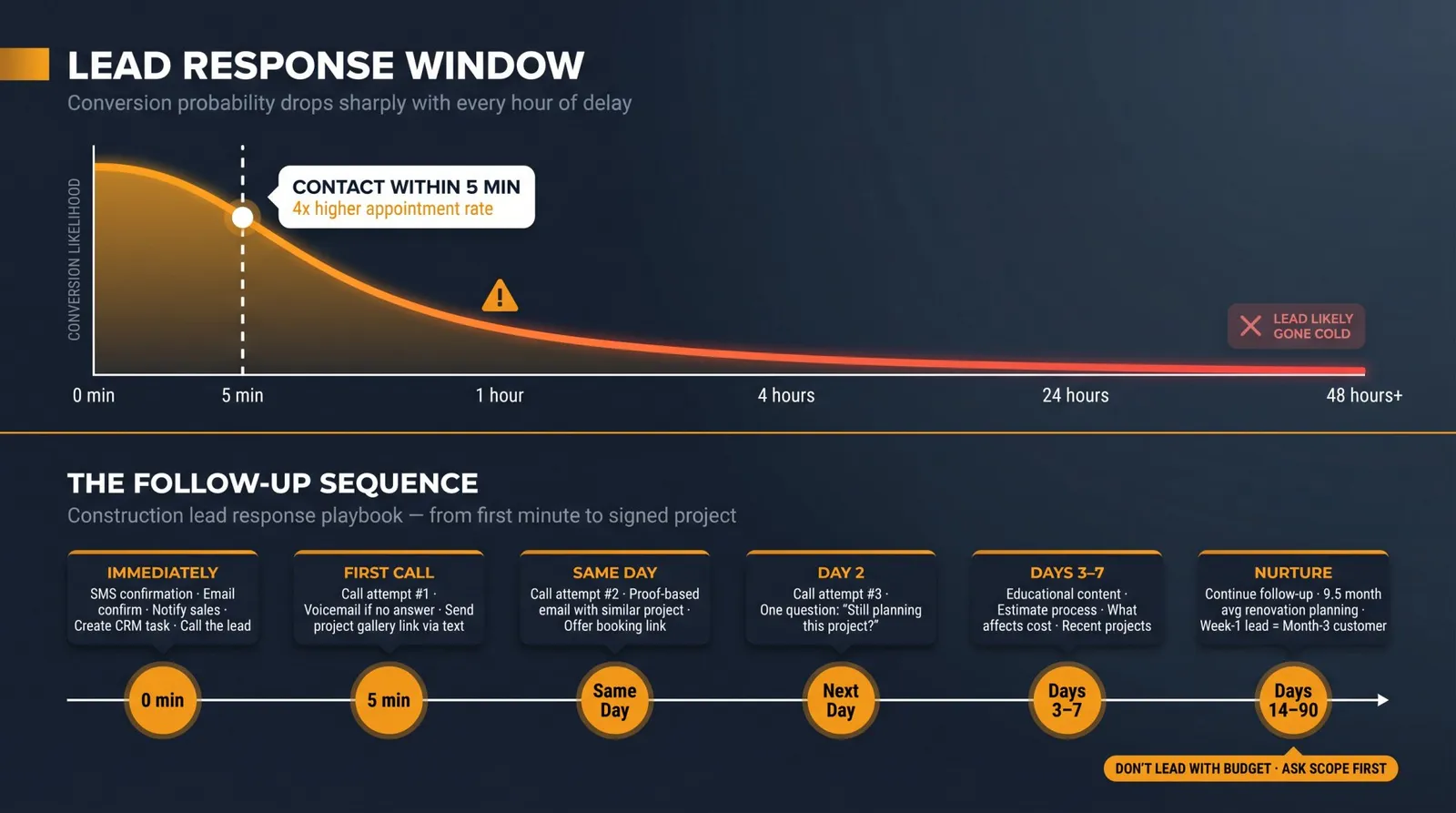
The recommended follow-up sequence:
Immediately: Send SMS confirmation (where consent allows). Send email confirmation. Notify sales or office staff. Create CRM task. Call the lead.
Within 5 minutes: First call attempt. If no answer, leave a short voicemail. Send a helpful text or email with a project gallery link.
Same day: Second call attempt. Send proof-based email: a similar project, a recent review, and clear next steps. Offer a booking link.
Next day: Third call attempt. Ask one simple question: "Are you still planning this project?"
Days 3-7: Send educational content: "How our estimate process works," "What affects project cost," "Recent projects in your area," "Questions to ask before hiring a contractor."
Days 14-90: Continue nurture. As the Houzz study shows, major renovation decisions often take months. A lead who isn't ready in week one may be your best customer in month three.
Call script opener:
"Hi [Name], this is [Rep] from [Company]. You requested information about [Project Type] through Facebook. I'm calling to learn a little more about the project, confirm the location, and see whether it makes sense to schedule an estimate or consultation."
Then: What are you hoping to have done? / Where is the project located? / What prompted the project? / Are you planning now or trying to start soon? / Have you set a budget range? / Are there other decision-makers involved? / Would a site visit or planning call be the best next step?
Don't open with "What's your budget?" before earning trust. Ask scope and context first.
What Metrics to Track for Construction Facebook Ads Beyond CPL
A construction Facebook ads dashboard that stops at CPL is telling you a small fraction of the story.
| Metric | Why It Matters |
|---|---|
| Spend | Budget control |
| Impressions | Delivery volume |
| CTR | Creative relevance |
| CPC | Traffic efficiency |
| Form open rate | Offer and creative alignment |
| Form completion rate | Form friction |
| CPL | Initial acquisition cost |
| Qualified lead rate | Lead quality |
| Contact rate | Follow-up performance |
| Appointment rate | Sales effectiveness |
| Show rate | Lead seriousness |
| Estimate rate | Opportunity quality |
| Close rate | Sales and pricing quality |
| Revenue won | Business outcome |
| Gross profit won | Real profitability |
| Cost per signed job | True acquisition cost |
| Payback period | Cash-flow impact |
UTMs: Every ad should have consistent UTMs. For example:
utm_source=facebook
utm_medium=paid_social
utm_campaign=meta_leads_kitchen_denver_apr2026
utm_content=before_after_carousel_v1
utm_term=higher_intent_form
Naming conventions make reporting faster and more reliable:
META_LEADS_KitchenRemodel_Denver_HigherIntent_Apr2026
META_RETARGET_Bathroom_Remodel_ProjectProof_Apr2026
META_VIDEO_RoofInspection_ServiceArea_Apr2026
Offline outcomes: Meta can optimize better when you send quality signals back, not just form submissions. Use your CRM to track qualified leads, booked appointments, estimates sent, and won projects, then send those signals back through Conversions API or CRM integrations. Meta's own documentation describes CRM integrations for retrieving and following up with leads, and Conversions API improves measurement across the customer journey.
Important 2026 note: Our April 2026 Meta updates roundup noted several changes relevant to construction advertisers: March 2026 attribution reclassification (only link clicks count as click-through now), Advantage campaign deprecations planned for May 19, 2026, and regional location-based ad fees beginning July 1, 2026 in several countries. If you're comparing 2026 performance data to earlier periods, annotate reports for the attribution reclassification so stakeholders don't misread a methodology change as a performance drop.
Why Your Construction Facebook Ads Aren't Working (And How to Fix Them)
When construction campaigns underperform, the problem is usually in one of five places.
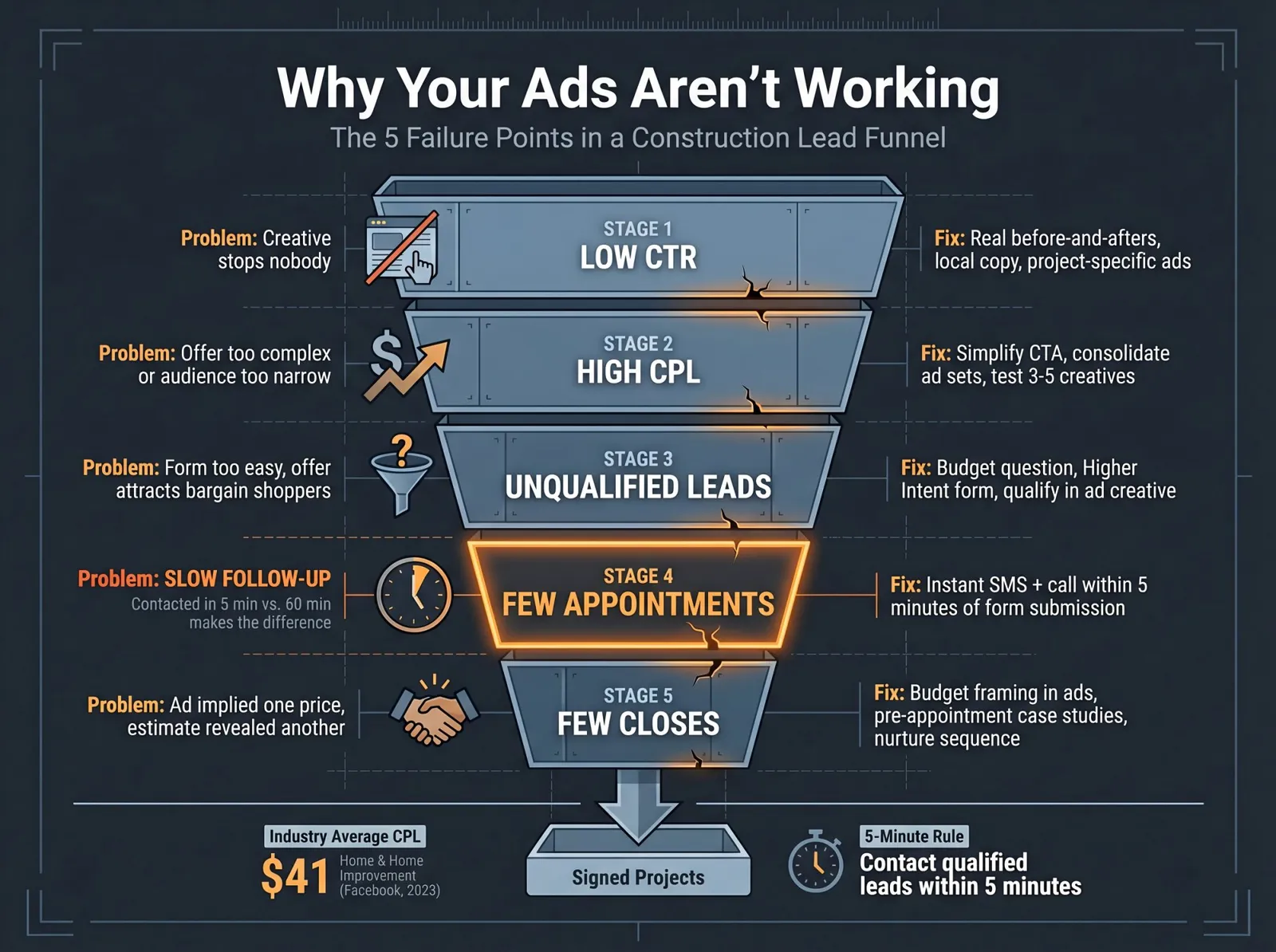
Problem: Low CTR
The most common cause is creative that doesn't stop the scroll: weak opening frame, stock photos, generic copy, an offer that isn't specific enough, no local relevance, or the wrong project type for the audience.
Fix it by:
- Using real before-and-after creative instead of stock
- Mentioning the service area directly in ad copy
- Leading with the finished outcome, not the process
- Testing project-specific ads by service line
- Adding a testimonial or review screenshot to the visual
- Swapping a static image for a 20-second video walkthrough
Problem: High CPL
| Root cause | What to try |
|---|---|
| Offer too high-friction | Test Instant Form vs. landing page |
| Form too long | Reduce to 4-5 core questions |
| Audience too narrow | Broaden to service-area targeting |
| Budget fragmented | Consolidate ad sets |
| Creative unclear | Test 3-5 new creatives at once |
Simplify the CTA. Improve message-match between the ad and the landing page.
Problem: Lots of leads, few qualified
This is a form and offer problem, not a traffic problem. The form is too easy, the offer attracts bargain shoppers, or there's no budget question filtering out poor-fit inquiries. The other common cause: sales isn't tagging lead quality in the CRM, so Meta never learns the difference.
Fixes: Add qualification questions (budget range, timeline, project type). Use the Higher Intent form type. Exclude poor-fit services from the ad creative. Send qualified/unqualified signals back to Meta via Conversions API.
Problem: Qualified leads, few appointments
The most common culprit here is slow follow-up. A qualified lead contacted within five minutes converts at a dramatically higher rate than one contacted after an hour. Every other fix is secondary to this.
Other contributing factors: weak call script, no booking link on the thank-you screen, poor lead handoff, sales team unaware of which ad offer was shown. Fix the speed first, then address each of the others in sequence.
Problem: Appointments, few closes
Ads that generate appointments but lose most of them at the estimate stage usually have a mismatch between ad messaging and budget expectations. The ad implied one price range, the estimate revealed another.
Fixes:
- Add project budget framing directly in ads and forms ("projects starting at $25k," "full kitchen remodels, not small repairs")
- Send case studies before the appointment, not after
- Improve estimate turnaround speed
- Build a post-estimate nurture sequence for homeowners still deciding
- Track estimate-to-close rate by campaign to identify where the pattern breaks
How Many Facebook Ad Variations Should Construction Companies Test?
Most construction companies don't test nearly enough creative. They run one or two ads, declare that "Facebook doesn't work for us," and walk away before the algorithm had enough data to find anything meaningful.
A practical first test for a single service:
- 3 service-specific angles
- 3 creative formats
- 2 offers
- 2 form types or landing-page paths
That's 20-40 ad variations from one focused campaign. For a remodeling company:
| Angle | Creative Format | Offer |
|---|---|---|
| Before-and-after kitchen | Carousel | Design consultation |
| Owner explains process | Video | Planning call |
| Customer testimonial | Image/video | Estimate request |
| Budget education | Video | Project-fit call |
| Recent local project | Image | Consultation |
| Common mistakes | Video | Remodel planning call |
Scale this across multiple service lines, cities, seasonal offers, and different lead form variations, and you're quickly looking at 60-100+ active test variants just to properly cover a mid-size remodeling company's market.
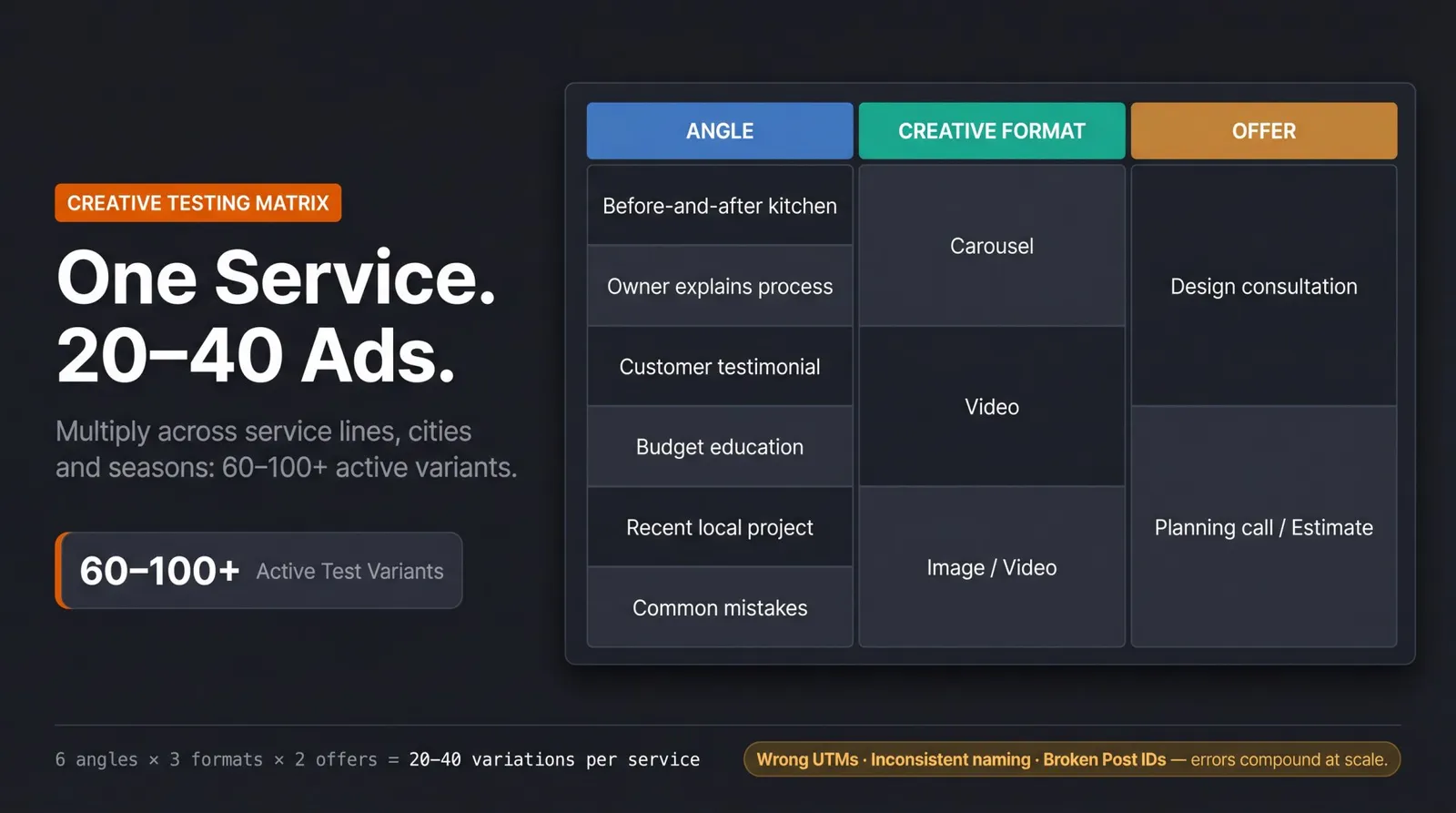
Getting all of those variations live (correctly named, UTM-tagged, properly organized by campaign and ad set, with consistent copy templates) is where most teams lose the most time. And it's where errors pile up: wrong UTMs, inconsistent naming, missing form associations, broken Post IDs on relaunched winners.
This is the operational bottleneck that slows construction advertisers down more than any strategic issue.
How AdManage Helps Construction Advertisers Scale Facebook Ads
The strategy sections above describe what a complete Facebook ads system for construction looks like. AdManage is what we built to make that system operational without it consuming your team's hours.
When a construction campaign is properly built (multiple service lines, multiple cities, multiple offers, multiple before-and-after creatives, retargeting variants, seasonal pushes), you're managing dozens of naming conventions, UTM structures, form associations, and creative groupings simultaneously. That's the operational challenge. Most platforms don't solve it. They just expose all that complexity to you in a busy dashboard.
Here's how we approach it at AdManage:
Bulk launching across service lines and markets. Instead of creating ads one by one inside Meta Ads Manager, you can bulk-launch entire batches: kitchen campaigns for Denver, bathroom campaigns for Austin, roofing campaigns for three service areas. All at once, with consistent structure.
Enforced naming conventions. Every ad that goes live follows the naming convention you set. META_LEADS_KitchenRemodel_Denver_HigherIntent_Apr2026 is the kind of name that makes filtering, reporting, and analysis possible. Without enforcement, you're piecing together what ran where months later.
UTM management. UTMs are pre-mapped and consistently applied. No more manually building UTM strings in ad copy fields and hoping nobody makes a typo. Your CRM attribution is only as good as your UTM consistency, and we make that automatic.
Copy templates per service line. Build templates for kitchens, bathrooms, roofing, decks, and commercial: each with headline variations, description variations, CTAs, and tracking specs. Load the template, adjust for the specific market or creative, launch.
Google Sheets workflow. For agencies managing multiple construction clients, our Google Sheets add-on lets you map ads by service, location, form, landing page, and UTM directly from a spreadsheet, then bulk-launch into Meta from the sheet. If your team already manages client creative briefs in Sheets, this makes the handoff from planning to launch seamless.
Cloud creative imports. Pull before-and-after assets directly from Google Drive, Frame.io, Box, or Air. For construction companies that organize project photos by job type and location, this means your creative library and your ad system are connected, not separate silos.
Post ID preservation. When you relaunch a winning ad or test it in a new market, Post ID preservation keeps the social proof (likes, comments, shares) from the original ad attached to the new one. For construction ads that have accumulated genuine community engagement, that proof carries real conversion value.
Multi-account and multi-language. Agencies running paid social for three construction clients in different regions can manage all three accounts from a single workflow, with separate naming conventions, UTM structures, and creative libraries per client.
A practical AdManage workflow for construction campaigns:
① Build a naming convention template for service type, city, offer, creative angle, and month
② Upload before-and-after assets into organized Drive or Frame.io folders
③ Create copy templates for each service line
④ Use the Google Sheets add-on to map ads by service, location, form, and UTM
⑤ Bulk launch test variations in one batch
⑥ Preserve Post IDs where social proof on winner ads matters
⑦ Use reporting and CRM data to identify winning angles
⑧ Relaunch winning ads across new service areas or project types with consistent structure
AdManage doesn't replace strategy, creative quality, or sales follow-up. It removes the operational bottleneck so your team can test more high-quality construction ads with cleaner execution, at the speed that proper creative testing actually requires.
| Manual Ad Operations | With AdManage | |
|---|---|---|
| Time to launch 50 variations | 8-15+ hours | 1-2 hours |
| Naming convention consistency | Depends on human discipline | Enforced automatically |
| UTM accuracy | Error-prone at scale | Pre-mapped and consistent |
| Creative workflow | Upload manually per ad | Bulk import from Drive/Frame.io/Box |
| Post ID preservation | Manual workaround | Built-in workflow |
| Multi-client management | Separate login/process per account | Unified with per-client settings |
Get started with AdManage, built for the teams running paid social at scale who can't afford to lose hours to manual ad operations.
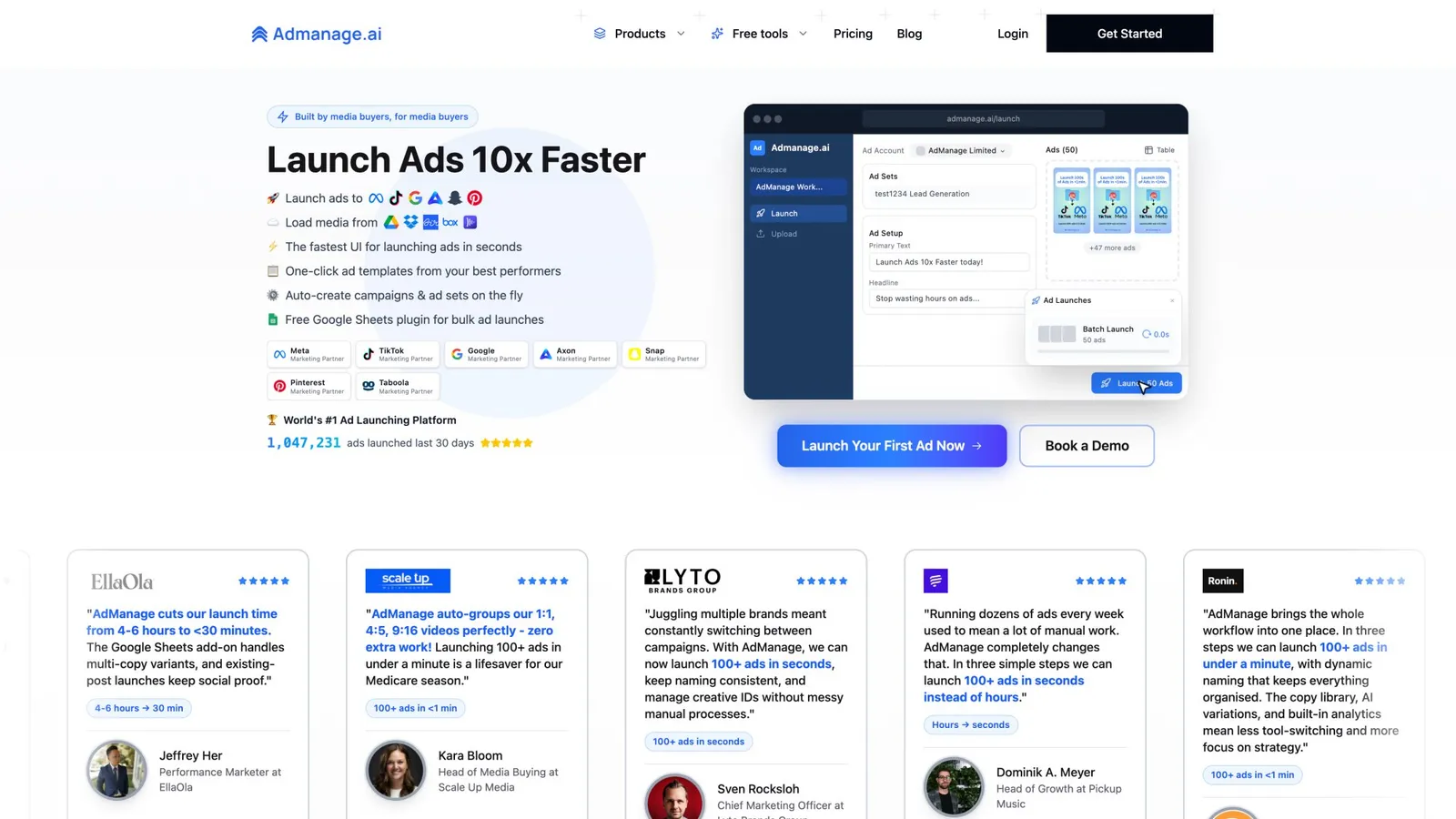
The platform that makes this possible looks like this in practice:
Your 30-Day Construction Facebook Ads Launch Plan
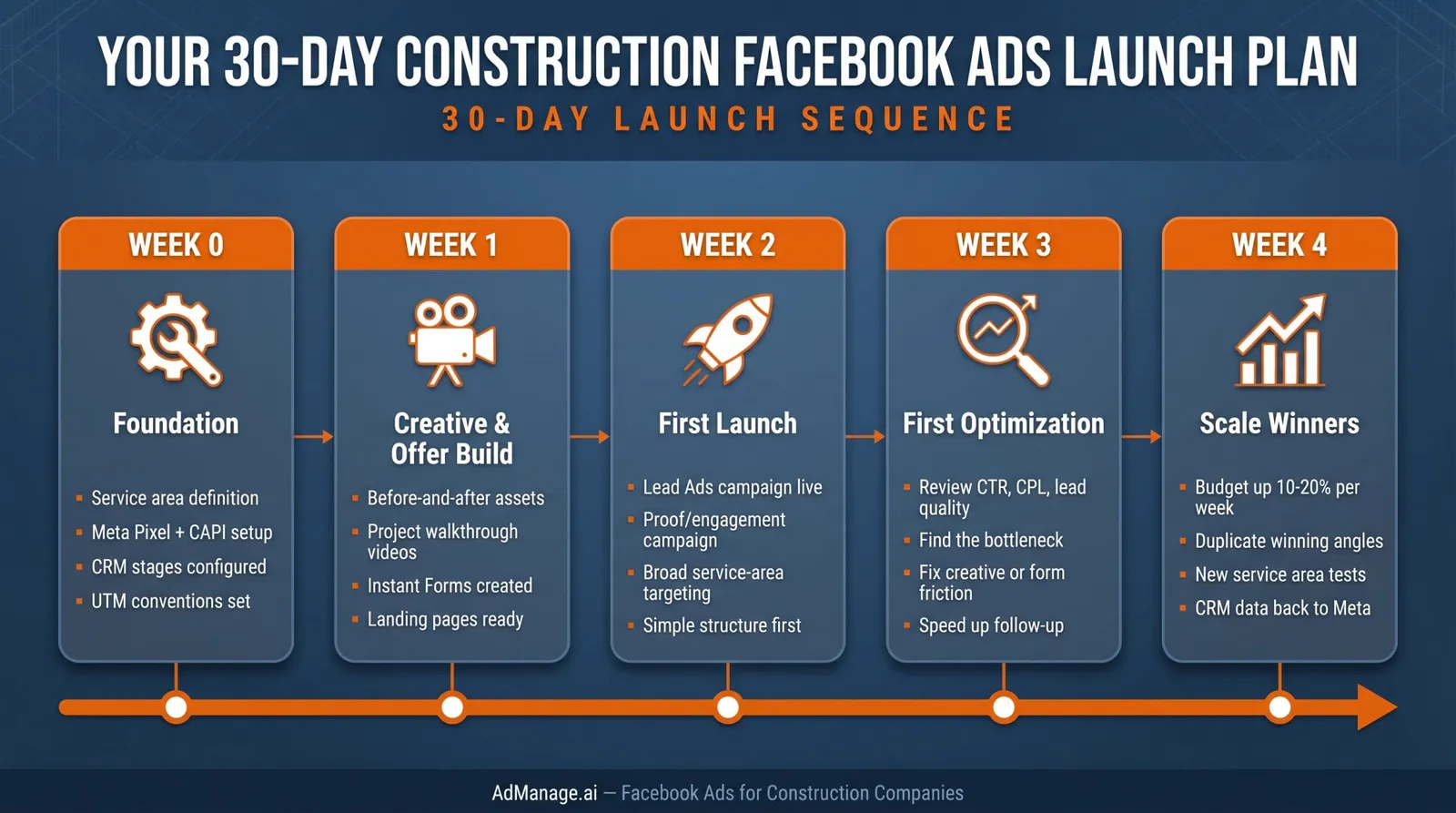
Week 0: Foundation
Before a single ad goes live:
- Define service areas (where you can actually profitably service leads)
- Choose 1-3 core services for the first test
- Set lead qualification criteria (what makes a "good" lead for sales)
- Confirm sales capacity (how many leads can the team follow up with per day)
- Create CRM stages (New lead, Contact attempted, Contacted, Qualified, Consultation booked, Estimate sent, Won, Lost, Unqualified)
- Install Meta Pixel and Conversions API where possible
- Set up lead notifications
- Create UTM and naming conventions
- Build privacy policy and consent language for lead forms
- Gather project photos, videos, testimonials, and reviews
Week 1: Creative and Offer Build
Create:
- 5-10 before-and-after assets (photos and short videos)
- 3 short project walkthrough videos (20-30 seconds each)
- 2 owner or project manager videos
- 3 testimonial assets (screenshot or short video)
- 2 educational assets (problem education or process explanation)
- 1-2 Instant Forms (one standard, one Higher Intent)
- 1 landing page per priority service
- Thank-you screen with booking link
Choose one main offer per service: "Request a kitchen remodel consultation," "Schedule a roof inspection," "Get a custom deck estimate," "Book a commercial build-out consultation."
Week 2: First Launch
Launch:
- One primary Lead Ads campaign with the best offer and creative
- One proof or engagement campaign
- One retargeting campaign if website traffic and engagement audiences are large enough
Keep the structure simple. Don't over-segment by age, gender, interest, placement, and micro-location until policy and performance justify it. Let Meta optimize with broad service-area targeting and strong creative signals first.
Week 3: First Optimization
Review: CTR, CPC, CPL, form open rate, form completion rate, qualified lead rate, contact rate, appointment rate, lead quality comments from sales.
Make changes based on where the bottleneck is:
- CTR low: change creative
- Form opens high but submissions low: simplify the form
- CPL fine but qualification poor: add questions
- Leads qualified but not booking: fix follow-up speed
- Appointments happen but don't close: fix sales process and expectation-setting
Week 4: Scale Winners
Scale only what's working:
- Increase budget gradually on winning campaigns (10-20% per week, not doubling overnight)
- Duplicate winning creative angles into new service areas or project types
- Test new hooks using the same winning offer
- Create retargeting ads based on objections your sales team is hearing
- Turn sales feedback into new ad angles
- Upload qualified lead and won-job data to Meta where possible
- Pause ads generating low-quality leads despite sufficient spend
A Complete Facebook Ads Funnel Example for a Construction Company
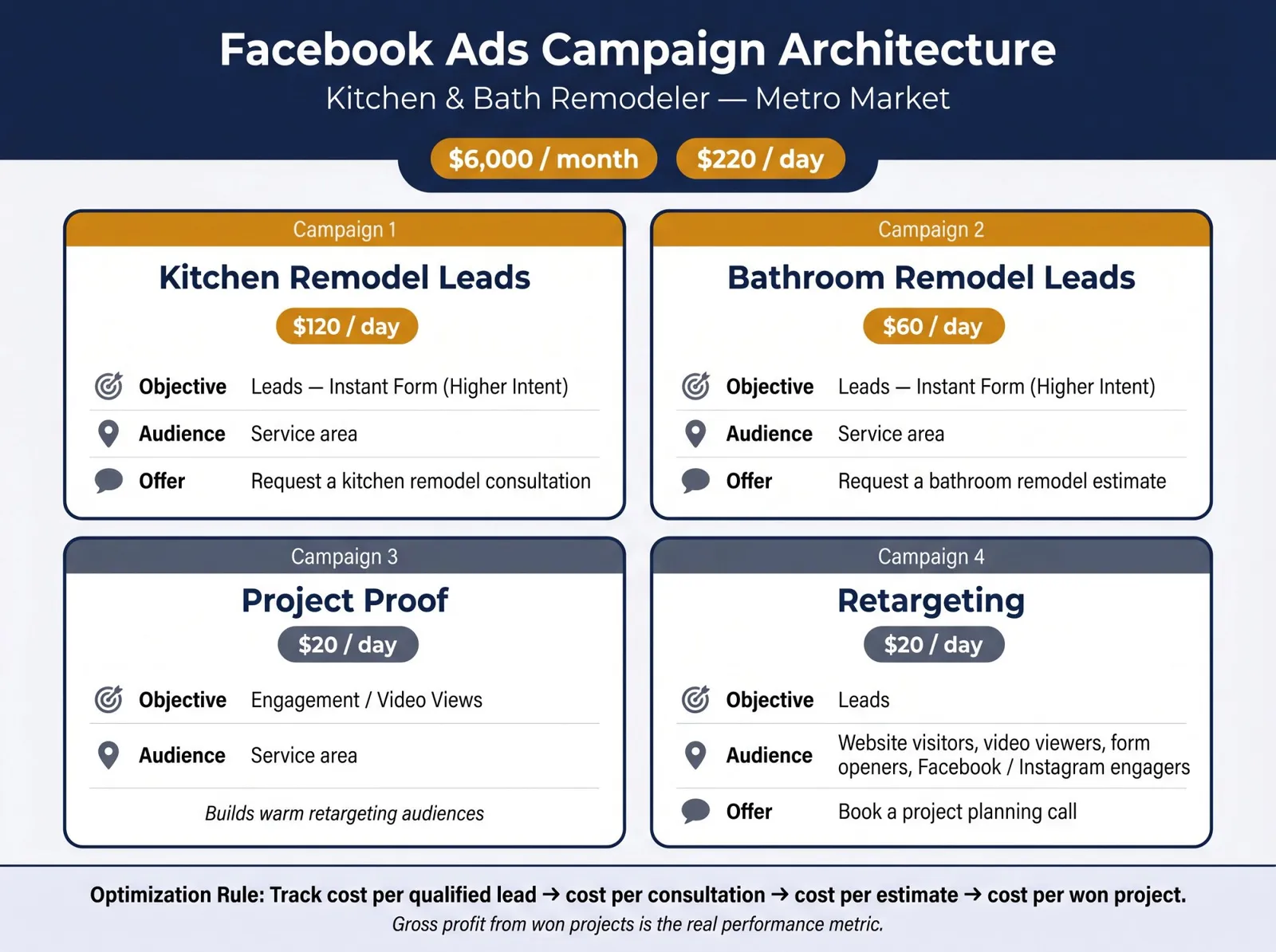
Company: Kitchen and bath remodeler in a metro market.
Goal: Generate qualified design consultation requests.
Monthly budget: $6,000.
Campaign 1: Kitchen Remodel Leads
- Objective: Leads
- Conversion location: Instant Form (Higher Intent)
- Budget: $120/day
- Audience: Service area
- Creative: Before-and-after carousel, finished kitchen walkthrough video, owner explaining design-build process, customer testimonial
- Offer: Request a kitchen remodel consultation
Campaign 2: Bathroom Remodel Leads
- Objective: Leads
- Conversion location: Instant Form (Higher Intent)
- Budget: $60/day
- Audience: Service area
- Creative: Bathroom transformation carousel, curbless shower video, "What affects bathroom remodel cost" educational video
- Offer: Request a bathroom remodel estimate
Campaign 3: Project Proof
- Objective: Engagement or video views
- Budget: $20/day
- Audience: Service area
- Creative: Recent projects, time-lapse clips, client testimonials, process videos
Campaign 4: Retargeting
- Objective: Leads
- Budget: $20/day
- Audience: Website visitors, form openers, video viewers, Facebook/Instagram engagers
- Offer: Book a project planning call
- Creative: Reviews, "How our consultation works," "What happens after you request a quote," case study
Form questions: What project are you planning? / What city is the home in? / What is your estimated budget? / When would you like to start? / Are you the homeowner or decision-maker? / What is the best time to call?
CRM stages: New lead, Contact attempted, Contacted, Qualified, Consultation booked, Consultation completed, Estimate sent, Won, Lost, Unqualified.
Optimization rule: Don't judge by CPL alone. Track cost per qualified lead, cost per consultation booked, cost per estimate sent, and cost per won project. Gross profit from won projects is the real performance metric.
Facebook Ads for Construction: Common Questions Answered
Do Facebook ads work for construction companies?
Yes, but they work best when treated as a complete lead generation system, not a "boost post and wait for calls" approach. The strongest results come from specific service offers, real project creative, qualifying lead forms, fast follow-up, and CRM-connected measurement. Construction companies that approach it this way consistently generate profitable leads. Those that treat it as a broadcast channel mostly get frustrated.
What is a good cost per lead for construction Facebook ads?
Recent 2025 Facebook Lead Ads benchmarks reported a 41.26 average CPL** for Home & Home Improvement and **37.34 for Industrial & Commercial. But your real target CPL depends on your trade, market, average project value, and close rate. A remodeler can profitably pay 150-250 per qualified lead if their project values and margins support it. The better question is: what's your maximum CPL based on your actual numbers? Run the backwards math first.
Are Facebook leads lower quality than Google leads?
Often, yes. At the raw lead level, Google search leads typically have higher immediate intent because the person is actively searching for a contractor right now. Facebook leads tend to be earlier in the buying journey, but they can be significantly cheaper, more scalable, and highly valuable when properly qualified and nurtured. Compare cost per booked appointment and cost per signed job across channels, not just CPL.
Should contractors use Instant Forms or landing pages?
Use Instant Forms for speed, mobile conversion, and simple estimate or inspection offers. Use landing pages for high-ticket, complex, or trust-heavy projects that need more proof before the prospect is ready to submit. Many construction advertisers benefit from using both and retargeting between them.
What Facebook campaign objective should construction companies use?
Use the Leads objective for lead generation campaigns. Meta's Leads objective is designed to help businesses find potential customers, and lead ads support Instant Forms, calls, or messaging depending on campaign setup. For proof and awareness campaigns, use Engagement or Video Views.
What should construction companies put in the lead form?
Ask for contact information plus project type, location, timeline, budget range, and decision-maker status. For higher-ticket services, use a Higher Intent form so prospects review their information before submitting. For commercial leads, add space type, square footage, and whether the lease is signed.
How much should a construction company spend on Facebook ads?
A local contractor can start around 50-100/day. Remodelers, roofers, window companies, and outdoor living contractors often need 100-250/day to generate enough data quickly. Commercial contractors and custom builders may spend less on lead volume but more on proof, retargeting, and nurture content. The right budget depends on your target CPL, sales capacity, and the cost of your acceptable customer acquisition.
Can construction companies use before-and-after photos?
Yes: before-and-after creative is consistently one of the strongest formats for construction, as long as the work is real, claims are accurate, and the ad doesn't use misleading or prohibited claims. Authentic project transformations build trust faster than almost any other format.
Do construction ads need Meta's Housing Special Ad Category?
It depends on the ad, offer, landing page, and business model. Meta says housing ads include ads that promote or directly link to housing opportunities or related services, and advertisers running those ads need to specify the relevant Special Ad Category. Construction advertisers should review Meta's current guidance carefully. A new-home community ad, a roofing replacement ad, and a commercial tenant improvement ad may not be treated the same way. Don't try to bypass the policy. Not legal advice.
How do I reduce junk leads from Facebook?
Use more specific offers (not just "free quote," but "free kitchen remodel consultation" or "free roof inspection"), real project proof creative, Higher Intent forms, budget range questions, service-area questions, and timeline questions. Make sure your sales team tags lead quality accurately in the CRM, and send that qualified/unqualified feedback back to Meta through Conversions API so the algorithm learns what a good lead looks like.
Should construction companies run Facebook ads and Google ads together?
Usually yes. Google captures active demand from people already searching for a contractor. Facebook creates and nurtures demand earlier in the planning journey, shows proof, retargets interested prospects, and can capture leads months before they'd ever search. The best mix depends on budget and service type, but the channels work better together than either works alone.
How to Build a Facebook Ads System That Wins for Construction
Facebook ads can be a profitable lead generation channel for construction companies in 2026, but only when built as a complete system.
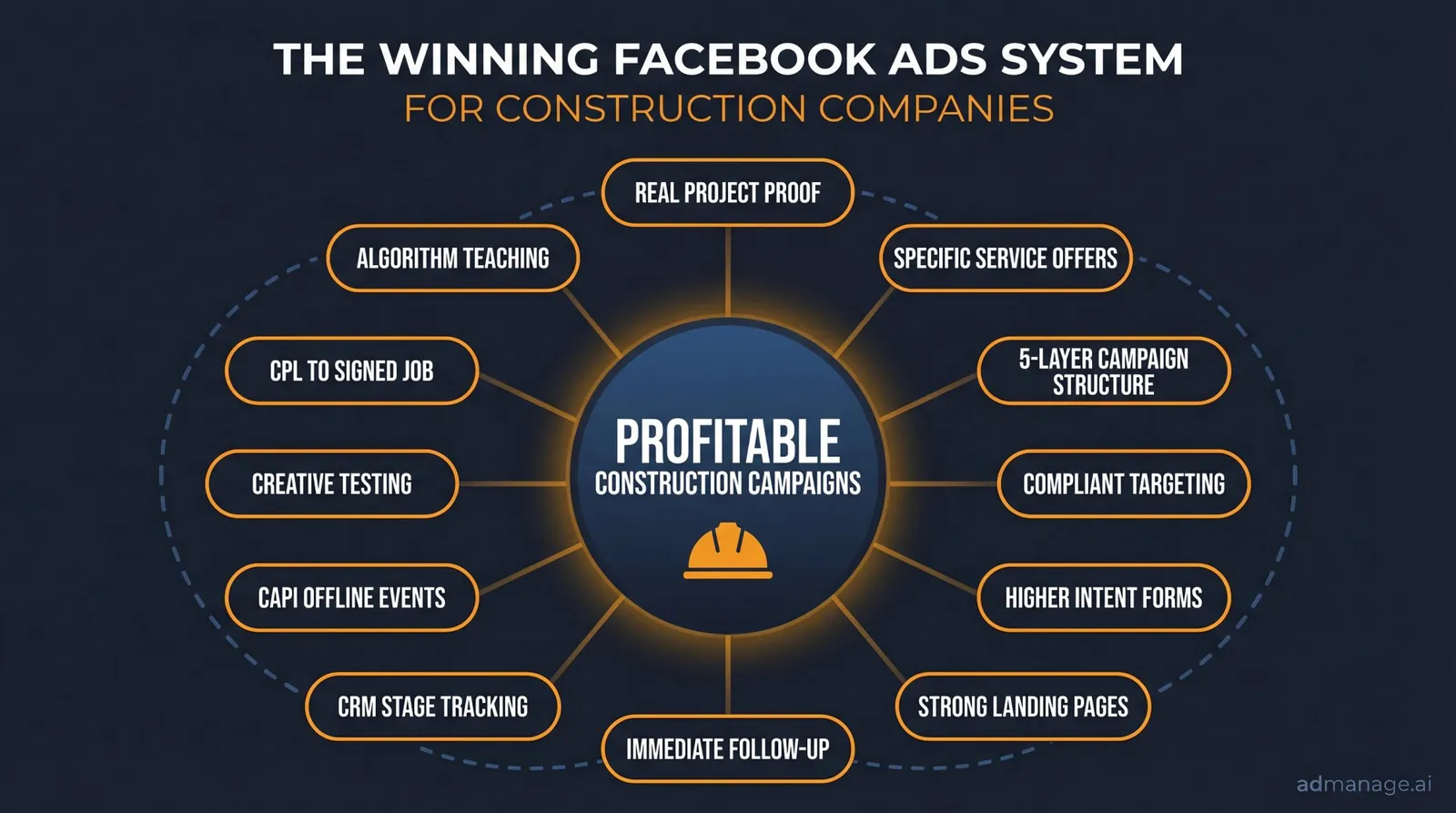
The winning system has these components:
- Real project proof in every campaign layer
- Specific service offers (not generic "free quotes")
- Clean campaign structure across all five layers
- Compliant targeting (including Special Ad Category awareness)
- Higher-intent lead forms with proper qualification questions
- Strong landing pages for high-ticket or complex projects
- Immediate follow-up (within five minutes, not five hours)
- CRM qualification and stage tracking
- Offline conversion tracking back to Meta via CAPI
- Continuous creative testing
- Measurement beyond CPL, all the way to cost per signed job
The contractors who lose money usually ask Meta for "leads." The contractors who win teach Meta what a qualified project opportunity looks like, then let the algorithm find more of them.
That's the real difference.
If you're ready to stop spending hours on manual ad operations and start testing at the speed construction campaigns actually require, AdManage was built for exactly this. From bulk launching to naming conventions to UTM management to Google Sheets workflows, we handle the operational side so your team can stay focused on strategy, creative, and closing.
Start scaling your construction campaigns with AdManage and see why performance marketing teams trust us to launch hundreds of ad variations without breaking naming, UTMs, or social proof.