
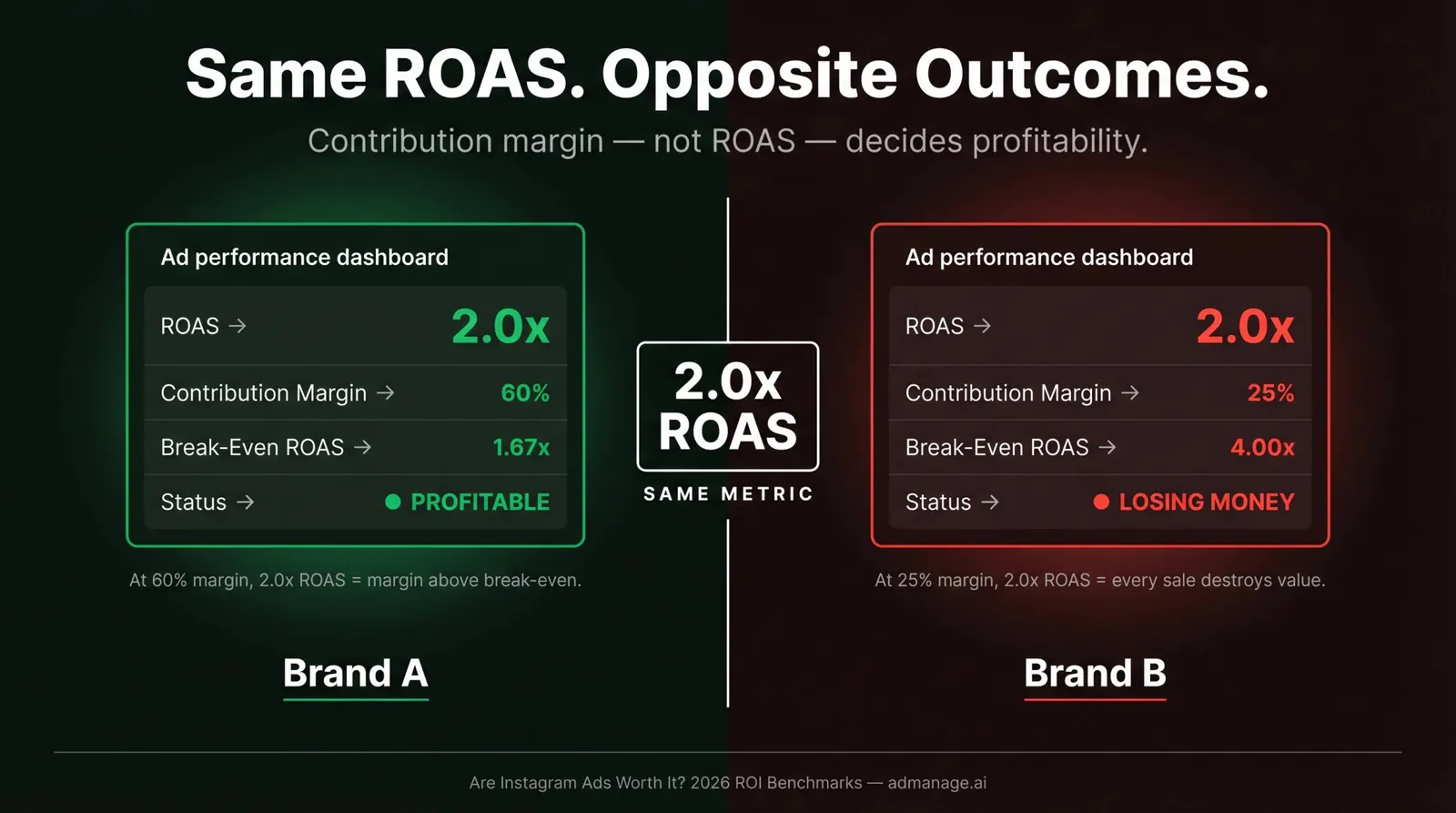
Two brands. Both running Instagram ads. Both hitting 2.0 ROAS in Meta Ads Manager. One is profitable. The other is losing money on every customer they acquire.
Same platform. Same metric. Opposite outcomes.
This isn't a glitch in the math. It happens because ROAS doesn't tell you if you're making money. Your contribution margin does. A brand with 60% margin can survive a 2.0 ROAS and grow. A brand with 25% margin needs 4.0 ROAS just to break even before overhead.
If you've been judging Instagram ads by benchmarks you found online without running your own break-even calculation first, you've been asking the wrong question. This guide gives you the right framework: a break-even ROAS formula, current 2026 cost benchmarks, a diagnostic table for your specific numbers, and a 30-day test plan.
At AdManage, we've worked with performance teams managing $50M+ in ad spend across D2C brands like Photoroom, Zoe, and MVF, and the most common reason Instagram "doesn't work" isn't the platform. It's the math going unchecked and the creative volume going too low.
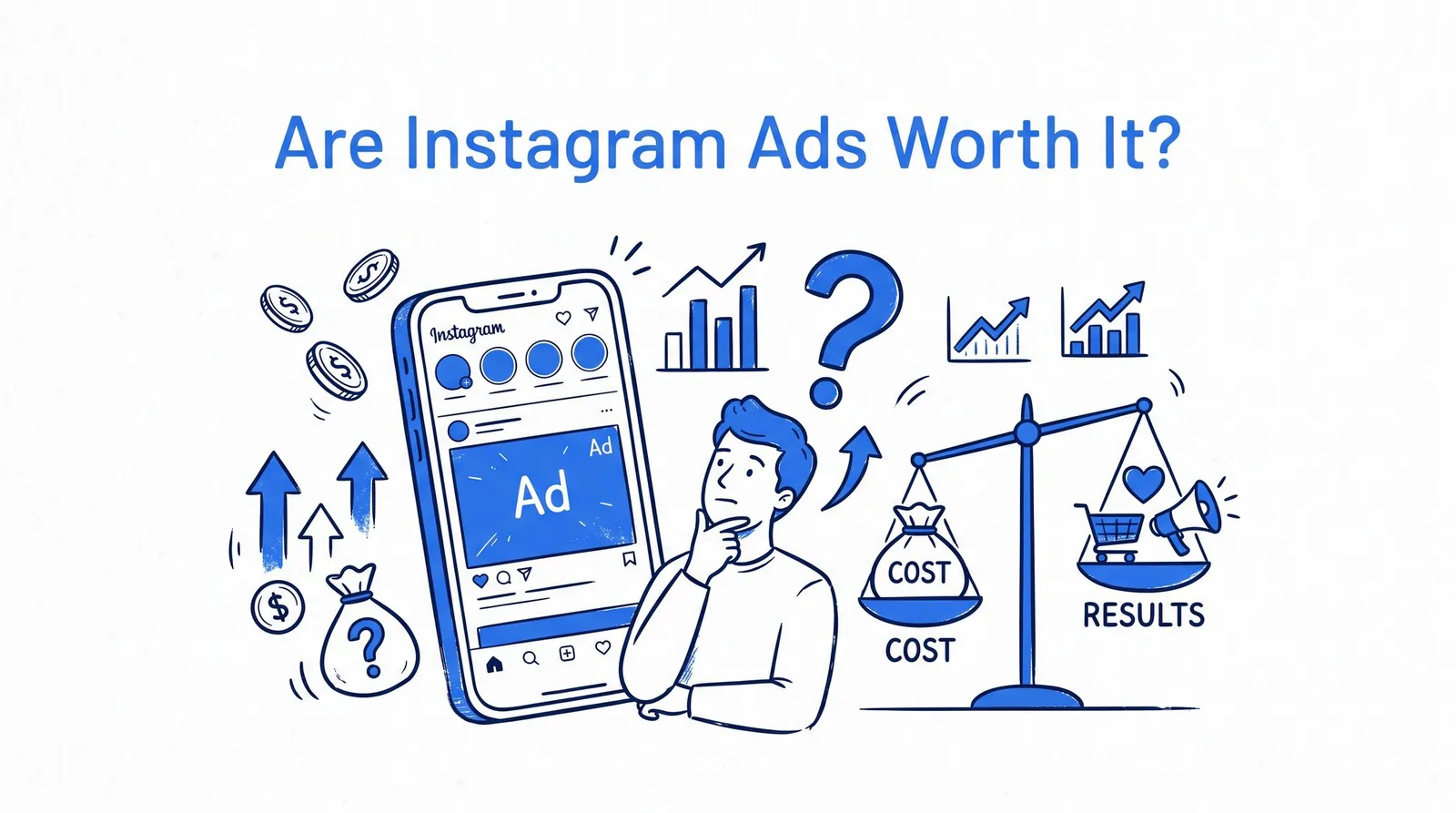
Is Instagram Still a Good Ad Platform in 2026?
Instagram advertising isn't dying. The advertising environment is getting more demanding, but the underlying scale of the platform keeps growing. DataReportal's April 2026 global snapshot puts worldwide social media user identities at 5.79 billion, roughly 69.9% of the global population, and more than 30% of adult internet users say they discover brands through social ads.
Meta's own numbers back this up. In Q4 2025, Meta reported 3.58 billion Family daily active people, ad impressions up 18% year over year, and average price per ad up 6%. For all of 2025, Meta posted $200.97 billion in revenue, with ad impressions growing 12% and average ad prices rising 9% for the year. More impressions means more inventory. Higher average prices means stronger advertiser demand. That combination also means brands with weak creative or bad unit economics get punished faster.
The format mix has also shifted. Tinuiti's Q1 2026 Digital Ads Benchmark Report found Reels accounting for 33% of Instagram ad impressions, the highest share it's ever reported. A Reels-first creative strategy is now the baseline for 2026, not just a nice-to-have alongside Feed.
In 2026, Instagram ads aren't dead. Lazy Instagram ads are dead.
Static creative, slow testing cycles, narrow interest targeting, and ROAS-only analysis won't cut it anymore. The platform rewards advertisers who feed it volume, variety, and clean conversion signals. That's why having a structured creative testing system matters more now than it did two years ago.
Instagram Ad Cost Benchmarks 2026: CPM, CPC, and CTR
Use this table as a planning reference, not a target. These ranges pull from Instagram-specific sources where available and Meta-wide sources where Instagram-only data isn't separated. Because most performance advertisers run Instagram through Meta Ads Manager (often with blended placements), Meta-wide benchmarks are still directionally useful.
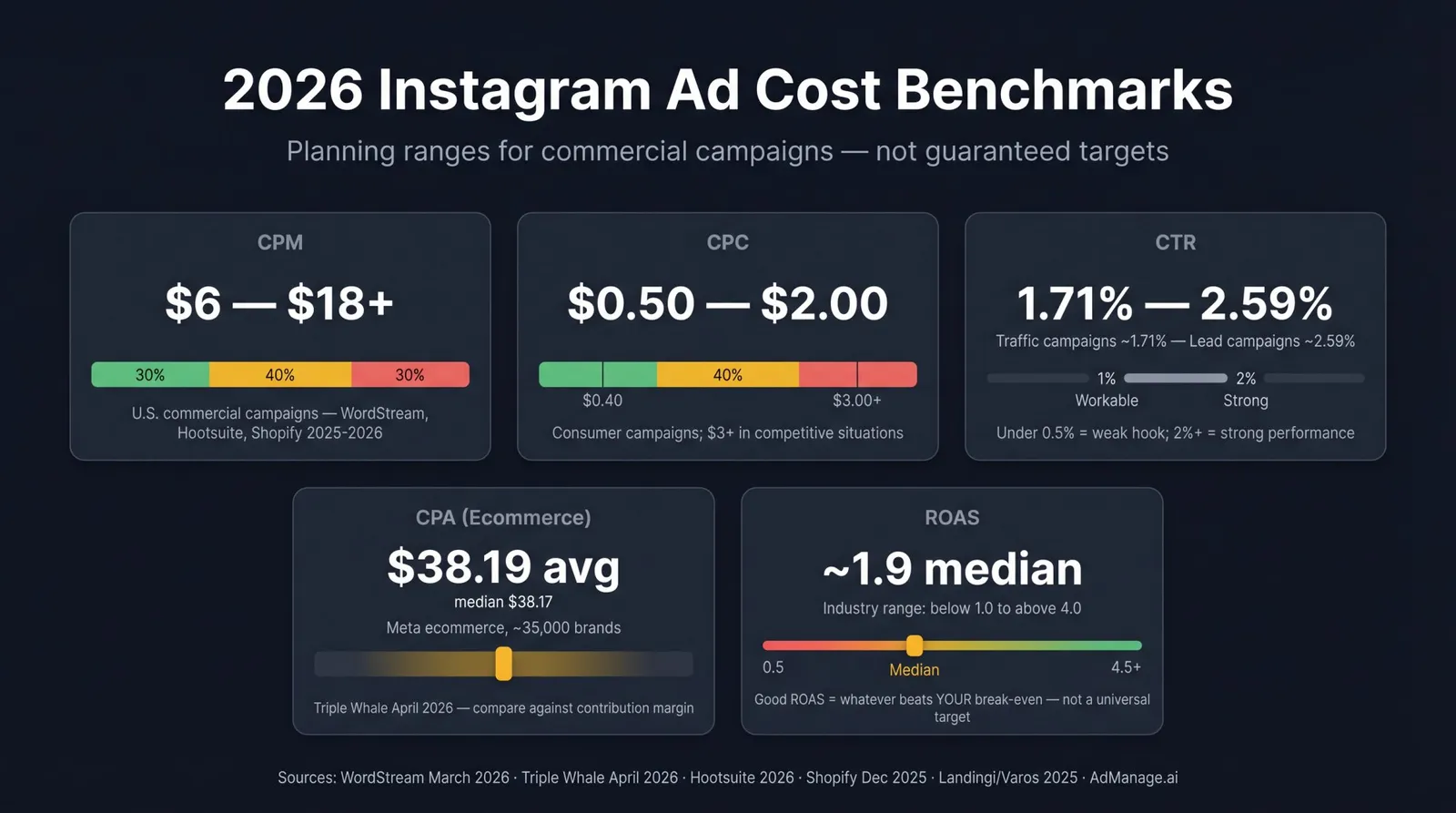
| Metric | 2026 Planning Range | What "Good" Looks Like | Source |
|---|---|---|---|
| CPM | ~6–18+ for most commercial campaigns | Lower CPM only matters if traffic converts | WordStream March 2026 (2–6 for better-performing); Hootsuite 2026 (9.46 average); Shopify Dec 2025 U.S. (16.25) |
| CPC / link CPC | ~0.50–2.00 for most consumer campaigns; $3+ in competitive situations | Sub-$1 clicks are only strong if downstream conversion quality holds | WordStream March 2026: 0.40–0.70 average CPC, 0.50–1.20 link CPC; Hootsuite/Shopify: ~1.31–1.39 |
| Cost per engagement | 0.03–0.08 | Useful for content testing; not a substitute for CAC or ROAS | WordStream March 2026 |
| CTR | Traffic campaigns ~1.71%, lead campaigns ~2.59%, ecommerce ~2.19% | Under 0.5% usually means weak hook or wrong objective; 1%+ workable; 2%+ strong for performance campaigns | WordStream 2025 benchmarks; Triple Whale 2025 ecommerce Meta dataset |
| Lead conversion rate | ~7.72% average on Facebook lead campaigns | Low rate usually means weak offer, form, or traffic quality | WordStream 2025 benchmarks |
| Ecommerce CVR | ~1.6% average, 1.57% median | Below 1% requires high AOV, high margin, or strong LTV to work | Triple Whale April 2026 Meta ecommerce benchmark, ~35,000 brands |
| Cost per lead (CPL) | ~$27.66 average Facebook lead campaign | Good depends entirely on close rate and customer value | CPL benchmarks vary significantly by industry; WordStream 2025 |
| Ecommerce CPA | ~38.19 average, 38.17 median (Meta ecommerce) | Compare this against contribution margin and payback period, not just revenue | Triple Whale April 2026 |
| ROAS | Meta ecommerce median ~1.9; industry ranges from below 1.0 to above 4.0 | "Good ROAS" is whatever beats your break-even and is incremental | Triple Whale April 2026; Landingi/Varos 2025 |
One important caveat: most of this data is Meta-wide, not Instagram-only. A 2026 Meta benchmark breakdown breaks out Instagram placement specifically, showing Instagram Feed CTR at 0.22%–0.88%, Stories CTR at 0.33%–0.54%, Instagram Feed CPC around 3.35**, and Stories CPC around **1.83. The placement-level picture differs from blended Meta averages, which is why running with Meta placement flexibility and then reviewing Instagram's contribution is usually a better starting point than forcing Instagram-only delivery.
For a dedicated breakdown of what Instagram ads actually cost across all placements, see our full Instagram ad cost guide. And if you're wondering whether your CPM benchmarks vary significantly by industry compared to what you're seeing in your account, the industry-level picture is worth checking.
How to Calculate Your Break-Even ROAS (With Formula)
Every industry benchmark table, every "what's a good ROAS?" post, every agency case study is irrelevant until you know this number for your business.
Break-even ROAS = 1 ÷ contribution margin
Contribution margin should be calculated after product cost, shipping, fulfillment, payment fees, discounts, returns, and any other variable costs. Not before.
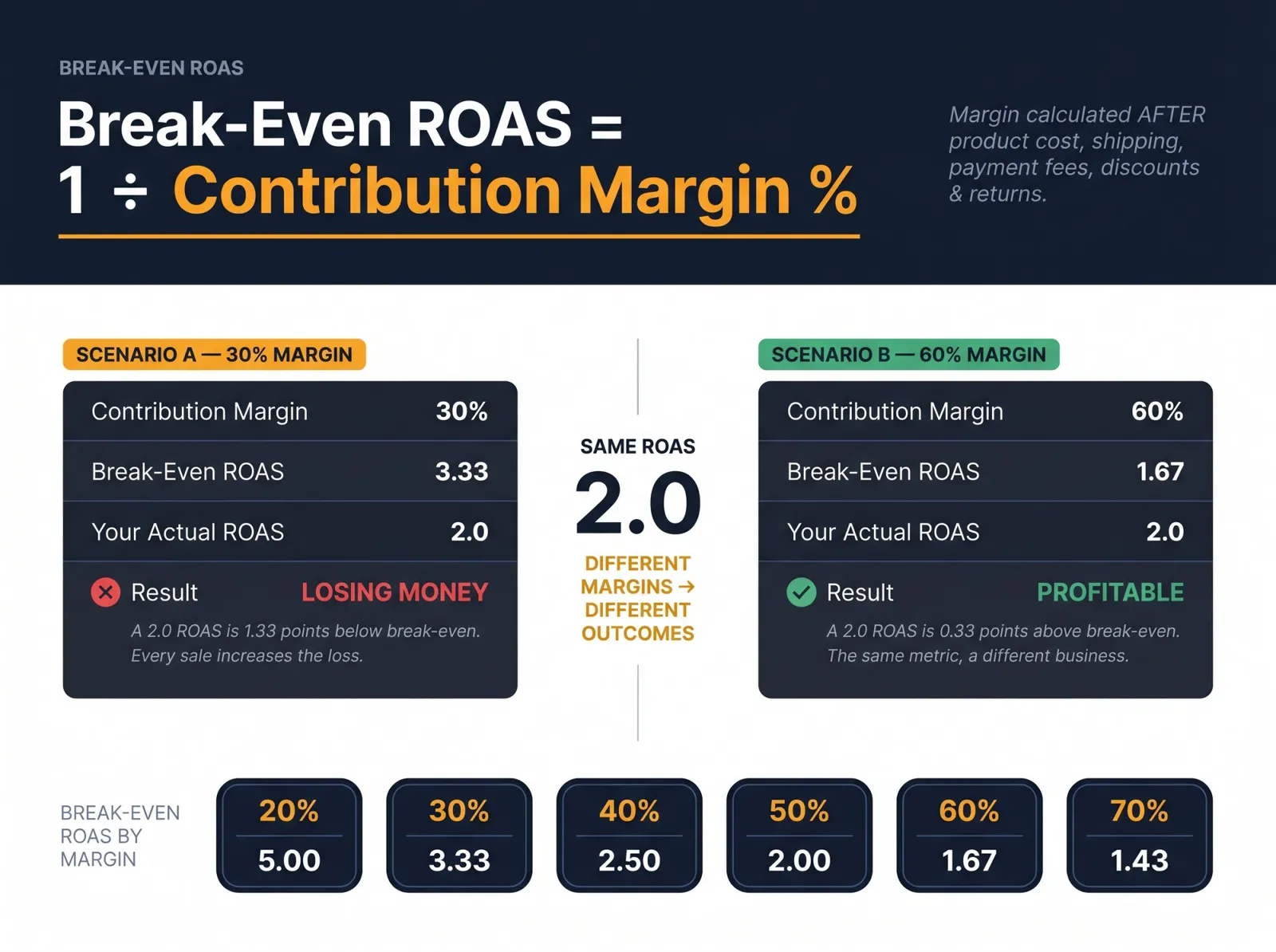
| Contribution Margin After Variable Costs | Break-Even ROAS |
|---|---|
| 20% | 5.00 |
| 30% | 3.33 |
| 40% | 2.50 |
| 50% | 2.00 |
| 60% | 1.67 |
| 70% | 1.43 |
This is why public ROAS benchmarks are dangerous without context. If your contribution margin is 30%, a 2.0 ROAS is losing money before a single dollar of fixed cost. If your margin is 60%, that same 2.0 ROAS may be profitable even after overhead.
Triple Whale's April 2026 Meta ecommerce benchmark reports a median ROAS of 1.93 across nearly 35,000 brands. That's useful to know. But if your break-even is 3.33, the industry median being 1.93 doesn't help you. The median can't tell you whether your specific account is on the right side of profitable.
Industry differences also matter. Landingi's January 2026 report using Varos 2025 data shows Meta Ads ROAS ranging from 4.39 for baby products to 0.98 for books. A full breakdown:
| Industry | 2025 Meta Ads Median ROAS |
|---|---|
| Baby | 4.39 |
| Entertainment | 3.27 |
| Electronics | 2.95 |
| Toys | 2.69 |
| Fashion | 2.65 |
| Home & Garden | 2.60 |
| Sports & Fitness | 2.41 |
| Food & Beverages | 1.67 |
| Beauty | 1.57 |
| Education | 1.54 |
| Healthcare | 1.20 |
| Books | 0.98 |
Source: Landingi / Varos 2025 Meta Ads benchmarks, published January 2026
Don't copy your industry's median as a target. Use it as a reality check. If your break-even ROAS is 3.3 and your industry median is 1.6, Instagram cold prospecting may not be viable unless you have a real edge in AOV, margin, offer, or conversion rate.
Meta has also published research claiming advertisers using its AI-driven ad tools saw [**4.52 in revenue per ad dollar**](https://about.fb.com/news/2025/05/over-half-trillion-dollars-3-million-us-jobs-linked-metas-ai-driven-ads-technologies/) compared to 3.71 across U.S. advertisers in the study. Worth knowing, but it's Meta-funded, revenue-based, and not profit-based. Don't treat it as a guaranteed margin target.
The better questions to ask instead of "is 2.0 ROAS good?"
- What is our contribution margin after variable costs?
- What is our repeat purchase rate or lifetime value?
- How much payback delay can our cash flow tolerate?
- Is the revenue incremental, or would some of it have happened without the ad?
- Are we measuring new customers separately from returning customers?
- Are we over-crediting retargeting?
Answering that last question (whether retargeting is over-credited) usually requires looking beyond last-click models. Multi-touch attribution frameworks give you a more accurate picture of which touchpoints are actually converting versus which are just claiming credit for purchases that would have happened anyway.
That's how you actually decide whether Instagram ads are worth it.
Instagram Ads ROI by Business Model: Ecommerce, Lead Gen, Apps, B2B
The right benchmark depends on what you're selling. Here's how Instagram tends to work across different business models.
Do Instagram Ads Work for Ecommerce and DTC Brands?
Instagram is still one of the strongest discovery channels for visual categories: apparel, beauty, home, food, fitness, baby, pets, and consumer electronics. Triple Whale's April 2026 Meta ecommerce benchmark shows:
- $14.19 average CPM
- 2.19% average CTR
- 1.6% average conversion rate
- $38.19 average CPA
- 1.86 average ROAS
- $71.69 average order value
The same dataset shows Meta accounting for 68.31% of total ad budget among the brands analyzed, which signals that despite rising costs, ecommerce teams aren't abandoning the channel.
Verdict: Instagram ads are usually worth testing for ecommerce if you have at least one of these: 40%+ contribution margin, $60+ AOV, strong repeat purchase or subscription economics, a product that demonstrates well visually, enough creative output to test new hooks weekly, and clean purchase tracking with new-customer reporting. They're risky if you're selling a low-margin commodity, your site converts poorly, or your "creative strategy" is one static image and a discount code. For ecommerce and DTC brands looking for the full playbook, our Meta ads guide for ecommerce covers the complete setup and optimization process.
Do Instagram Ads Work for Lead Generation?
CPL by itself is a weak signal. Lead quality, close rate, and downstream revenue matter more. Industry research puts average CPL at 27.66**, but [the range by industry is enormous](https://admanage.ai/blog/facebook-ads-cost-per-lead-benchmarks): restaurants at **3.16, real estate at 16.61**, health and fitness at **52.98, beauty at 51.42**, and dental at **76.71.
Verdict: Instagram ads work for lead gen when you know your lead-to-sale conversion rate, you can contact leads quickly, you have a strong offer, your customer value supports the CPL, and you track qualified leads (not just form fills). A 60 lead is expensive for a 99 offer. It's cheap for a $5,000 service with a 20% close rate.
Are Instagram Ads Worth It for Apps and Mobile?
Instagram is mobile-native and highly visual, which are real advantages for app advertisers. But app campaigns need strong event tracking, app install attribution, and LTV models.
Verdict: Worth it when you optimize beyond installs, track trial starts and subscription conversions, maintain enough creative volume to refresh frequently, and can segment by geography, platform, and payback period. Campaigns that optimize for cheap installs instead of activated, paying users tend to produce misleading numbers. The three metrics app marketers actually need are worth understanding before building your Instagram app campaign strategy.
Should B2B and SaaS Companies Run Instagram Ads?
Instagram can work for B2B, but not typically as a last-click acquisition channel. It's often better for retargeting, founder-led content, product education, and demand creation at the top of the funnel.
Verdict: Worth testing for B2B if your buyer spends time on Instagram, you have short and visual educational content, you measure pipeline influence rather than just direct demo bookings, and you're using Instagram alongside search, LinkedIn, email, and retargeting. For high-intent demand capture, Google Search and LinkedIn are usually stronger starting points.
Are Instagram Ads Worth It for Local Businesses?
Instagram works for local businesses when the offer is visual, timely, and geographically specific: gyms, salons, restaurants, events, real estate, and premium services.
Verdict: Worth testing if the local market is large enough, you have strong social proof, you use video or before/after content, and you track calls, bookings, and appointments, not just likes.
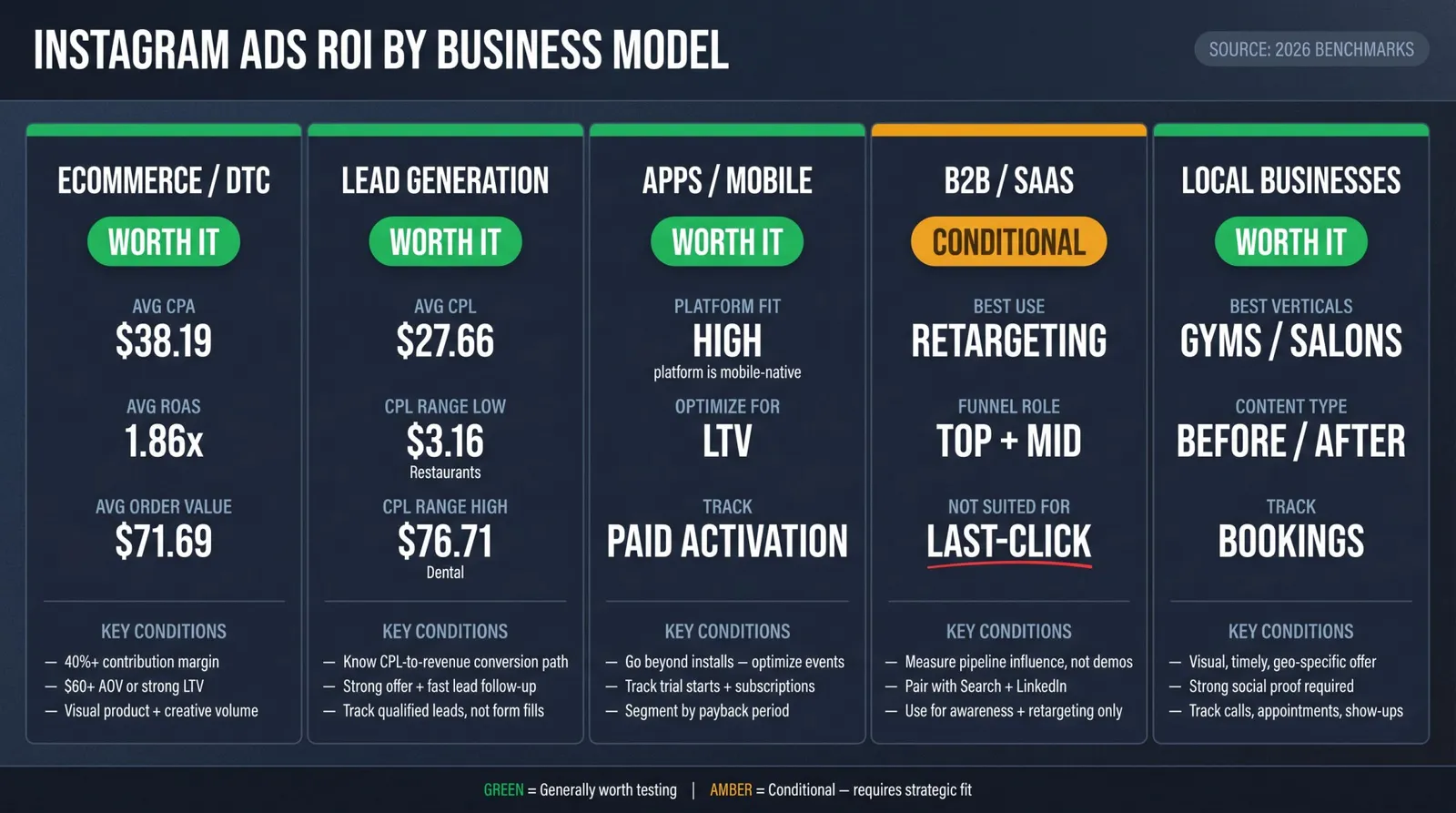
| Business Model | Generally Worth It? | Key Conditions |
|---|---|---|
| Ecommerce / DTC | Yes, for visual products | 40%+ margin OR strong LTV; creative volume |
| Lead gen | Yes, with right metrics | Know CPL-to-revenue path; have strong offer |
| Apps | Yes, with LTV model | Optimize beyond installs; track paid activation |
| B2B / SaaS | Conditionally | Use for awareness + retargeting; not last-click |
| Local businesses | Yes, for visual services | Strong offer; track bookings not engagement |
Why Instagram Ad Costs Vary So Much and What You Can Control
Two advertisers can target the same country and see completely different CPMs, CPCs, and CPAs. Here are the primary drivers.
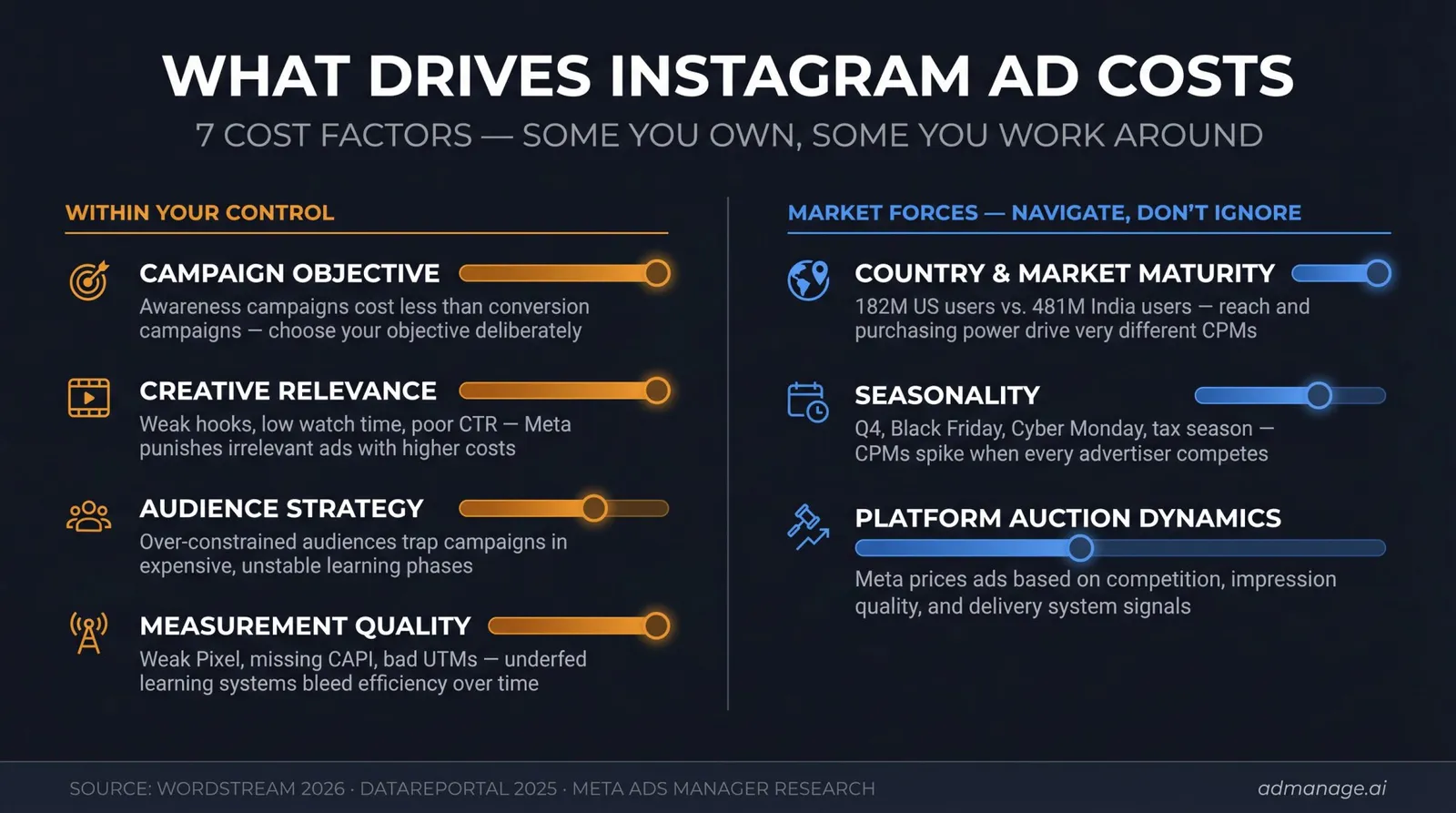
1. Campaign objective. Awareness, traffic, leads, and sales campaigns are priced differently because Meta optimizes for different outcomes. WordStream notes that objective is one of the biggest cost drivers, with awareness generally cheaper than conversion-focused campaigns.
2. Click quality. A low CPC isn't automatically good. Cheap clicks that don't convert are expensive. For ecommerce, the useful question isn't "what's our CPC?" but "what's our cost per qualified session, add-to-cart, and new customer?" For lead gen: "what's our cost per qualified lead and closed customer?"
3. Creative relevance. Meta's auction rewards ads that people respond to. Weak hooks, low watch time, poor CTR, and low engagement can increase costs. Research shows that low CTR pushes costs up because the ad isn't resonating.
4. Country and market maturity. A U.S. prospecting campaign and an India awareness campaign won't have the same cost structure. DataReportal reports 182 million Instagram users in the U.S. and 481 million in India in late 2025, but reach, purchasing power, and ad prices differ noticeably.
5. Seasonality. Q4, Black Friday, Cyber Monday, tax season, and category-specific peaks can move CPMs fast. Budget accordingly.
6. Audience size and learning phase dynamics. Too many targeting constraints can trap campaigns in expensive, unstable learning. Audience size and learning phase dynamics affect costs meaningfully, and too-narrow audiences are one of the more common culprits.
7. Measurement quality. If your Pixel, Conversions API, app events, UTMs, and CRM mapping are weak, Meta optimizes with poor feedback. Your dashboard may show numbers, but the learning system is underfed. That shows up in cost efficiency over time.
How to Diagnose Why Your Instagram Ads Aren't Working
Before making any budget decision, run your current performance through this table.
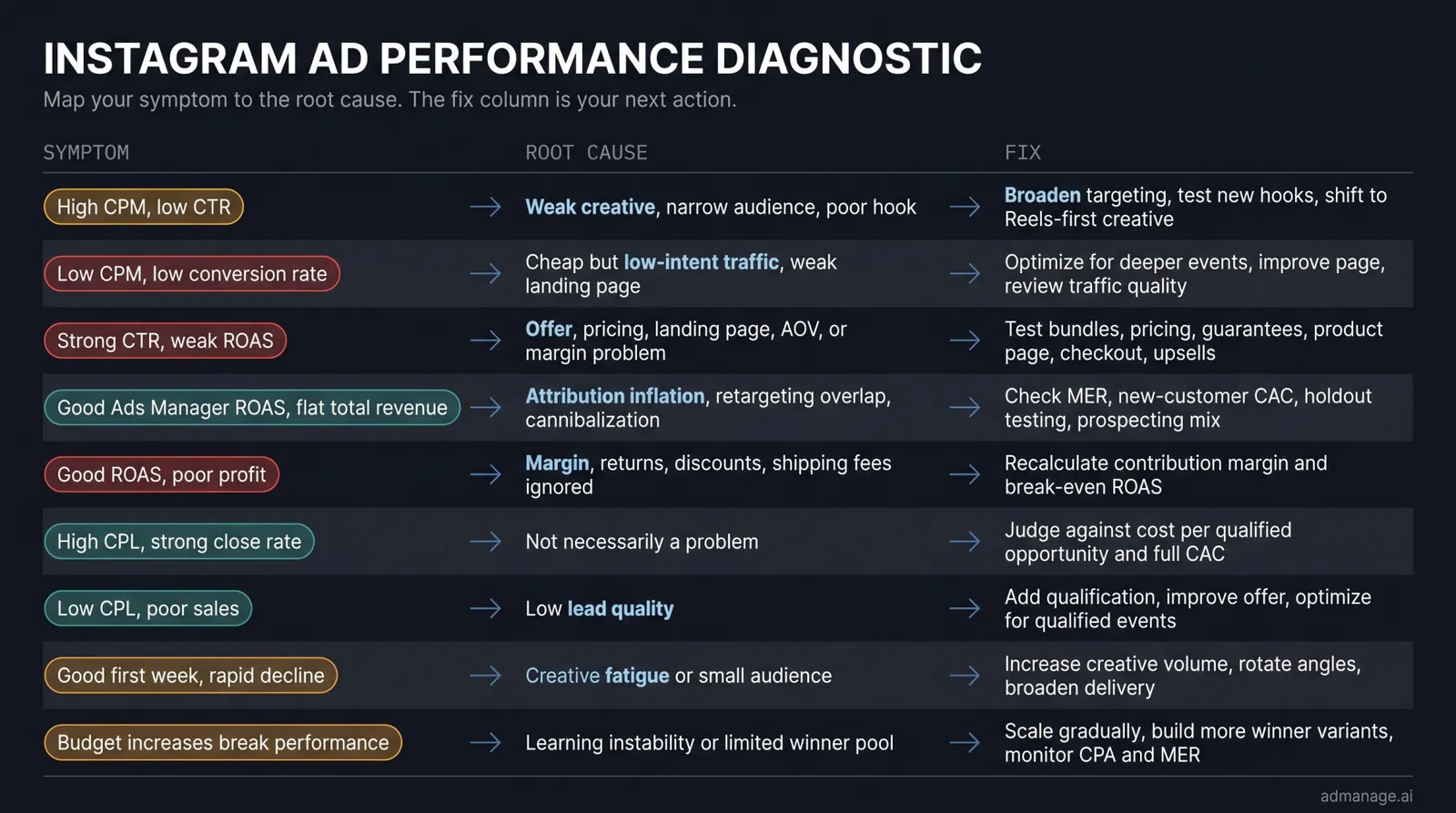
| Symptom | Likely Cause | What to Do |
|---|---|---|
| High CPM, low CTR | Weak creative, narrow audience, poor hook, competitive segment | Broaden targeting, test new hooks, shift to Reels-first creative, refresh offer angle |
| Low CPM, low conversion rate | Cheap but low-intent traffic, weak landing page, wrong objective | Optimize for deeper events, improve page, review traffic quality |
| Strong CTR, weak ROAS | Offer, pricing, landing page, AOV, or margin problem | Test bundles, pricing, guarantees, product page, checkout, upsells |
| Good Ads Manager ROAS, flat total revenue | Attribution inflation, retargeting overlap, cannibalization | Check MER, new-customer CAC, holdout testing, prospecting vs retargeting mix |
| Good ROAS, poor profit | Margin, returns, discounts, shipping, or payment fees ignored | Recalculate contribution margin and break-even ROAS |
| High CPL, strong close rate | Not necessarily a problem | Judge against cost per qualified opportunity and full CAC |
| Low CPL, poor sales | Low lead quality | Add qualification, improve offer, optimize for qualified events |
| Good first week, rapid decline | Creative fatigue or small audience | Increase creative volume, rotate angles, broaden delivery |
| Budget increases break performance | Learning instability or limited winner pool | Scale gradually, build more winner variants, monitor CPA and MER |
The diagnosis table is useful, but it leads to a deeper question: once you know what's wrong, can you fix it fast enough? For most issues, the fix involves new creative. And that's where many teams run into a structural problem.
Why Creative Volume Is Your Biggest Instagram ROI Lever
There's a version of "Instagram isn't working for us" that has nothing to do with the platform and everything to do with testing velocity.
Meta's ad delivery has become increasingly AI-driven. The Meta Andromeda engineering post describes a next-generation ad retrieval system designed to evaluate enormous numbers of candidate ads, narrowing them down for ranking. Meta's Advantage+ tools expand the pool of eligible ads through automation across audiences, budgets, placements, and creative.
The practical takeaway is worth sitting with:
Creative is now one of your most important targeting levers.
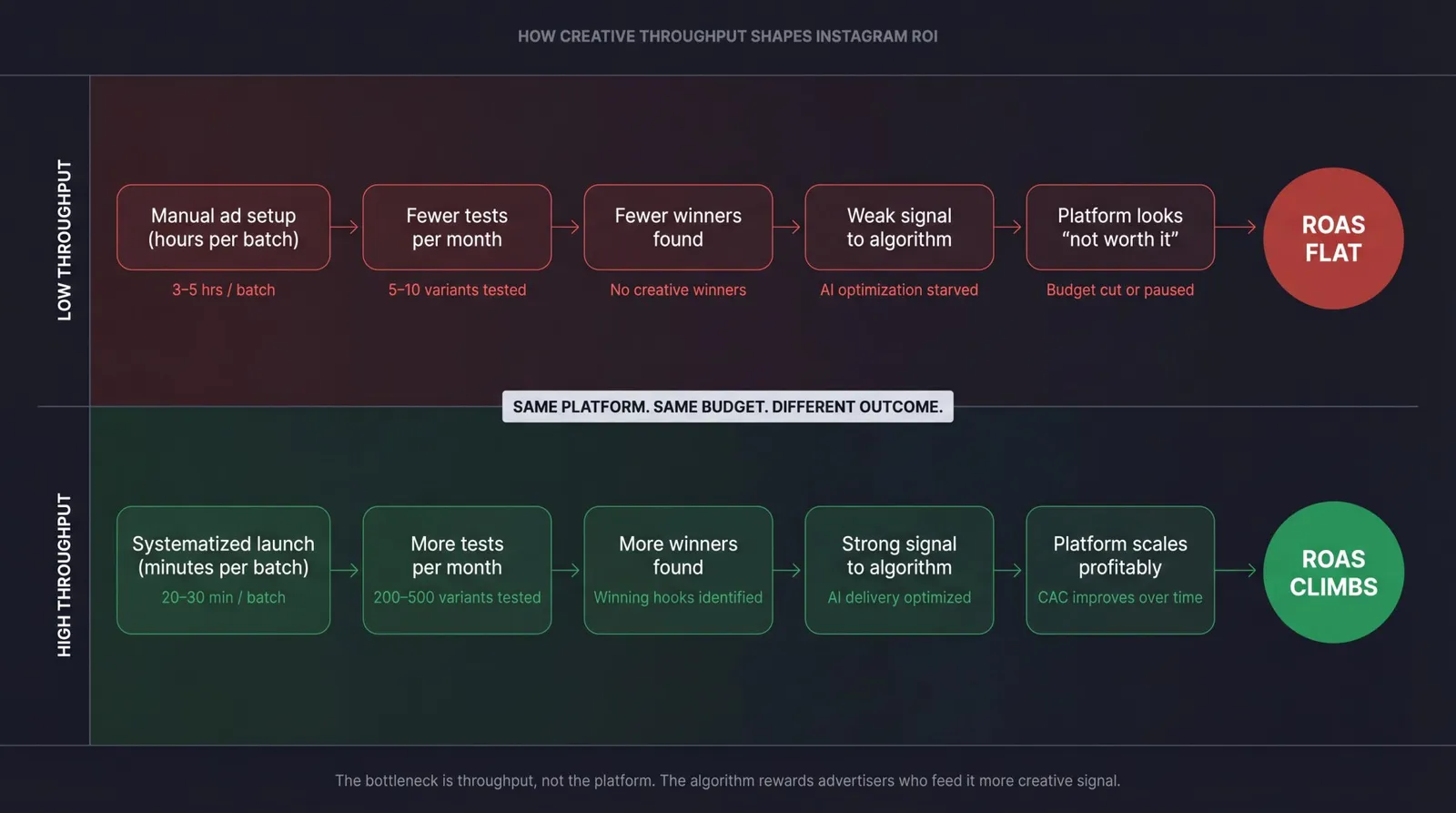
When the algorithm handles audience expansion and placement optimization, the main input the advertiser controls is the quality and variety of creatives. Winning accounts test many hooks, formats, angles, creators, intro sequences, offer frames, proof points, and landing page combinations. They don't wait three weeks to launch five new ads.
Common Thread Collective's April 2026 DTC Index reported Meta spend in its index up 25.28% year over year while ROAS degraded by only 3%, arguing that Meta had become more elastic for brands able to use it well. The report highlights AI-driven delivery, creative execution, and incrementality discipline as the key drivers.
This is where ad operations directly affect ROI. If a media buyer spends hours manually setting up each batch of ad variants, the brand tests less. If the brand tests less, it finds fewer winners. If it finds fewer winners, Instagram looks "not worth it" even when the real bottleneck is throughput, not platform performance.
Incrementality data from Stella's 2025 DTC benchmark, which analyzed 225 geo-based tests from August 2024 to December 2025, found a median incremental ROAS of 2.31x, with an interquartile range of 1.36x to 3.24x. The brands at the upper end aren't guessing. They're testing systematically, measuring incrementally, and iterating faster than competitors. And as Measured's incrementality guidance explains, using attribution for tactical optimization, MMM for strategic allocation, and incrementality testing for causation together is the right approach for serious budget decisions.
How AdManage Helps You Launch More Instagram Ads
High-performing paid social teams don't usually lose because they lack ideas. They lose because launching, naming, QA'ing, translating, tagging, and testing those ideas is too slow.
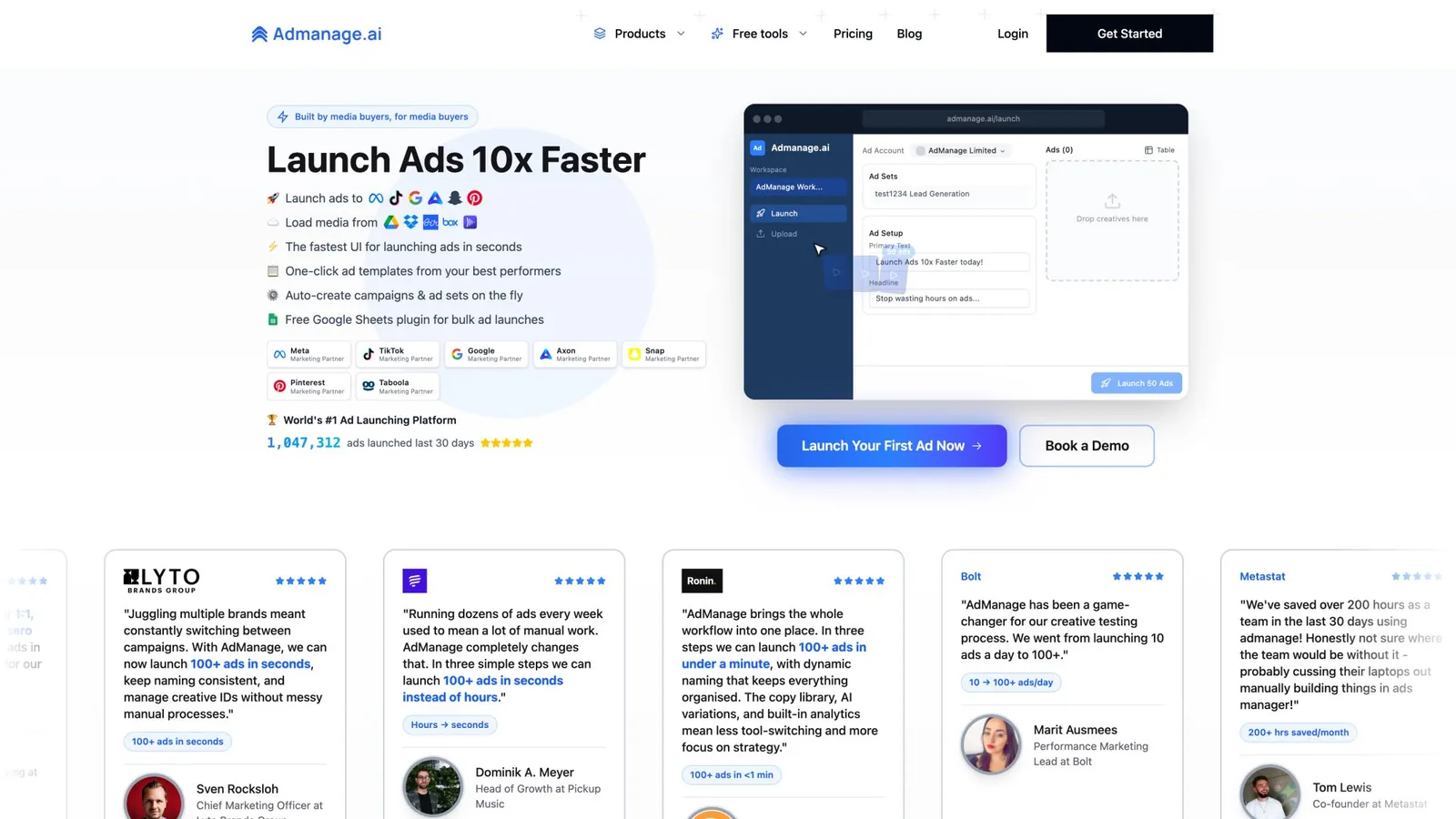
AdManage's live platform statistics show current launch activity. Rolling totals change, so check the live page for current figures. Any hours-saved total is an estimate based on a manual-work assumption, rather than measured labor saved for every advertiser.
That's not marketing copy. That's the operational reality of teams who've moved creative testing from a bottleneck to a competitive advantage.
Here's how operations affects specific ROI bottlenecks:
| ROI Bottleneck | What Happens Without a Solution | How AdManage Helps |
|---|---|---|
| Creative ideas are ready but not live | Testing cadence slows; fatigue hits before winners are found | Bulk-launch hundreds of Meta ads from structured workflows in a fraction of the time |
| Naming conventions are inconsistent | Reporting becomes unreliable; optimization decisions are made on bad data | Enforce naming conventions and consistent campaign structure at launch |
| UTMs are missing or wrong | GA4, Shopify, CRM, and BI data become messy; attribution breaks down | Standardize UTMs automatically during launch |
| Teams rebuild similar ad structures manually each time | Media buyers waste hours on repetitive setup | Reusable templates and repeatable launch flows for Meta, TikTok, Google, and more |
| Social proof gets fragmented when ads are duplicated | Winners lose engagement and comment history; trust signals reset | Post ID preservation where strategy requires it |
| Localization slows market expansion | Markets stay under-tested; winning formulas don't get adapted | Translation and multi-language launch workflows |
| QA happens too late | Errors reach live campaigns; budget wastes before anyone catches it | Preview and validate batches before they go live |
For a brand testing five ads a month, this probably doesn't change much. For a team testing hundreds or thousands of Instagram and Meta variations per month, launch speed becomes a direct growth constraint.
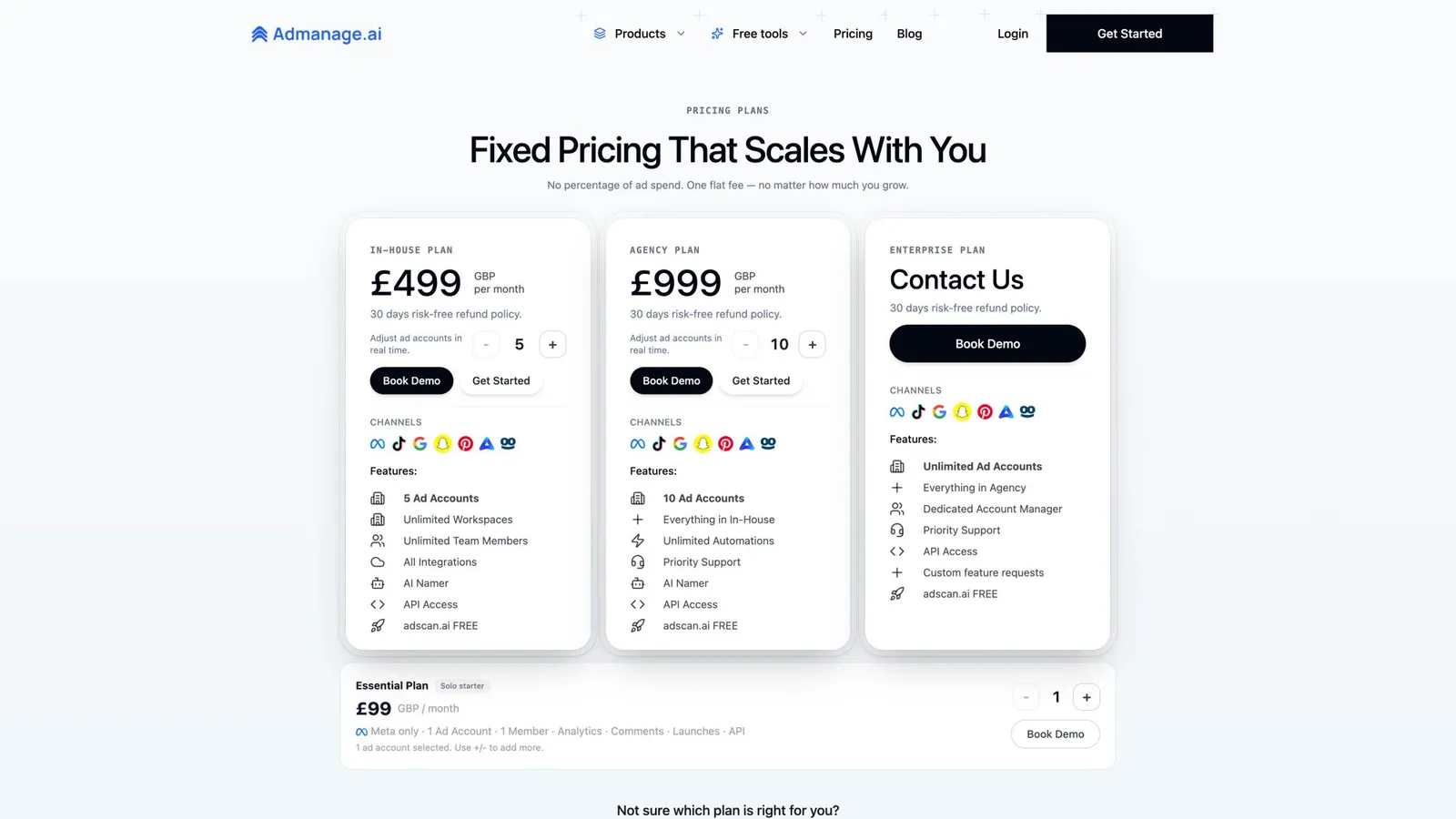
AdManage currently starts at £199.99/month for Essential, with 1 Meta ad account. In-house starts at £499.99/month with 5 ad accounts; Agency starts at £999.99/month with 10. Enterprise has custom unlimited-account arrangements. Channel access, AI credits, team allowances and money-back terms vary by plan; check the live pricing page.
Ready to run more creative tests without adding headcount? Start with AdManage and see how fast your launch throughput can move.
How to Test Instagram Ads in 30 Days: A Step-by-Step Plan
If you're deciding whether Instagram ads deserve more budget, this plan gives you a structured approach to find out.
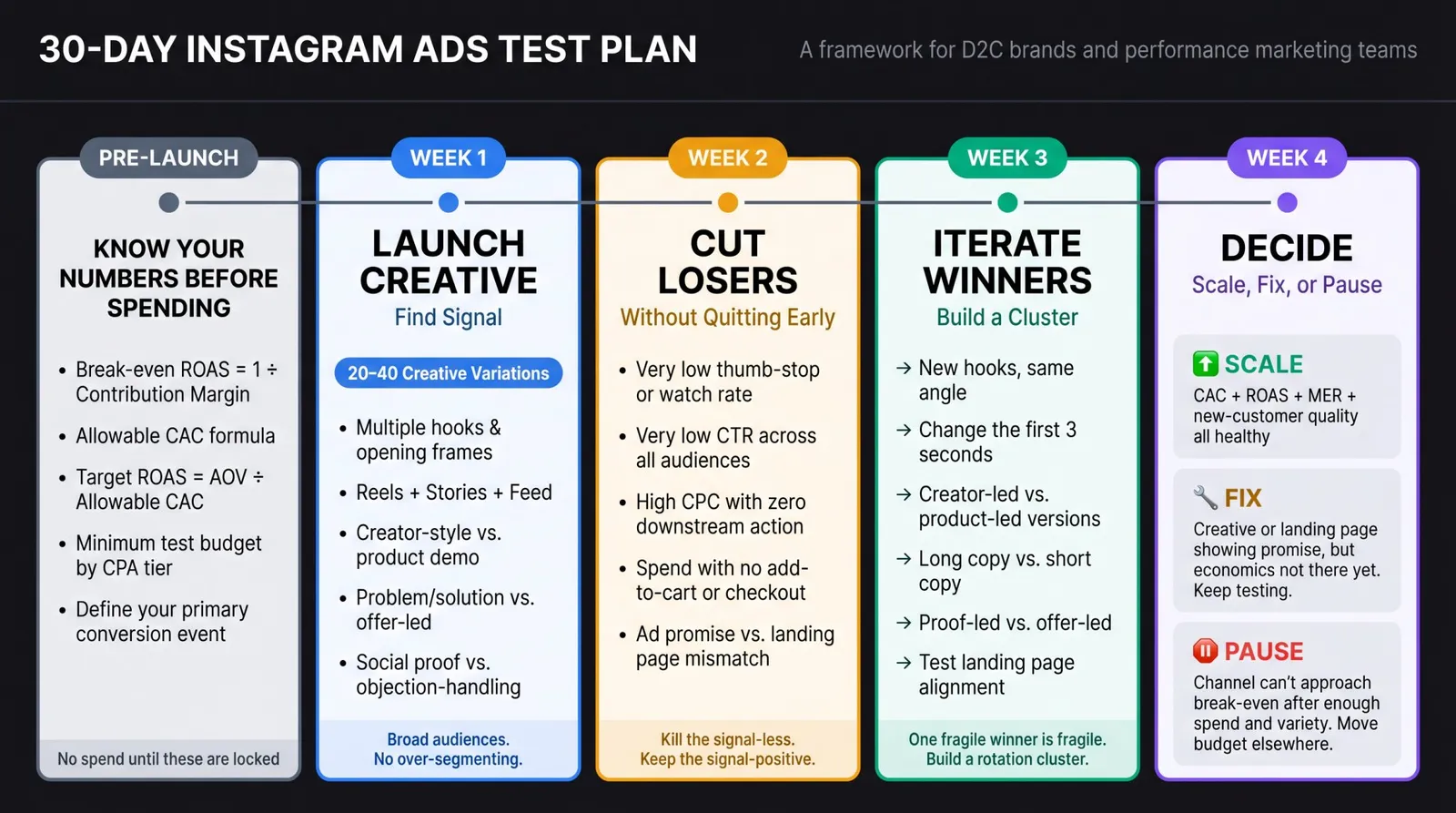
Before You Launch: How to Calculate Your Ad Economics
Don't run a single dollar until you know:
- AOV (average order value)
- Contribution margin after variable costs
- Break-even ROAS
- Allowable CAC (cost per acquisition)
- Target payback period
- Primary conversion event you're optimizing for
- How you'll define and count new customers
- Minimum acceptable MER (Marketing Efficiency Ratio, total revenue ÷ total ad spend)
- Budget for a statistically meaningful test
The allowable CAC formula:
Allowable CAC = AOV × contribution margin − required profit per first order
Example: AOV 80, 50% margin, gross contribution 40, required first-order profit 8 → allowable CAC = **32**. If you're paying $38 per purchase, the first order loses money.
For LTV-based businesses:
Allowable CAC = expected contribution over payback window − required profit buffer
Example: First order contribution 40, expected 120-day repeat contribution 35, required profit buffer 15 → allowable CAC = **60**.
Target ROAS = AOV ÷ allowable CAC
Example: AOV 80 ÷ allowable CAC 32 = target ROAS 2.5. A 2.0 ROAS isn't "almost there" for this brand. It's below the required level.
Also know your test budget before you start:
| Target CPA | Directional Test (10 conversions) | Better Test (30 conversions) | Stronger Test (50 conversions) |
|---|---|---|---|
| $20 | $200 | $600 | $1,000 |
| $40 | $400 | $1,200 | $2,000 |
| $75 | $750 | $2,250 | $3,750 |
| $150 | $1,500 | $4,500 | $7,500 |
A 500 test can't fairly judge a channel if the target CPA is 100 and the buying cycle is 14 days. Size your test accordingly.
Week 1: Launch Enough Creative Variations to Find Signal
Start with 20–40 creative variations if budget allows. Test:
- Multiple hooks and opening frames
- Multiple formats: Reels, Stories, Feed
- Creator-style videos vs. product demos
- Problem/solution angles vs. offer-led angles
- Social proof ads vs. objection-handling ads
Use broad or algorithm-friendly audiences. Avoid over-segmenting too early.
Week 2: How to Cut Losing Ads Without Quitting Too Early
Don't kill ads because they're not profitable after a few hundred impressions. Look for:
- Extremely low thumb-stop or watch rate
- Very low CTR across all audiences
- High CPC with zero downstream action
- Spend with no add-to-cart, lead, or checkout at all
- Obvious mismatch between ad promise and landing page
Then produce more variations based on what's showing signal.
Week 3: How to Scale What's Working in Your Instagram Ads
For ads showing promise:
→ Make new hooks using the same angle
→ Change the first three seconds
→ Test creator-led vs. product-led versions
→ Test long vs. short copy
→ Test proof-led vs. offer-led approaches
→ Test landing page alignment (does the page match the ad's specific promise?)
Don't just increase budget on one fragile winner. Build a cluster of related winners that can rotate as fatigue sets in.
Week 4: How to Decide If Instagram Ads Are Worth Scaling
Evaluate:
- CPA vs allowable CAC
- ROAS vs break-even ROAS
- New-customer CAC specifically
- MER movement during the test
- Creative fatigue rate
- AOV and repeat purchase signals
Then choose one of three actions:
① Scale: CAC, ROAS, MER, and new-customer quality are all healthy.
② Fix: Creative or landing page signals are promising but economics aren't there yet. Keep testing with improved inputs.
③ Pause: The channel can't approach break-even after enough spend and creative variety. Move budget elsewhere.
Instagram Ads Scorecard: When to Scale, Fix, or Pause
Use this before making any budget increase decision.
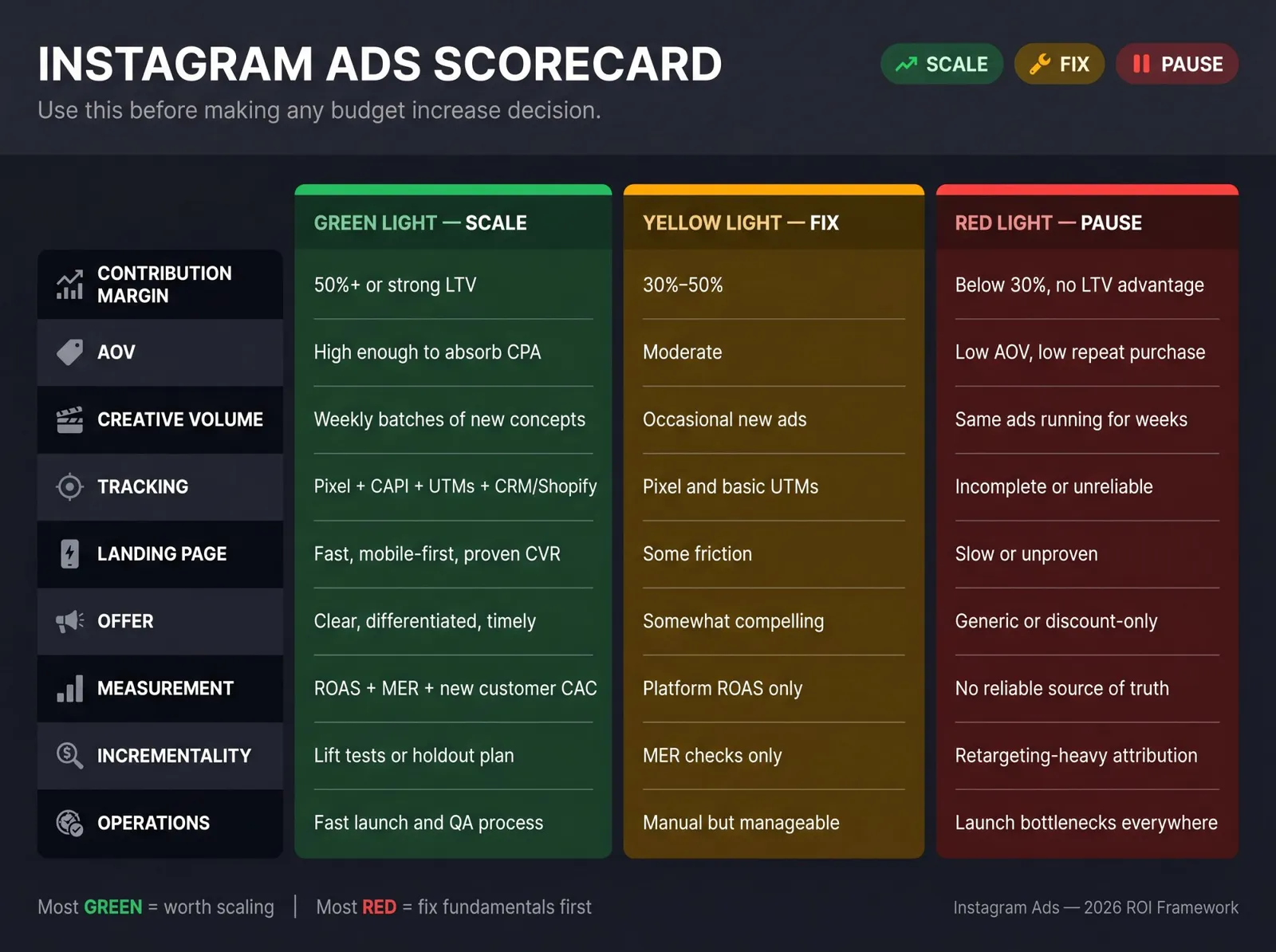
| Category | Green Light | Yellow Light | Red Light |
|---|---|---|---|
| Contribution margin | 50%+ or strong LTV | 30%–50% | Below 30% with no LTV advantage |
| AOV | High enough to absorb CPA | Moderate | Low AOV, low repeat purchase |
| Creative volume | Weekly batches of new concepts | Occasional new ads | Same ads running for weeks |
| Tracking | Pixel, CAPI, UTMs, CRM/Shopify reconciliation | Pixel and basic UTMs | Incomplete or unreliable |
| Landing page | Fast, mobile-first, proven CVR | Some friction | Slow or unproven |
| Offer | Clear, differentiated, timely | Somewhat compelling | Generic or discount-only |
| Measurement | ROAS + MER + new customer CAC | Platform ROAS only | No reliable source of truth |
| Incrementality | Lift tests or holdout plan | MER checks only | Retargeting-heavy attribution |
| Operations | Fast launch and QA process | Manual but manageable | Launch bottlenecks everywhere |
If most answers are green: Instagram ads are probably worth testing or scaling. If most are red, Instagram's not your first problem.
6 Mistakes That Make Instagram Ads Look Worse Than They Are
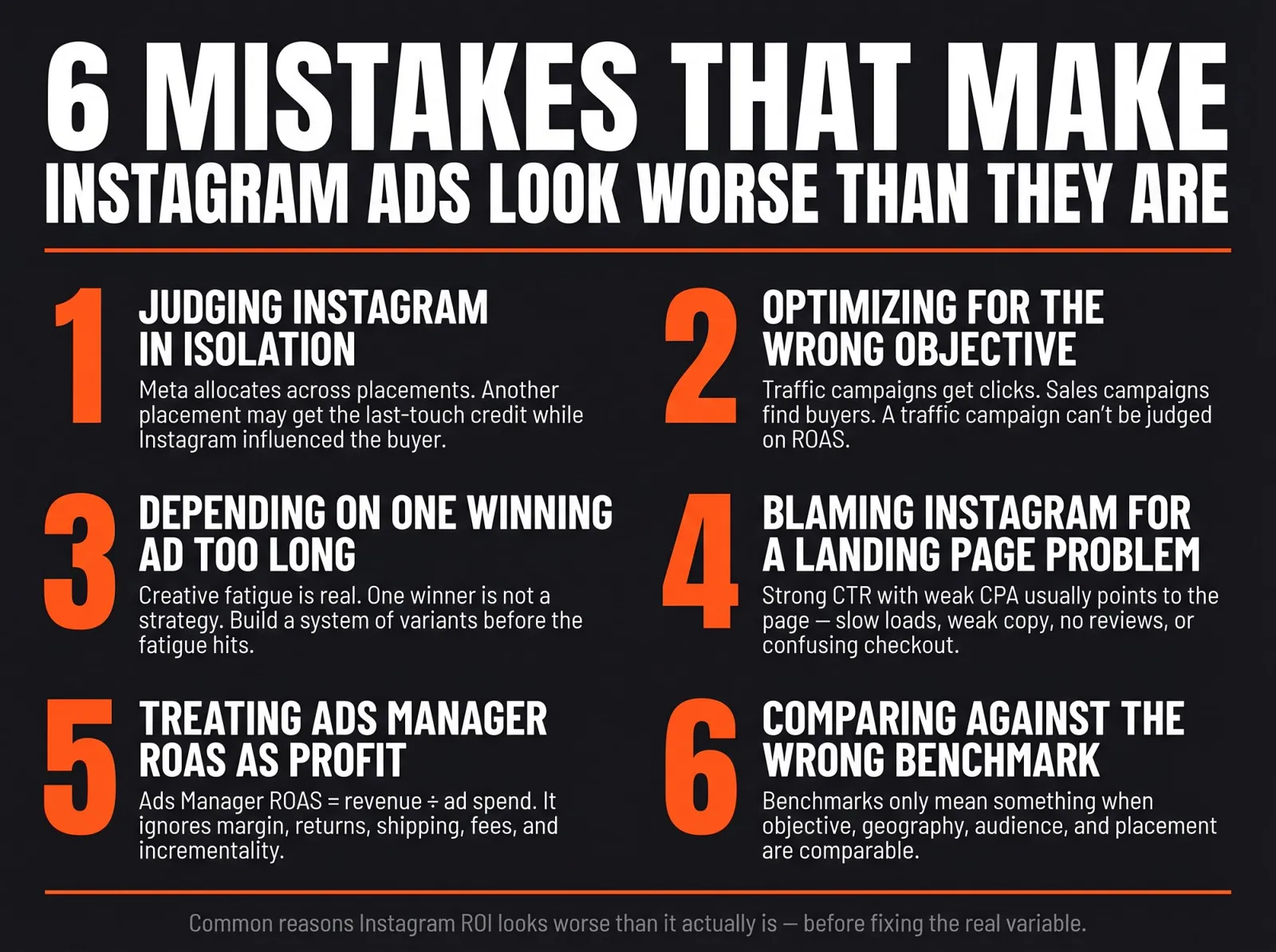
Mistake 1: Judging Instagram in isolation when Meta is allocating across placements
If you're running Meta campaigns with automatic placements, Instagram may be influencing buyers even when another placement gets the last-touch credit. Use placement-level reporting, but don't assume the last-touch view is the full story.
Mistake 2: Optimizing for the wrong objective
Traffic campaigns generate clicks. Sales campaigns find buyers. Lead campaigns find leads. Running a traffic campaign and then wondering why ROAS is low isn't a platform problem.
Mistake 3: Depending on one winning ad too long
Creative fatigue is real. A winning concept needs to be turned into a system of variants: different hooks, different creators, different formats, different angles on the same proof point. One winner isn't a strategy.
Mistake 4: Blaming Instagram for a landing page problem
If CTR is strong but CPA is weak, the problem may not be the ad. It's often the page: slow load time, weak product descriptions, no reviews, confusing pricing, surprise shipping costs, or weak checkout flow.
Mistake 5: Treating Ads Manager ROAS as profit
Ads Manager ROAS is revenue divided by ad spend. That's it. It doesn't account for margin, returns, discounts, payment fees, shipping, or whether the revenue was incremental. Use it for tactical optimization. Use MER, contribution margin, and new-customer CAC for the real profitability check.
And one note worth adding: the broader trust environment on Meta is something legitimate advertisers need to navigate carefully. Reuters reported in April 2026 that Australia's competition regulator sued Meta over alleged scam ads featuring celebrities, with Meta disputing the allegations and saying it has expanded advertiser verification and related protections. For legitimate advertisers, the practical implication is that trust signals, compliance, landing page clarity, and brand safety carry real weight now, especially in regulated or trust-sensitive categories like finance, health, and crypto.
Mistake 6: Comparing against the wrong benchmark
A U.S. skincare prospecting campaign shouldn't compare itself to a global engagement benchmark. A lead-gen campaign shouldn't compare itself to ecommerce ROAS. A blended Meta account shouldn't compare itself to Instagram-only Feed CPC. Benchmarks are only meaningful when the objective, geography, audience, and placement are comparable.
2026 Verdict: Are Instagram Ads Worth It?
Yes, if:
- Your contribution margin supports paid acquisition at realistic ROAS levels
- Your product or offer can be explained and demonstrated visually
- You can produce and launch new creative consistently
- You measure CAC, ROAS, MER, and new-customer quality together
- You're willing to go Reels-first with your creative strategy
- You have enough budget for the algorithm to learn
- You understand that platform ROAS is a tactical signal, not a profit measurement
No, if:
- You need unrealistically high first-order ROAS to survive because margins are too thin
- You can't produce new ads consistently
- Your landing page is slow or unconvincing
- Your offer is undifferentiated
- You're measuring cheap clicks or vanity engagement instead of business outcomes
- You can't separate new customers from returning customers
- You're using paid social to compensate for poor product-market fit
The 2026 final verdict:
Instagram ads are still worth it. But they're no longer a simple media buying channel. They're a creative testing, unit economics, and measurement discipline.
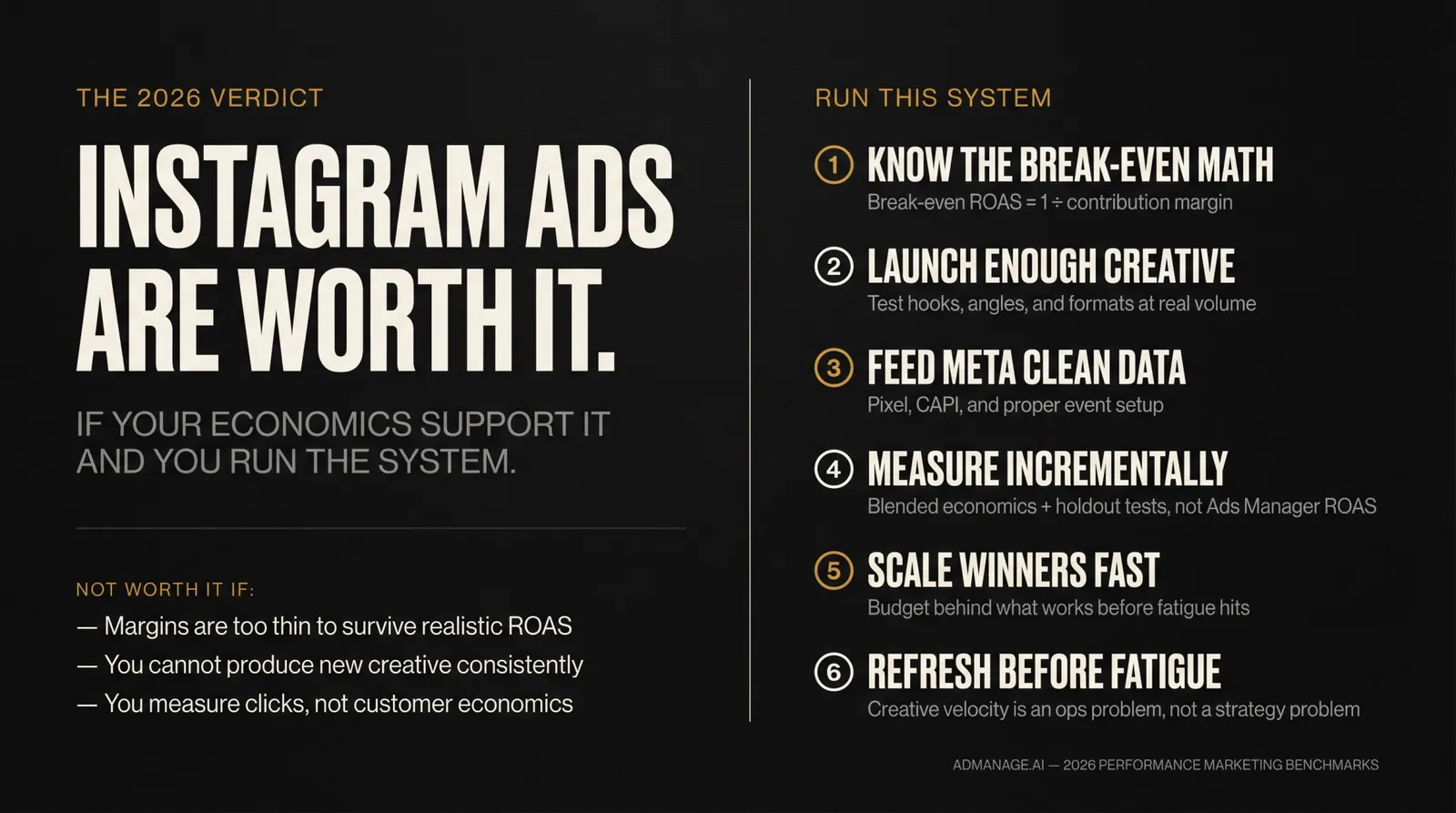
Brands winning on Instagram are running a system:
① Know the break-even math before anything else.
② Launch enough creative to find real signal.
③ Feed Meta clean conversion data via Pixel, CAPI, and proper event setup.
④ Measure incrementality and blended economics, not just Ads Manager ROAS.
⑤ Scale what works and refresh before fatigue destroys performance.
⑥ Keep operations fast enough to stay ahead of creative fatigue.
If you can run that system, Instagram remains one of the most powerful paid acquisition channels available in 2026. If you can't, the same platform will burn budget fast.
The operations part of that list is the one most marketing content ignores. At AdManage, we've built specifically for teams who are tired of creative bottlenecks slowing down their paid social results. If you're running hundreds of Meta variations per month (or want to be), take a look at what AdManage does and how teams use it to move faster. Full pricing details are here.
Frequently Asked Questions About Instagram Ads in 2026
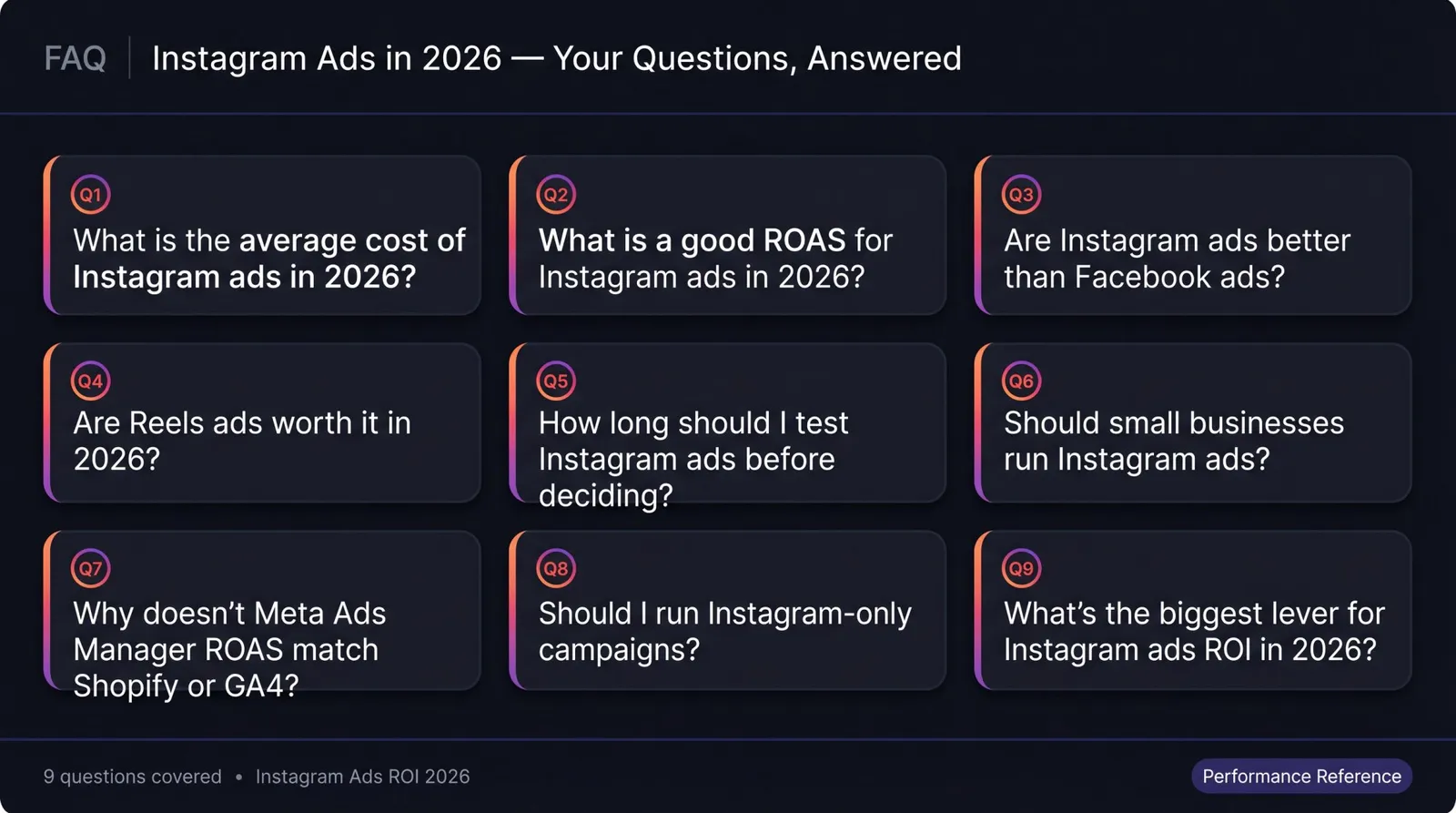
What is the average cost of Instagram ads in 2026?
Planning ranges for most commercial campaigns sit at roughly 6–18+ CPM and 0.50–2.00 CPC, with wide variation depending on objective, country, audience, placement, creative quality, and seasonality. WordStream's March 2026 Instagram cost benchmarks give lower ranges for better-performing campaigns (2–6 CPM, 0.40–0.70 CPC), while Hootsuite's 2026 data puts the Instagram CPM average at 9.46, and Shopify cites December 2025 U.S. CPM at 16.25. Treat these as planning ranges, not targets.
What is a good ROAS for Instagram ads in 2026?
A good ROAS is any ROAS that beats your break-even ROAS after accounting for contribution margin and incrementality. For many ecommerce brands, 2.0–3.0 ROAS can be workable depending on margins. Triple Whale's April 2026 ecommerce Meta benchmark shows a median ROAS of 1.93 across nearly 35,000 brands, while industry medians in Landingi/Varos data range from below 1.0 to above 4.0 by category. The only ROAS that matters is the one above your break-even.
Are Instagram ads better than Facebook ads?
Not universally. Instagram typically performs better for visual discovery, Reels, creator content, younger demographics, and mobile-first products. Facebook can outperform for some older demographics, certain conversion paths, and broader placements. For performance campaigns, starting with Meta's placement flexibility and then reviewing Instagram's contribution separately is usually the stronger approach rather than forcing Instagram-only delivery upfront.
Are Reels ads worth it in 2026?
Yes. Reels should be part of most Instagram creative strategies in 2026. Tinuiti's Q1 2026 Digital Ads Benchmark Report found Reels at a 33% share of Instagram ad impressions, an all-time high in its dataset. If your creative strategy is still primarily Feed-focused, you're missing a notable portion of Instagram's ad inventory.
How long should I test Instagram ads before deciding?
Most brands should test for at least 30 days and long enough to collect a statistically meaningful number of conversions. If your target CPA is 50, a 300 test covering fewer than 10 conversions can't draw a real conclusion. Judge performance after enough spend, enough creative variation, and enough time for conversion lag to play out.
Should small businesses run Instagram ads?
Yes, but only with disciplined testing. Start with a clear offer, simple conversion tracking, strong creative, and a budget tied to allowable CAC. Local businesses should track calls, bookings, messages, appointments, and show-up rates, not likes or clicks. A $500/month budget can generate useful data if the offer is specific and the audience is tight.
Why doesn't Meta Ads Manager ROAS match Shopify, GA4, or my actual revenue?
Each system attributes revenue differently. Meta may credit view-through and click-through conversions that GA4 and Shopify don't recognize. Shopify records store revenue. GA4 uses its own attribution model. Your bank account reflects cash after refunds, fees, and costs. Use Ads Manager for tactical optimization signals. Use MER (total revenue ÷ total ad spend), contribution margin, and new-customer CAC for actual profitability decisions.
Should I run Instagram-only campaigns?
Only if you have a specific strategic reason: creator campaigns, Reels-native content, brand goals, or a specific demographic constraint. For direct response, forcing Instagram-only delivery limits Meta's optimization flexibility. Most advertisers are better served by running Meta campaigns with flexible placements and then analyzing Instagram's contribution in placement-level reporting.
What's the biggest lever for Instagram ads ROI in 2026?
Creative throughput. Meta's increasing automation and AI-driven delivery make the quality and volume of creative inputs more important than audience targeting precision. Brands that launch more high-quality variations, test faster, and iterate on signals consistently are the ones finding profitable performance at scale. The operations infrastructure behind creative testing matters as much as the creative ideas themselves.